


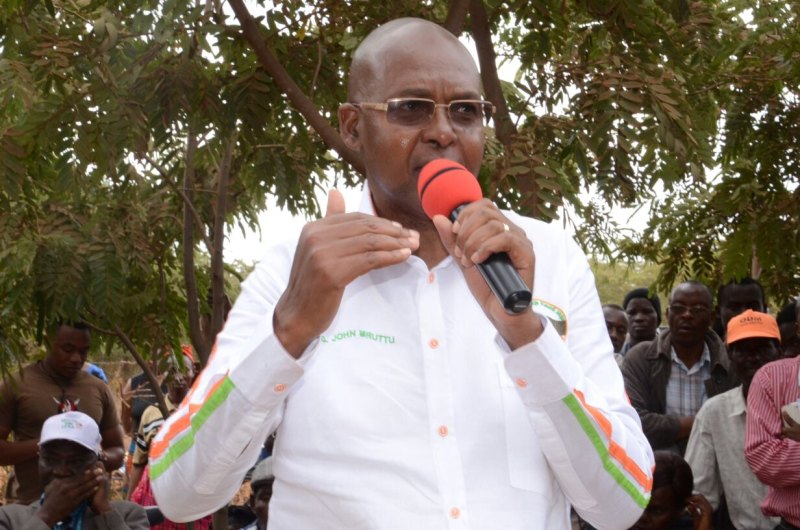
Former Taita Taveta Governor John Mruttu has petitioned Parliament to initiate a national conversation on succession and inheritance reforms, arguing that outdated and cumbersome processes are denying millions of Kenyans the opportunity to fully benefit from family assets.
In a petition presented to the National Assembly’s Public Petitions Committee, Mruttu says succession and inheritance issues have become one of the most overlooked barriers to social and economic progress, affecting families, agriculture, financial inclusion, women’s rights and youth empowerment across the country.
The former governor says many of the country’s development challenges remain hidden in plain sight.
At the centre of his concerns is the reality that millions of Kenyans continue to live, work and invest on land that remains legally registered in the names of deceased relatives years or even decades after their deaths.
“Across our Republic, millions of Kenyans wake up every morning to till land that legally belongs to people who passed away many years ago. They cultivate crops, rear livestock, build homes and raise families on land that has sustained generations. Yet in the records of the State, ownership often remains vested in fathers, mothers and grandparents who departed this world decades earlier,” he says.
According to Mruttu, succession processes are frequently delayed due to the high costs involved, complex legal procedures, inadequate public awareness and efforts by families to avoid conflict during periods of grief.
However, such delays often make the process even more difficult over time as beneficiaries increase, family relationships become more complicated and vital records become harder to trace.
“In some cases, succession is only initiated when disputes arise or when the land is needed for sale, subdivision or financing. By then, what might initially have been a manageable process has often become significantly more difficult,” he notes.
While inheritance matters are traditionally viewed as private family affairs, Mruttu argues that their impact extends far beyond households and directly affects national development.
He says the failure to complete succession leaves productive assets economically dormant despite their continued use by families.
“Families continue to build homes, rear livestock and support livelihoods on such land, yet many remain unable to realise its full economic value because ownership has not been formally transferred through succession,” he says.
“As a result, productive assets remain physically present but economically constrained. The living work the land, but in the records of the State, the dead still own it.”
Mruttu believes succession reform should be treated as a national economic and justice issue rather than merely an inheritance matter.
He argues that unlocking ownership of inherited land could significantly expand access to credit, stimulate agricultural investment and boost entrepreneurship, particularly in rural Kenya.
“Succession reform should therefore be viewed not merely as an inheritance issue, but as a justice issue, an economic transformation issue and an opportunity to unlock rural capital for inclusive national development,” he states.
The former governor links his proposals to the principles enshrined in the Constitution of Kenya 2010, which guarantees human dignity, equality, access to justice and protection of property rights.
He argues that succession procedures should be simplified and made more accessible to ordinary citizens.
“Succession procedures should therefore be accessible, affordable and responsive to the realities faced by ordinary citizens,” he says.
“When families are unable to complete succession because the process is too costly, too complex or too distant, the constitutional promise of equal access to justice becomes difficult to realise in practice.”
Mruttu further argues that delayed succession disproportionately affects widows and young people. He says many widows who helped acquire and develop family assets continue to face uncertainty over their rights and security of tenure long after the death of their spouses.
“Widows who may have contributed significantly to the acquisition and development of family assets often continue to live with uncertainty regarding security of tenure,” he says.
He adds that young people frequently inherit land in theory but lack the legal ownership documents required to utilise it productively or leverage it for economic opportunities.
“No society can claim to uphold family values while leaving widows in prolonged uncertainty,” Mruttu states.
The petition also highlights the broader economic implications of unresolved succession matters.
According to Mruttu, many rural communities are rich in assets but remain unable to convert those assets into productive capital because ownership remains legally unresolved.
“Kenya’s rural communities are often asset-rich but capital-poor, not because wealth is absent, but because much of that wealth remains legally trapped and unable to participate fully in the formal economy,” he says.
He argues that secure land ownership can facilitate access to credit, support investment in agriculture and encourage enterprise development.
“Farmers can invest in irrigation, mechanisation and value addition. Entrepreneurs can establish businesses and expand existing enterprises. Financial institutions can extend credit with greater confidence where ownership is clear and secure,” he says.
Mruttu believes one of Kenya’s greatest untapped opportunities lies in unlocking wealth already existing in villages and farms rather than searching for new resources.
“One of the greatest economic opportunities before Kenya may not lie in discovering new resources, but in unlocking the wealth that already exists within our villages and farms,” he says.
To support his case, the former governor points to international examples where reforms have improved land ownership systems and reduced disputes.
He cites Rwanda’s land and inheritance reforms, which strengthened tenure security and promoted gender equality in property ownership.
He also references South Africa’s simplified procedures for smaller estates and streamlined probate systems in countries such as Canada and the United Kingdom.
However, Mruttu is not calling for immediate legislative amendments. Instead, he wants Parliament to establish a National Multi-Sectoral Task Force on Succession and Inheritance Reform to undertake a comprehensive review of the Law of Succession Act and related laws.
Under his proposal, the task force would bring together representatives from Parliament, the Judiciary, the Office of the Attorney General, the Ministry of Lands, county governments, financial institutions, women’s groups, youth organisations, faith-based bodies and cultural leaders.
Its mandate would include conducting public participation, reviewing interconnected laws and presenting recommendations to Parliament within six months.
Mruttu says comprehensive succession reforms could strengthen families, improve food security, expand financial inclusion, create jobs for young people and support balanced regional development.
by Allan Kisia