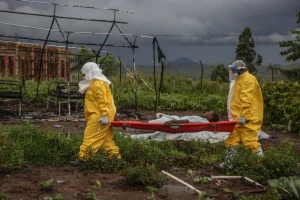



One month into the latest Ebola outbreak in the Democratic Republic of the Congo, neighbouring Rwanda says it’s taking “public health precautions,” even though no cases have been detected within its borders.
The country’s health minister says vigilance is key.
“The spread of this current outbreak came as a surprise when it was announced in mid-May. What worried most people was how such a large number of cases could have built up so quickly, when it should have been detected earlier.”
Since the outbreak was declared , 808 cases have been confirmed in the DRC, including 192 deaths, according to the latest World Health Organization figures.
Neighbouring Uganda has seen 19 confirmed cases, including two deaths.
“At the moment, we can see things are moving in the right direction, even though it will still take some time in countries like Uganda, for example,” Nsanzimana says.
“They’ve gone 10 days without a new case, which is reassuring, and in other parts of the DRC as well, we’re starting to see good results. But in Ituri, which is still the epicentre, there are still new cases every day.”
Despite urgent efforts to limit the spread of the virus, officials from the International Federation of Red Cross and Red Crescent Societies on Tuesday joined a growing chorus of warnings over the swelling scale of the crisis in DR Congo especially.
“The peak is, I think, not beyond us, but in front of us,” Bruno Michon, the IFRC’s operations manager for the outbreak, told reporters in Geneva.
“We are afraid that this could last one year” before the epidemic is over, he said, speaking from Bunia, capital of the DRC’s northeastern Ituri province, which is the outbreak’s epicentre.
Rwanda can’t afford to let down its guard, Nsanzimana says:
“The longer it takes with the virus present at our borders, the more it weighs on our economies and on our daily activities. Even if there is no Ebola in Rwanda, there are still cross-border activities. There are planes that land in Kigali and go on to Entebbe, with stopovers.”
Aid workers say cuts to US funding have led to insufficient contact tracing and a shortage of protective equipment. The World Health Organization on Tuesday stressed that community engagement, access and trust are also essential to stop transmission.