

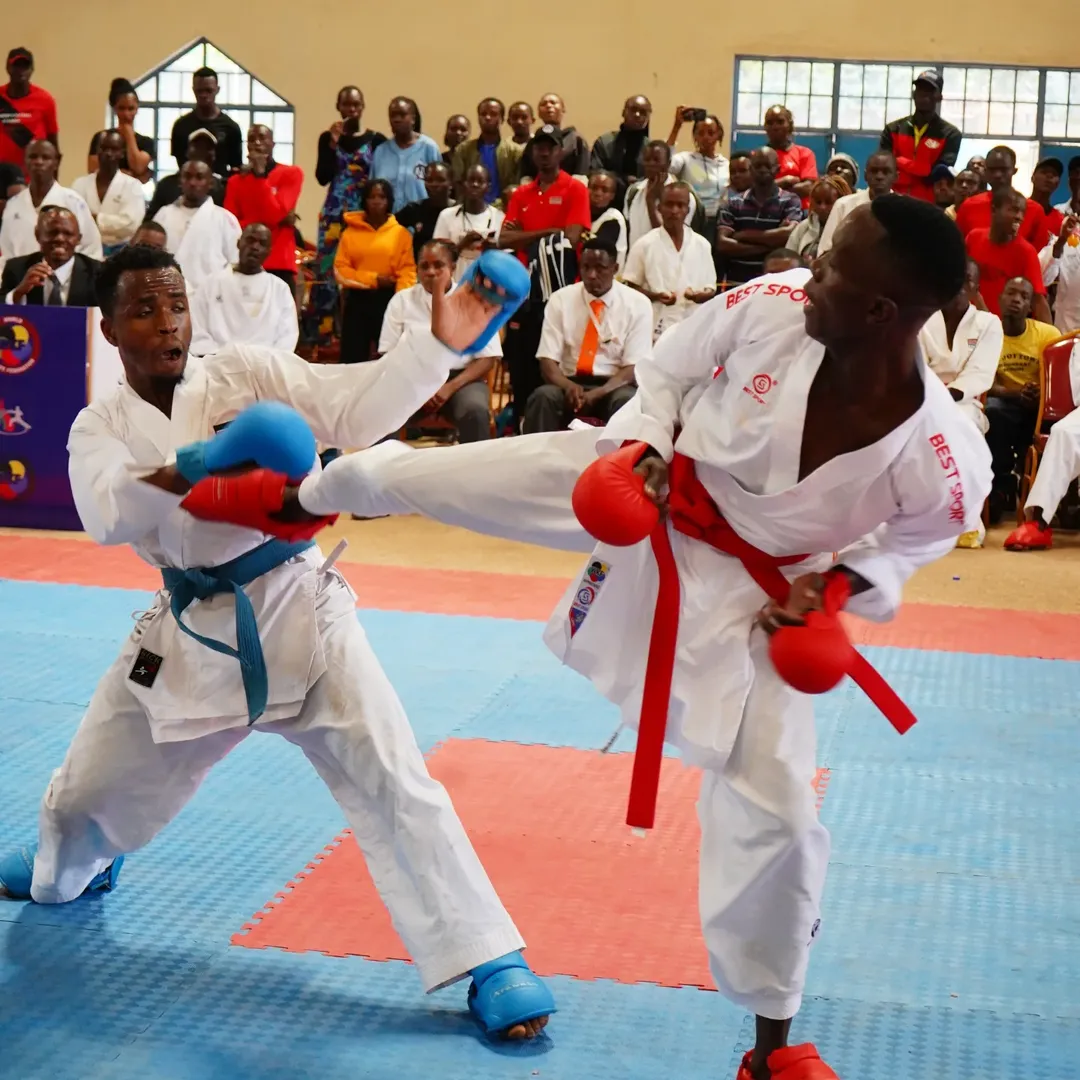
Kenya has continued to make significant strides in karate, with local karatekas increasingly flying the nation’s flag with distinction on continental and global stages.
Today’s Know Your Sport segment steps into the dynamic world of karate, a martial art and combat sport popularised globally by television icon and six-time undefeated Professional Middleweight Karate champion, the late Chuck Norris.
Karate is a traditional martial art centred on striking techniques, blending punches, kicks, knee strikes, elbow attacks and open-hand manoeuvres into a sophisticated system of combat and self-defence.
The word karate translates to “empty hand,” reflecting the discipline’s philosophy of self-defence without the use of weapons.
Unlike combat sports that rely heavily on brute force, competitive karate places a premium on technique, timing, speed, agility, control and tactical awareness.
The sport is broadly divided into two main disciplines: Kumite and Kata.
Kumite, meaning sparring, is karate’s combat showcase — a point-based fighting format where two athletes engage in a tactical battle of precision and control.
In most competitions, opponents face off in a three-minute contest, seeking to execute clean, controlled techniques to designated target zones. Points are awarded only for strikes that demonstrate proper form, balance, timing and accuracy.
Permitted scoring areas include the head, neck and torso.
A Yuko (one point) is awarded for a successful punch or direct strike, Waza-ari (two points) for a body kick or certain scoring techniques to the back area, while Ippon (three points) — the highest score — is reserved for a clean head kick or a successful sweep or takedown immediately followed by a controlled scoring strike.
Victory in Kumite can be achieved in two ways: by opening an eight-point advantage over an opponent or by finishing with the higher score when the three-minute contest ends.
The second discipline, Kata, highlights karate’s technical and artistic dimension.
Kata is a choreographed sequence of offensive and defensive techniques performed against imaginary opponents. It is designed to simulate combat situations while showcasing a practitioner’s mastery of movement and martial principles.
Athletes are assessed on a wide range of performance indicators, including posture, precision, power, rhythm, speed, balance and technical execution.
A panel of judges evaluates every movement, measuring both technical excellence and athletic expression, with the competitor earning the higher score declared the winner.
In official competitions governed by the World Karate Federation (WKF), contests are held on a matted 10-by-10-metre playing surface known as the ‘tatami’.
The arena consists of an 8-by-8-metre central competition zone surrounded by a one-metre red safety border.
The surface must be flat, padded and free from hazards to ensure optimum athlete safety.
Safety remains a cornerstone of karate, with the sport enforcing strict measures designed to minimise injury through disciplined training methods, controlled techniques and proper facility standards.
Competitors are expected to observe dojo etiquette, maintain proper grooming standards such as clipped nails and wear approved protective equipment.
During sparring or full-contact training, athletes typically wear headgear, mouthguards, chest protectors, groin guards, hand and foot pads, and shin guards.
Karate traces its origins to Okinawa, Japan, where it began as an indigenous unarmed self-defence system known as ‘te’.
The discipline evolved significantly between the 15th and 17th centuries after local rulers imposed weapons bans, prompting practitioners to refine methods of combat without arms.
Karate was formally organised and introduced to mainland Japan in the 1920s before spreading rapidly across the globe after World War II, when American servicemen stationed in Japan and Okinawa encountered the martial art and carried it back home.
Its global popularity surged throughout the 1960s and 1970s, fuelled by Hollywood action films, expanding international competitions and the establishment of the World Karate Federation in 1970.
The sport reached another milestone when it made its Olympic debut at the Tokyo 2020 Olympic Games.
Karate found its way to Kenya in the late 1960s and early 1970s, introduced largely by expatriates, returning Kenyan students trained abroad and Japanese instructors who brought martial arts instruction — particularly the Shotokan style — to disciplined forces such as the police and military.
Today, the sport continues to flourish locally under the stewardship of the Kenya Karate Federation (KKF).