



The landscape of public service delivery in Kenya continues to be marred by a culture of bribery, where the quest for efficiency often forces citizens to pay extra for services.
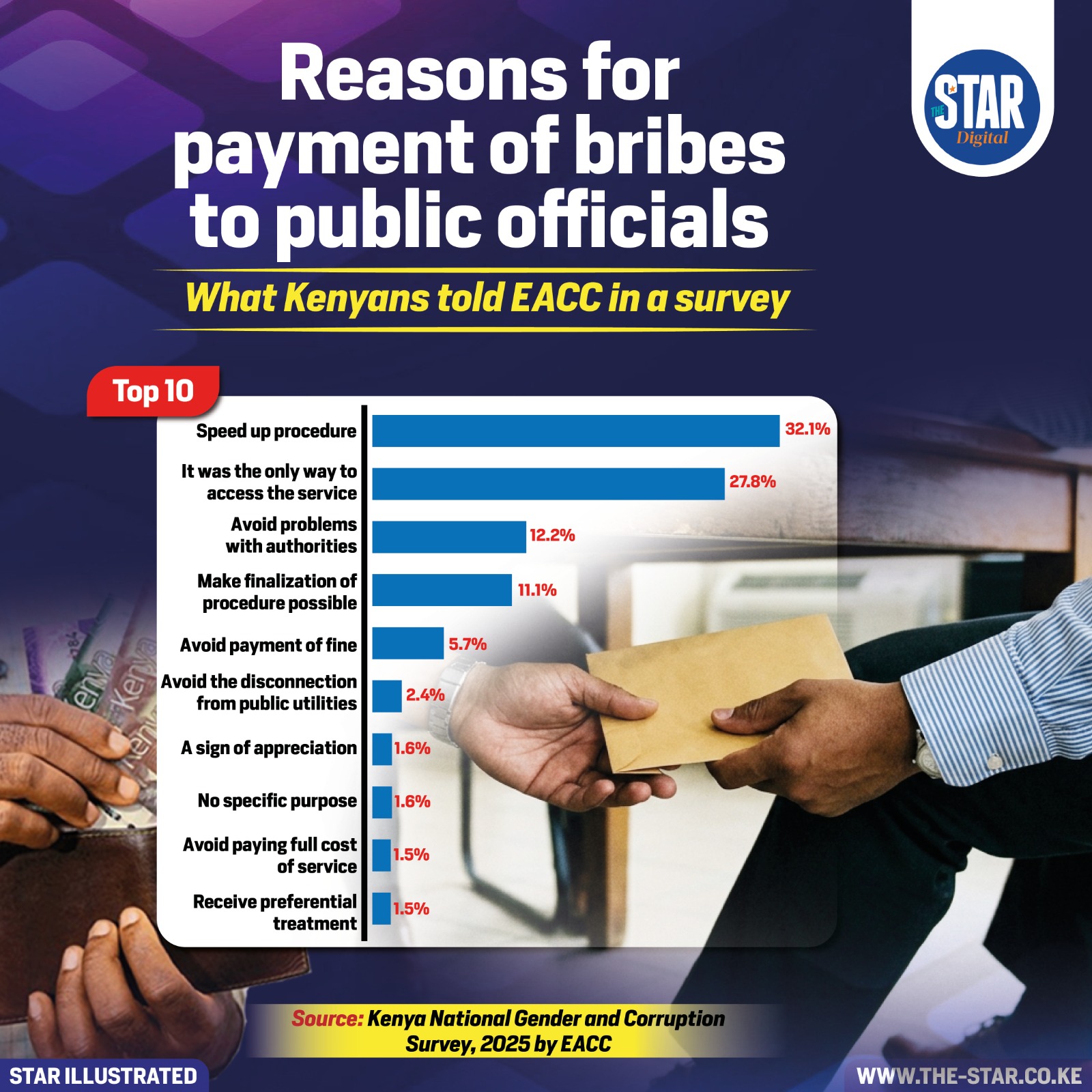
According to the Kenya National Gender and Corruption Survey 2025 conducted by the Ethics and Anti-Corruption Commission (EACC), the primary catalyst for these illegal payments is the need to speed up slow administrative procedures.
A significant 32.1% of respondents identified the pursuit of faster service as their main motivation for offering a bribe, highlighting a systemic bottleneck in government offices.
Perhaps more concerning is the 27.8% of Kenyans who reported that paying a bribe was the only viable way to access the service they required. This suggests a “pay-to-play” environment where basic rights and services are gated behind illicit fees.
Fear also plays a substantial role in these interactions; 12.2% of people paid to avoid problems with authorities, while 11.1% did so just to make the finalization of a procedure possible.
Beyond the major drivers of speed and access, smaller segments of the population use bribery as a shield against legal or financial consequences.
Around 5.7% of those surveyed paid to avoid official fines, and 2.4% sought to prevent the disconnection of essential public utilities.
Interestingly, a combined 3.2% of cases are attributed to “a sign of appreciation” or have no specific purpose at all, indicating how deeply normalised these transactions have become.
Finally, a small minority of 1.5% use bribes to seek preferential treatment or to avoid paying the full official cost of a service.