


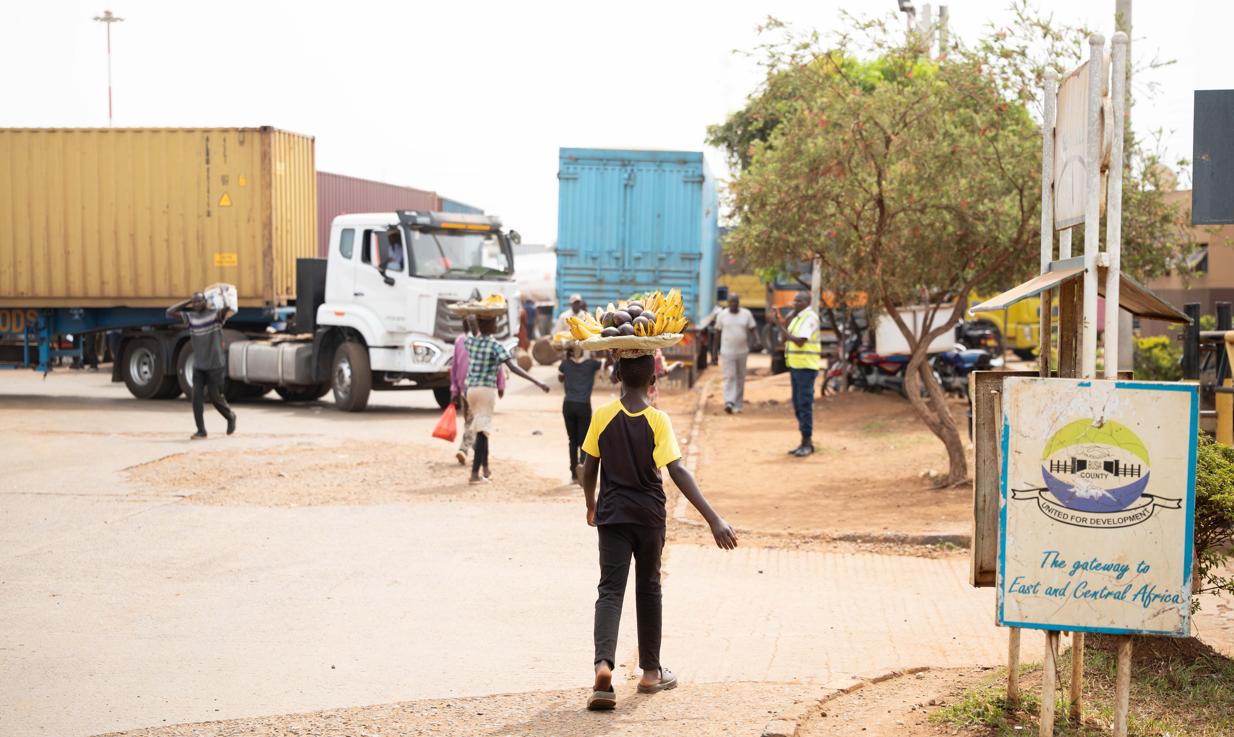
Farmers at the border town of Busia have been forced to find cheaper ways of transacting with clients across the border with Uganda due to multiple challenges and approvals, a new study shows.
The study commissioned by Alliance for Food Sovereignty in Africa (AFSA), established that the farmers and traders are subjected to several disjointed levies.
These increase the cost of doing business and slows down trade, an important factor when selling highly perishable farm products.
The researchers conducted interviews with territorial market actors at some East African Community (EAC) border points.
They find that for the export of two to five tonnes of cereals between Uganda and Kenya, traders must navigate seven different trade facilitation agencies, with inspection fees and testing charges totalling approximately Sh20,000.
This corresponds to around 10 per cent of the consignment value.
These include application of several fees by Plant Health, Standards Bodies, Phytosanitary, Counterfeit, Biosafety, Port Health, and Agriculture Food Authorities to ease trading in cereals and horticultural products under the EAC Simplified Trade Regime (STR).
High sanitary and phytosanitary standards (SPS) certification costs present significant challenges for agroecological entrepreneurs, since agroecological products are organic– trading across the territorial markets between Kenya, Tanzania and Uganda respectively.
AfriCert, which operates in multiple East African countries including Uganda and Kenya charges daily inspection fees of $250 (Sh32,000), with 16 pesticide residue analysis costing $140 (Sh18,000) per sample.
For agroecological traders trading across the border, findings revealed that the financial burden of these certifications is prohibitive and reduces their competitiveness compared to larger agribusinesses that benefit from economies of scale.
“As a result, some agroecological traders have resorted to informal trade routes to evade taxes. This in turn exposed them to risks such as confiscation of goods and harassment by border officials,” the report reads.
“If East Africa is serious about uplifting the small man out of poverty, then leaders must make it possible and easier for them to trade. Agroecology is an avenue that can be utilised to fetch the farmers fair prices.
According to the report, agroecology enables farmers to produce their own farm inputs, helping them reduce production costs while maintaining healthy soils and ecosystems.
“With the right support and commitment from leaders, agroecological approaches could be strengthened and scaled across the EAC region,” said Bathseba Ratemo, an agroecology expert and programmes officer with Participatory Ecological Land Use Management (PELUM) Kenya.
Agriculture accounts for 25-40 per cent of EAC’s Gross Domestic Product (GDP), employing over 80 per cent of the population in the region, and constituting about 65 per cent of intra-regional trade.
Based on the study’s findings, the most sold agroecological products between Kenya and Uganda are maize (146.9 metric tonnes) and beans (92.6 metric tonnes).
Other agroecological products identified in the territorial markets were Bananas, aerial yams, beans, sweet potatoes, fish, maize, forest products like honey, medicinal plants and herbs.
Other identified agroecological products in the Busia territorial market include local food plants like groundnuts, sesame (simsim), and cereals, while root crops include yams and cassava.
The study also revealed a rise in production and trading in other agroecological products like oranges, pineapples, avocadoes, groundnuts, and passionfruit.
Done to better understand the state of trade in agroecological products within the EAC, the study found that there are some progressive policies that could be built upon to enable more trade in agroecological products.
The region, the study notes, can leverage on the East African Fruits and Vegetables Value Chain Strategy and Action Plan 2021-31, EAC Common External Tariff (CET) 10 of 2022, the Common Market Protocol and Simplified Trade Regime.
This is in addition to the EAC Elimination of Non-Tariff Barriers (NTBs) Act of 2017 among others, which can be used to strengthen cross-border trade of agroecological products.
Agroecology is an integrated approach to farming that applies ecological principles to agricultural systems, combining traditional knowledge with modern science to create sustainable, resilient food systems.