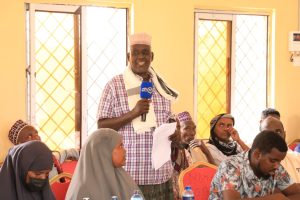

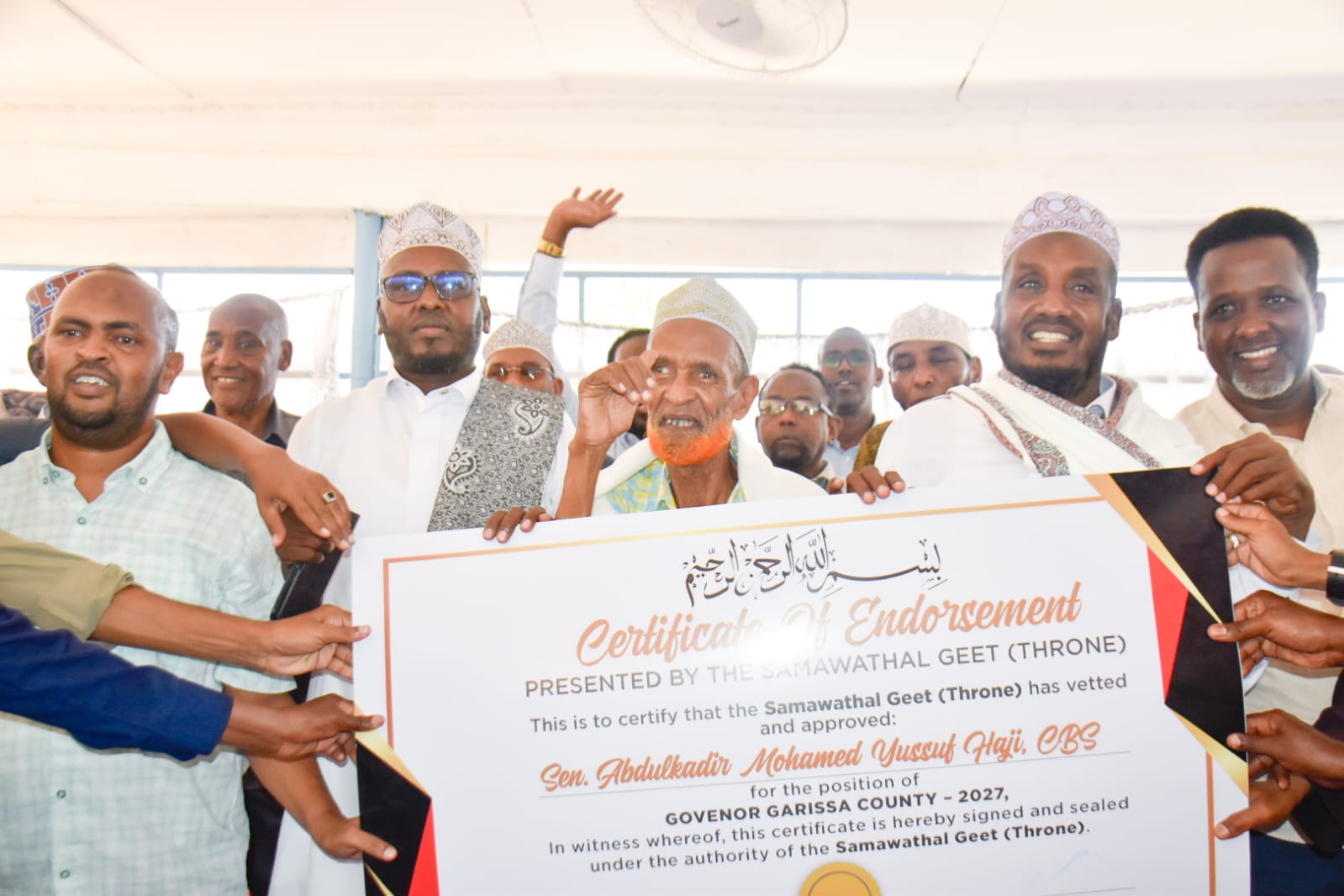
As the sun set over Garissa on Wednesday, elders gathered at the community shrine to settle a question that has quietly dominated living rooms, tea shops and WhatsApp groups for months.
The question has been: Who will carry the Samawadhal clan’s hopes into the 2027 gubernatorial race?
After months of consultations, quiet lobbying and closed-door meetings, the elders announced their verdict. The clan will rally behind Senator Abdulkadir Haji.
For many in attendance, the declaration was more than a political endorsement.
It was the culmination of a delicate balancing act — one that pitted two respected sons of the community against each other: Senator Haji and former Ijara MP Ahmed Abaas.
Abaas had formally presented his interest first, submitting his application to the council of elders in June last year.
Haji followed in November. What followed, elders say, was a rigorous vetting process led by Sultan Hassan Omar Shurie, who guided the council through weeks of consultations.
Both aspirants were invited to outline their agendas before the elders.
In a region where negotiated democracy has long shaped political contests, the process was seen as an attempt to avoid internal fractures that could weaken the clan’s bargaining power.
Standing before hundreds of community members, elder Mohamed Shide announced the decision. The endorsement certificate was issued in absentia, but the message was firm: the council had unanimously settled on Haji.
“From the onset, we approached this duty with fairness, wisdom and consultation,” Shide said, acknowledging the weight of the responsibility placed on the elders.
He said while all candidates were invited to appear before the council, one did not honour the invitation.
Soon after the announcement, Senator Haji responded on Facebook, thanking the elders and signalling that the campaign season had effectively begun.
“Anchored in unity and guided by faith, we now move forward with purpose,” he wrote.
“It is time to hit the road and carry this shared vision to the people across Garissa county.”
Yet beneath the celebratory tone lay an appeal for calm and cohesion.
Elder Dubat Amey was quick to clarify that the decision was not a rejection of Abaas’ leadership qualities.
“This does not mean Abaas was unfit. He could equally have been picked,” he said.
“But we can only field one candidate to avoid dividing our votes.”
It was a public call for unity — and a subtle acknowledgment of the political risks that come with clan fragmentation.
Former Garissa Deputy Governor Abdullahi Hussein framed the endorsement as a strategic shift.
In previous election cycles, the Samawadhal community had negotiated for positions such as senator and deputy governor through alliances with other dominant clans.
This time, he said, the community had resolved to pursue the county’s top seat.
For Mohamed Salat, the moment represented both opportunity and vulnerability.
“It is the first time we are going for this seat,” he said, appealing not only to his clan but also to other communities in Garissa. “Give us a chance this time round.”
Holugho MCA Adow Omar struck a pragmatic tone, acknowledging the realities of local politics.
“We are alive to the fact that our politics revolve around clans,” he said, signalling that outreach to other communities would be critical in the months ahead.
In Garissa — and across much of Northeastern Kenya — elections are rarely just about party symbols.
They are about identity, alliances and negotiated settlements meant to preserve stability as much as secure victory.
The county’s three dominant clans — the Abduwaq, Awlihan and Samawadhal — have historically shaped the political map through power-sharing understandings designed to prevent vote-splitting and community tension.
But 2027 is already shaping up to be competitive.
Senator Haji is expected to face former Governor Ali Korane and former Lagdera MP Mohamed Shidiye, both of whom have declared interest in the seat.
Korane has already begun meet-the-people tours across Balambala, Garissa and Fafi, signalling an early start to what promises to be an intense campaign season.
For now, however, the focus in Samawadhal households is unity.
The elders have spoken.
The campaign drums are beginning to beat. And as 2027 draws closer, Garissa’s governorship race is once again reminding residents that in this region, politics is as much about community consensus as it is about the ballot.