


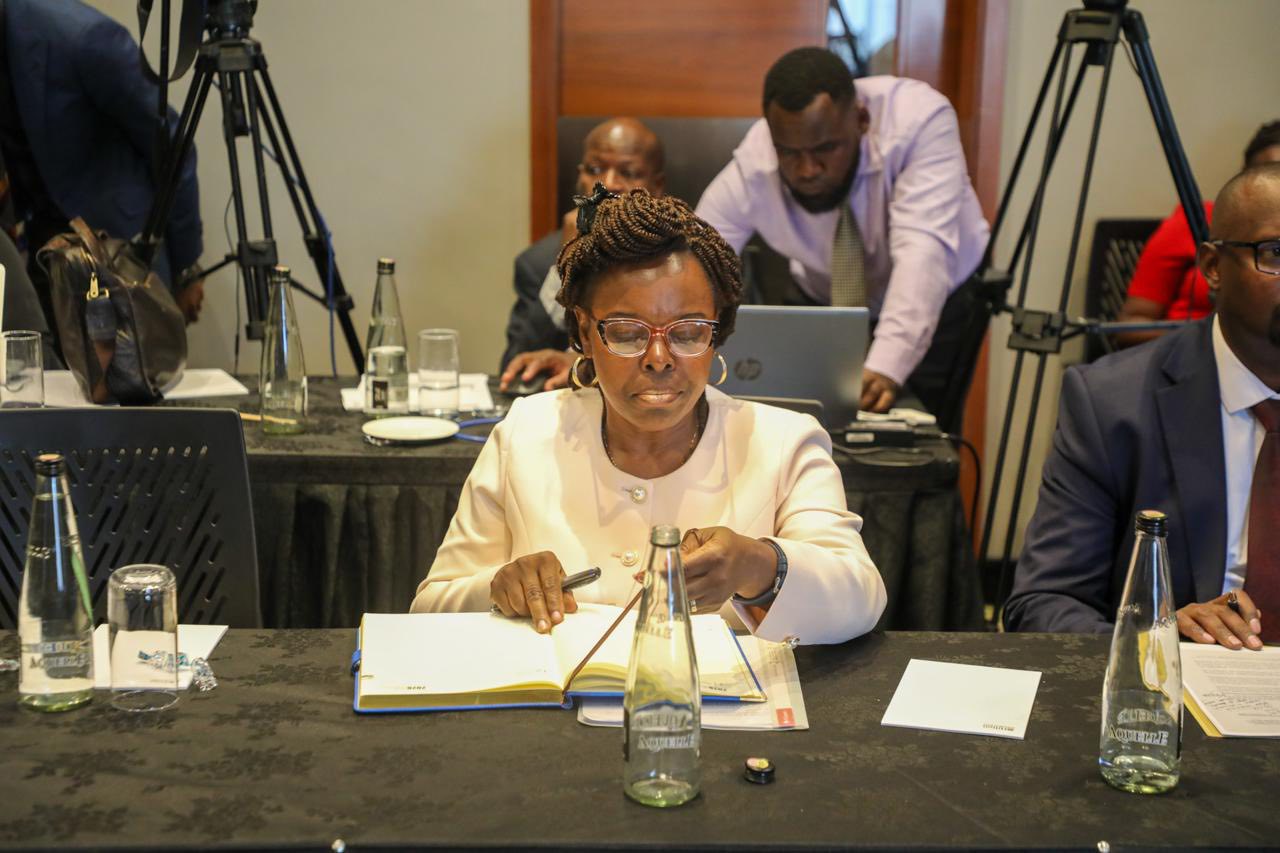
Controller of Budget Dr Margaret Nyakang’o has identified legislative gaps and policy proposals regarding the receipt, accountability, and budgeting of oil revenues and profit sharing arising from crude oil development and export.
Dr Nyakang’o told MPs that there is limited disclosure of petroleum agreements, including details on Production Sharing Contracts (PSCs), which hampers public accountability and undermines openness.
“There is a lack of precise mechanisms for monitoring the 5 per cent share of royalties intended for local communities. This ensures that the 5 per cent local community share is managed via a legally constituted, locally appointed Board of Management to prevent misuse,” she said.
In her report to the Joint Senate Standing Committee and National Assembly Departmental Committee on Energy on Wednesday, the CoB warned that there is currently no legal mechanism to safeguard oil revenues for future generations, as such proceeds may be applied to immediate operational expenditures.
She said her office should play a critical role in overseeing the sharing and utilisation of petroleum revenues accruing to the national and county governments.
Article 228(4) of the Constitution of Kenya mandates the CoB to oversee the implementation of national and county government budgets.
This is achieved by authorising withdrawals from public funds, specifically the Consolidated Fund, County Revenue Funds, and the Equalisation Fund, only if they are permitted by law.
Section 57(1) of the Act provides that the national government’s share of petroleum revenues before the imposition of taxes shall be deposited into a dedicated Petroleum Fund and managed in accordance with the Public Finance Management Act, 2012.
The Act prescribes that the local community’s share shall be paid into a trust fund managed by a board of trustees established by the county government in consultation with the local community.
“The exact mechanism for county governments’ spending of their share of oil revenues is inadequately defined in the current law. The mandate of the CoB in authorising withdrawal of funds from oil revenue arising from crude oil activities should be provided clearly in the Petroleum Act and Regulations,” Dr Nyakang’o’s report adds.
The Petroleum Act, 2019, provides the revenue-sharing framework for petroleum revenue proceeds. The national government’s share of profits derived from upstream petroleum operations shall be apportioned among the national government, the county government, and the local community at 75 per cent, 20 per cent, and 5 per cent, respectively.
Dr Nyakang’o said the Ministry of Energy and Petroleum should be compelled through legal provisions to prepare a special quarterly report for the Controller of Budget covering both the financial and non-financial performance of the T6 and T7 South fields in the Lokichar Basin, Turkana County.
“My office will then analyse this information and provide our quarterly reports to Parliament and the County Assembly through the quarterly Budget Implementation Review Reports.”
On her part, Auditor General Nancy Gathungu revealed that while the country has established a legal framework for petroleum management, it is not a member of the Extractive Industries Transparency Initiative (EITI).
A critical requirement of the Extractive Industries Transparency Initiative is the disclosure of beneficial ownership—the identities of the real people who own or control the companies bidding for oil blocks.
“Non-membership of the Extractive Industries Transparency Initiative means that the country does not adhere to the rigorous public register standards specifically designed for high-risk extractive industries,” Ms Gathungu said.
She added, “Further, international lenders and institutional investors utilise compliance as a key metric for Environmental, Social, and Governance (ESG) scoring. Non-membership of the EITI presents a higher governance risk premium to international markets, potentially increasing the cost of borrowing for energy infrastructure projects.”
by GEOFFREY MOSOKU