



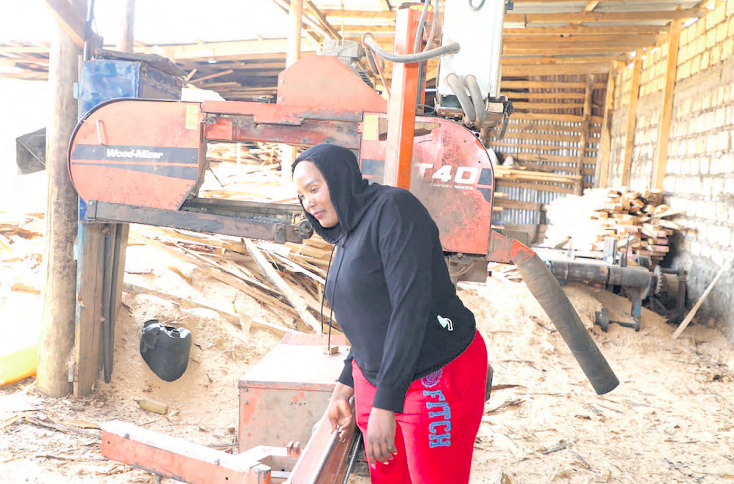
The state has unveiled a new strategy to bridge Kenya’s wood deficit by capitalising on the expansive arid and semi-arid landscapes.
Environment CS Dr Deborah Barasa says the opportunity to increase tree cover lies in private lands outside public forests, particularly in the arid and semi-arid lands (Asals).
“Commercial forestry will include wood, bamboo, non-timber forest products and ecosystem services,” she says.
“These ecosystem services include ecotourism, carbon trading and climate financing.”
Asals cover more than 80 per cent of Kenya’s landmass, home to about 39 per cent of the population, and are home to about 90 per cent of the wildlife.
These landscapes in the past have been colonised by invasive species, such as mathenge.
Currently, mathenge bushes and trees cover about 2,880,754 acres (11,658 square kilometres) of land, equivalent to about 1,165,771 hectares.
It is predominantly found on public, community and private land across 22 counties.
The worst-affected counties are Turkana, Tana River, Garissa and Baringo.
Other significant invasions are recorded in Taita Taveta, Kilifi, Samburu, Isiolo, Mandera, Marsabit, Wajir, Kajiado, Kwale, Lamu, Tharaka Nithi, Meru, Mombasa, Kitui and West Pokot counties.
The government has unveiled a National Strategy and Action Plan for the Control of Mathenge in Kenya 2025-35.
The strategy seeks to produce high-grade charcoal valued at about Sh54 billion annually from the invasive mathenge ‘weed’ as part of efforts to control its spread.
But even as mathenge is being utilised, the state has tasked the Kenya Forestry Research Institute to develop technologies to forest the recovered areas with other tree species.
The government has unveiled a National Commercial Forestry Strategy (2025-35), a 10-year blueprint designed to transform Kenya’s commercial forestry sector, positioning it as a competitive trade and investment pillar that significantly contributes to the national economy and climate action.
The strategy provides a foundation to accomplish sustainable management and protection of the environment and natural resources.
The strategy shows the national per capita wood demand in Kenya is estimated at one cubic metre per year, translating to a national wood demand of 51 million cubic metres.
This is expected to increase to about 60 million cubic metres by 2030.
During 2022, construction accounted for most of the demand for industrial wood products, with an estimated 580,000 cubic metres for timber trusses, concrete formwork, and joinery such as doors, windows, and floors.
It is estimated that tree growing accounts for 36 per cent, or Sh12 billion of Gross Value Addition in industrial wood products.
Primary processing has the potential to add an extra 25 per cent (Sh20 billion) to this value, with secondary processing adding an extra 42 per cent (Sh56 billion).
This shows tree growing accounts for only 36 per cent of the gross value added to industrial wood, while primary and secondary processing have the potential to add as extra 64 per cent to commercial forestry values.
Wood fuel remains a major energy source in Kenya, especially in rural areas where around 80 per cent of households rely on it for cooking.
In 2021, Kenya’s annual demand for wood fuel was about 40 million cubic metres, while sustainable supply was only around 30 million cubic metres, creating a deficit that is expected to increase.
The highest industry consumer of wood fuel is the tea sector.
Kenya’s forest cover was estimated at seven per cent 9,884,215 acres (four million hectares) in the year 2010 and has been increasing by 0.1 per cent.
The National Forest Resource Assessment conducted in 2021 established Kenya’s national tree cover at 12.13 per cent and forest cover at 8.83 per cent.
To sustain this increase and achieve the internationally recommended cover of 10 per cent, it is necessary to adopt a sustainable forest management system that also promotes tree planting and a proper silvicultural or woodland system for existing trees.
Kenya’s commercial forests include public or gazetted plantations managed by the Kenya Forest Service (KFS), were estimated at 375,600 acres (152,000ha) as of 2024, and the private forests, estimated at 116.139 acres (47,000ha), according to the KNBS report in 2022.
by GILBERT KOECH