

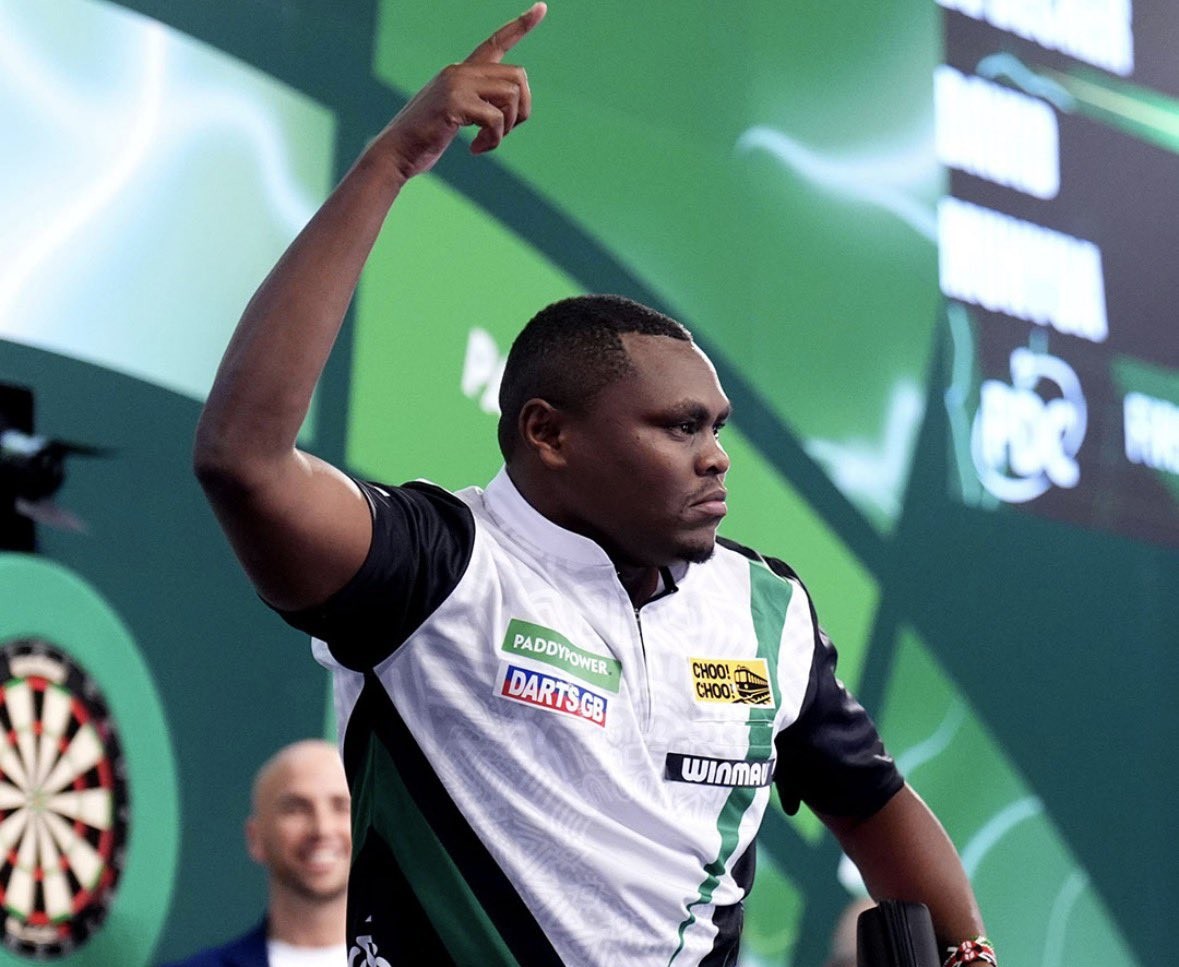
When David Munyua stepped onto the oche at the 2026 PDC World Darts Championship, few Kenyans were watching. Fewer still imagined that a veterinarian from Murang’a County would soon be rewriting the country’s sporting narrative on one of darts’ grandest stages.
Yet Munyua did more than win a match; he delivered a statement Kenya has long ignored at its own peril. By defeating world No. 18 Mike De Decker 3–2 in a thrilling comeback, Munyua became the first Kenyan to win a match at the PDC World Championship.
In a single evening, he thrust Kenya — and Africa — into a global sporting conversation where it has rarely featured. Darts, a discipline largely overlooked in local policy, media coverage and funding, suddenly had a Kenyan flag flying under the bright lights of Alexandra Palace.
The moment that captured global imagination was almost accidental. A wasp landed on Munyua’s arm mid-match, and, with remarkable composure, he brushed it away before calmly releasing his throw.
The crowd roared. Social media erupted. In that instant, Munyua became more than a darts player. He emerged as a symbol of poise, grit and quiet confidence — qualities Kenyan sport urgently needs to cultivate beyond its traditional strongholds.
For decades, Kenya’s sporting investment and imagination have revolved around three pillars: athletics, football and rugby. These sports deserve their status; they have delivered global recognition and national pride. But they have also monopolised resources, sponsorships and institutional attention, often at the expense of emerging or so-called “minor” disciplines. Munyua’s breakthrough exposes the cost of that narrow focus.
Here is an athlete who refined his craft without a professional league, without structured national funding, and without the infrastructure routinely afforded to mainstream sports.
By day, he treats animals as a trained veterinarian. By night, he practises a sport many dismiss as recreational. Yet on the world stage, he proved capable of defeating elite professionals and earning £25,000 (Sh 4.3 million) from a single first-round victory — more than many Kenyan athletes earn in entire seasons.
That financial reward is not merely a personal triumph; it is a flashing signal to policymakers and sponsors alike. Global sport has diversified. International federations, prize money, endorsements and broadcast audiences now extend far beyond traditional Olympic and football pathways.
Darts, snooker, boxing, e-sports, swimming, martial arts, cycling and motorsport all offer viable routes to international success — if talent is identified early and supported consistently.
Munyua’s second-round exit, a 3–0 loss to Kevin Doets, does nothing to diminish his achievement. Instead, it highlights the steep learning curve faced by athletes forced to bridge the gap between raw talent and elite professionalism largely on their own.
His openness about considering a temporary shift away from veterinary work to focus on darts should concern us as much as it inspires us. Why must Kenyan athletes choose between their livelihoods and their sporting dreams? The answer lies in structures — or the absence of them.
Kenya does not lack talent. It suffers from selective vision. What is required is a deliberate policy shift that recognises sport as an industry, not merely a medal-hunting exercise.
This means funding federations beyond the usual suspects, integrating lesser-known sports into school and university programmes, and creating clear pathways for international exposure.
Government support alone will not suffice. Corporate Kenya, quick to rally behind athletics heroes after Olympic success, must learn to invest earlier and more broadly.
Sponsorship should be about building potential, not merely chasing headlines. The media, too, must shoulder responsibility. Munyua was invisible to most newsrooms before his historic win.
That silence reflects a broader failure to tell diverse sporting stories before they trend elsewhere. David Munyua’s rise is both a reminder and a rebuke.
It shows that greatness can emerge from unexpected places when determination meets opportunity — even when that opportunity is largely self-made.
More importantly, it challenges Kenya to rethink the boundaries of its sporting ambition. If one veterinarian with a dartboard can shake the world, imagine what structured support could do for hundreds more across the country’s forgotten sports.
by TONY MBALLA