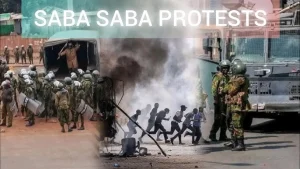



Interior Cabinet Secretary Kipchumba Murkomen commended the police for their conduct during nationwide demonstrations on Monday, July 7, 2025 – marking the 35th anniversary of Kenya’s historic Saba Saba pro-democracy protests.
During a tour of various police posts in Nairobi, he praised the officers for their diligence in “securing lives and property”, crediting them for a notably lower level of violence, looting, and vandalism compared to the unrest experienced during the June 25 protests.
Murkomen characterized the police presence as both “commendable and necessary for public safety”, noting that criminal elements had tried to hijack what was intended as a peaceful commemoration.
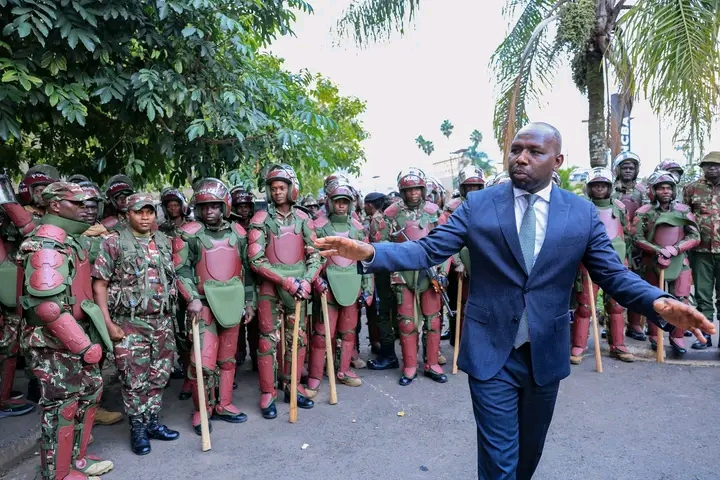
He stated, “Thanks to their efforts and other officers across the country, the incidents of violence, looting, and destruction of property were reduced compared to the last protests.”
His remarks cemented the government’s position that aggressive security measures were vital to preserve order during politically charged events.
During the June 25 protests, over 19 people were killed nationwide, and there was widespread looting, vandalism, and clashes.
By contrast, Murkomen emphasized, incidents this time around were “markedly reduced”.
However, police reports later confirmed that 11 people died, 52 officers were injured, and dozens of vehicles—both civilian and government—were damaged.
The Kenya National Commission on Human Rights (KNCHR) separately reported 10 deaths, 29 injuries, two abductions, and 37 arrests across 17 counties.
In his statement, Murkomen acknowledged the disruption caused by roadblocks around Nairobi’s Central Business District, calling the measures “necessary to ensure the safety of our people and the security of their property and businesses.”
He reassured the public that investigations would proceed: “The criminals who wreaked havoc on the June 25th demonstrations have already been charged in court.
Likewise, those responsible for Saba Saba incidents will also be investigated and charged.”
The June 25 protests culminated in significant violence, and numerous fatalities and injuries.
By comparison, Murkomen claimed a clear improvement on July 7, although the loss of life and arrests remained substantial.
Blocking roads into Nairobi, especially access to the CBD, disrupted livelihoods and sparked criticism but was defended by Murkomen as a necessary preventative strategy.
Despite his praise, Murkomen’s remarks come amid ongoing civil society concerns over police excess—highlighted by the deaths and injuries confirmed by KNCHR and other observers.
CS Murkomen’s narrative positions the police response on July 7 as an improvement over June 25, attributing reduced disorder to proactive deployment and roadblocks.
He lauded the officers for their vigilance while pledging legal action against those who provoked violence.
However, the persistence of fatalities and arrests underscores the fragility of public order and raises questions about the proportionality of the state’s response to dissent.
BY sheila chelangat