



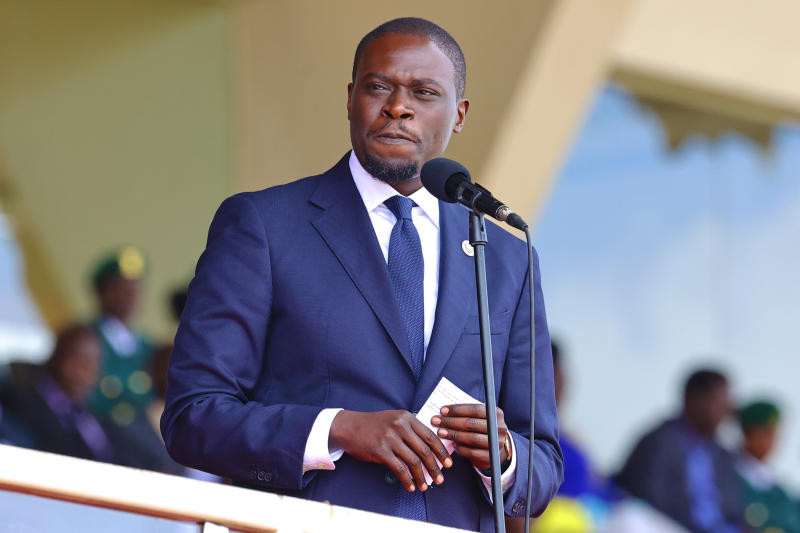
Nairobi Governor Johnson Sakaja has said the city will require more than Sh40 billion to fully address its persistent flooding problem.
Sakaja noted that of the annual budget of about Sh40 billion, much goes to salaries and essential services, making it difficult to independently finance large-scale infrastructure upgrades.
Sakaja argued that the capital city requires additional funding beyond the standard county revenue allocation due to its unique national and economic importance.
“The capital city cannot be organised just based on the share of revenue that it gets, like other counties,” he said.
The floods left several people dead and caused widespread destruction of property across different parts of the city, with residents reporting hours of traffic gridlock and flooded neighbourhoods.
Speaking during an interview, Sakaja defended his leadership amid criticism over the disaster and said he was ready to take responsibility as the head of the county government.
“Of course, inasmuch as a lot of this goes into decades of issues of planning, the city really was built on a swamp. But I’m the one in charge now,” Sakaja said.
The governor said Nairobi’s flooding challenges have been building up for decades due to poor urban planning, rapid population growth and encroachment on waterways.
However, he insisted that his administration is focused on finding long-term solutions rather than assigning blame.
Sakaja said the county government has already begun working with the national government to develop lasting infrastructure solutions to manage storm water and improve drainage systems.
“The drainage that we have is not built for this capacity of rain,” he said.
According to the governor, fixing the problem will require massive investment in new drainage infrastructure and major upgrades to existing systems.
“Look at Sh80 billion to sort out a problem,” Sakaja said, adding that the county government cannot raise such an amount on its own under the current budget structure.
The governor also pointed to illegal developments on riparian land as a major contributor to flooding in the city, warning that such structures may have to be removed to restore natural waterways.
He explained that many rivers in Nairobi had historically been protected by buffer zones that prevented construction along riverbanks, but over time, informal settlements and private developments had encroached on those areas.
Sakaja cited the Nairobi, Ngong and Mathare rivers as some of the waterways whose natural buffers have been heavily occupied, worsening flood risks during heavy rains.
He added that while the county government has hired thousands of workers under the Green Army programme to clean drainage systems, the problem is compounded by residents dumping waste in stormwater channels.
“We’ve hired 4,500 Green Army workers who are out there every day clearing drains, but people continue dumping waste in them,” he said.
Responding to criticism that he had not appeared publicly immediately after the flooding, Sakaja said he had been coordinating response efforts with county teams, emergency responders and national government agencies.
“I’m not a firefighter. When I appear at rescue scenes, the focus shifts, yet officers on the ground are working,” he said.
He said county teams had been working with organisations such as the Kenya Red Cross and other emergency responders to assist affected residents.
Sakaja maintained that the focus should now be on implementing long-term solutions to prevent similar disasters in the future.
“We must be the generation that solves this problem once and for all, not the one that remembers it and leaves it for someone else,” he said.