
The high demand for eye surgery and other specialised eye care services in Garissa has prompted calls for more development partners and NGOs to support the initiative.
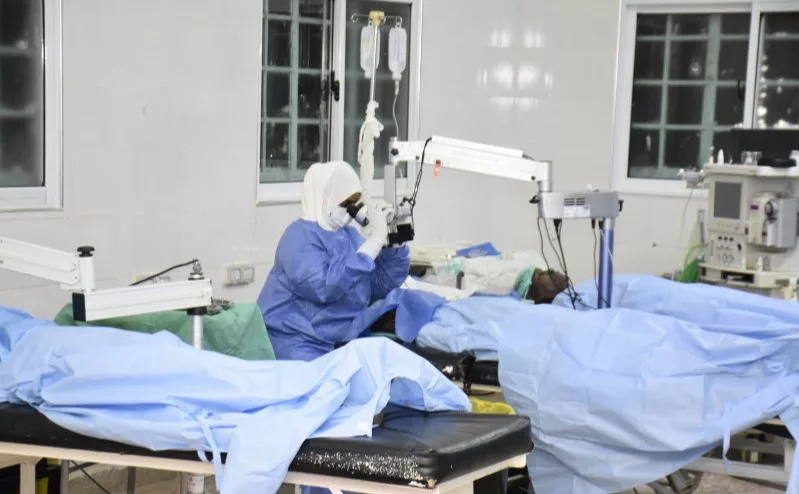
The call came during a free eye clinic at Garissa County Level V Teaching and Referral Hospital that is being conducted by Hands for Charity Canada, a non-governmental organisation.
The clinic, which is being done in collaboration with the Islamic Development Bank, involves conducting comprehensive ophthalmological assessments, screening patients for various eye conditions, identifying those requiring surgery, and providing the necessary treatment.
Speaking on the sidelines of the exercise, Hands for Charity Canada, East Africa Regional Manager, Dr Ahmed Farrah said partnerships between government health facilities and humanitarian organisations were essential in addressing the growing demand for specialised medical services, particularly among vulnerable residents who can’t afford treatment.
He called on other NGOs, development partners and well-wishers to support the health sector by identifying gaps in service delivery and investing in interventions that respond to the specific needs of communities.
“The demand is very high, and we already have a list of thousands of people who need eye surgery. The government is doing a lot to support the health sector, but we also need partners to come on board and complement its efforts in reaching people at the grassroots,” he said.
He said such partnerships should extend beyond ophthalmology to other departments within the health sector, urging organisations to conduct proper assessments before deciding where to direct their support.
He said evidence-based assessments will help partners identify the most pressing medical needs and ensure that available resources are channeled towards interventions that have the greatest impact.
Farrah said the eye clinic was part of efforts to restore sight among people who would otherwise struggle to access or afford specialised eye care.
The organisation is also planning to provide a fully equipped ophthalmology unit at the Dadaab Subcounty Hospital to strengthen local services.
Farrah said the planned ophthalmology unit will bring essential eye care services closer to the community, reducing the need for residents to travel long distances to Garissa for relatively minor investigations and treatment.
“This will save them time, effort and money while bringing essential services closer to the community. We consider ourselves part of this community, and we are committed to continuing our work here,” he said.
He also commended the hospital’s management for supporting the implementation of the programme and facilitating its activities on the ground.
The programme is targeting 500 patients for surgery and 2,000 others for screening, with those identified as requiring surgical intervention referred for further assessment, including pre-operative examinations, before undergoing the procedures.
The importance of the programme was underscored by beneficiaries who described years of vision difficulties that had affected their mobility, independence and ability to carry out daily activities.
Ismail Osman, one of the beneficiaries, said his eye problems began after he was involved in a road accident in 2018, an experience that left him struggling with his vision and made movement increasingly difficult.
“At some point, I could barely see anything. I had a lot of difficulties walking, and most of the time, I would fall down. Life was very difficult for me,” he said.
Osman said he visited Garissa Teaching and Referral Hospital last month seeking medical assistance and was subsequently booked for treatment on October 14.
He said he was relieved to receive treatment without having to pay, explaining that the cost of eye surgery had placed it beyond his financial means.
“Restoring one’s eyesight or treating eye-related conditions can be very expensive. Many of us cannot afford the cost of such procedures, and I personally did not have the money to pay for my treatment,” he said.
“But here I am, having received medical assistance without paying a single cent. I am grateful to God and to these well-wishers who have come to our aid.”
Osman expressed hope that the procedure would help restore his sight and enable him to resume his daily activities with greater ease.
Another beneficiary, Hadija Guyo Dawata, said she had endured eye problems for years, with the condition affecting her right eye for about a decade before similar difficulties developed in her left eye two years ago.
She said her deteriorating vision made it difficult to see in both dark and brightly lit environments, exposing her to accidents and other challenges.
Dawata recalled falling and injuring her right leg, which later required surgery, adding that her inability to afford eye treatment had forced her to live with the condition for years.
“When I heard that a free eye clinic was being conducted, I quickly came forward to seek help. As you can see, I am among the fortunate beneficiaries who have undergone surgery,” she said.
She thanked the organization and other well-wishers for extending assistance to patients who would otherwise have limited access to specialized treatment.
She urged more NGOs and development partners to support vulnerable residents, saying many people continued to suffer from eye conditions because they could not meet the cost of medical care.
“Many people are struggling with eye-related ailments but cannot afford the cost of treatment. We need more NGOs and well-wishers to come on board and support those who cannot afford medical care,” she said.