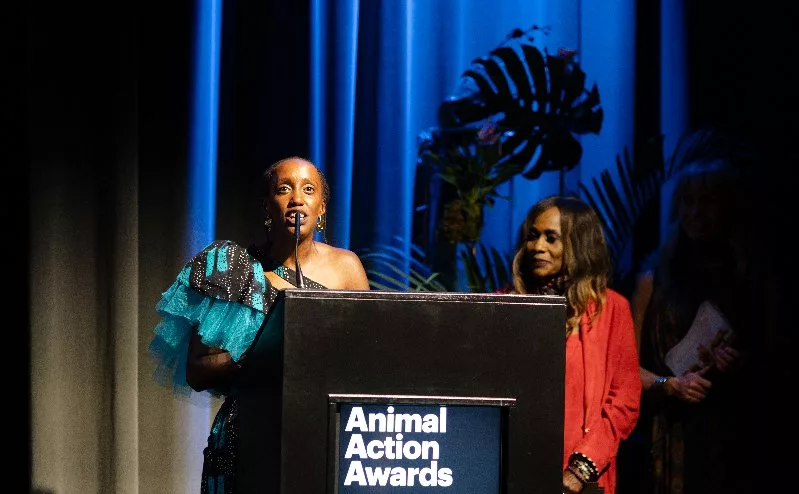
Dr. Mukami Ruoro-Oundo, a veterinarian at the Kenya Wildlife Service (KWS), has received this year’s Wildlife Vet of the Year Award from the International Fund for Animal Welfare (IFAW) at the BAFTA in London.
Caring for animals was Mukami’s childhood dream.
Growing up, she wanted to become a veterinarian so that she could care for cats and dogs.
But studying veterinary medicine at university was not easy. It took six years of hard work, resilience and grit to acquire the necessary qualifications.
While a student on industrial attachment at the KWS, she discovered she could become a wildlife veterinarian.
This propelled her ambition and passion to join the Service as a full-time employee.
Her dedication to her work has even led to a lioness at the Nairobi Orphanage and a Black Rhino at Tsavo West National Park being named Mukami, after the young and adventurous veterinarian.
“I saw an advertisement in one of the local newspapers for a veterinary officer position at KWS and applied.I was very happy and excited when another female veterinarian and I were selected for the job,” said Dr. Mukami.
“At the time, we were the only two women wildlife veterinarians, and it had been more than 16 years since a female veterinarian had worked in that role. I therefore understood that, in many ways, I was not just stepping into an existing space; I needed to create a blueprint to navigate it.”
Dr. Mukami said she wanted the women who followed to encounter fewer barriers, fewer assumptions about what they could or could not do, and a field ready to accommodate their presence.
“This meant showing up and doing the work exceptionally well, demonstrating that women were fully capable of meeting the demands of wildlife veterinary practice, from field rescues and immobilisations to long days in remote environments. Creating this blueprint also meant addressing practical barriers that could unintentionally limit women’s participation.”
Dr. Mukami said she began ensuring that additional tents were carried during field deployments so that female students and rangers could be accommodated appropriately.
“What might seem like a small logistical consideration could make the difference between a woman being able to participate in a field opportunity and having to sit it out due to a lack of suitable sleeping arrangements.”
In her line of work, Dr. Mukami has treated and cared for elephants, zebras, various antelopes, Black and White rhinos, big cats, mountain bongos, and unique species, including the world’s most trafficked animal, the pangolin.
“The first time I saw a live pangolin was in 2022, when I was called in to treat a pangolin who had been rescued from a trafficking ring and was missing half of his hind limb. The rest of the limb had to be amputated, and the surgery was successful. The pangolin, unfortunately, developed complications later and passed away. I learned a lot of lessons from that case,” Dr. Mukami explains.
As the focal contact person in the veterinary department at KWS for pangolins, she has pioneered protocols for the care and treatment of rescued animals.
Pangolins are very delicate animals and cannot survive well in captivity, as they have very specific diets: ants and termites only, and even then, each pangolin has specific preferences for the types of ants or termites.
When suspected criminals are arrested with pangolins, the legal, ideal situation is to have the pangolins presented in court as live evidence.
The protocols help advise the prosecution and the judicial system on why this is not possible.
While pangolins have become her favourite animal, rhinos, giraffes, and lions follow closely.
“In July, together with four colleagues, we performed surgery on a five-day-old white rhino who was born with a genetic issue. The surgery was the first of its kind documented in this species in the country. She is recovering well, and getting to see her recovery has been inspiring,” says Dr. Mukami.
Dr. Mukami has been involved in the translocations and ear notching of rhinos, as well as microchip placement in rhino horns.
In the unfortunate event that a rhino is poached, the chips help trace and identify its origins.
One of the most inspiring cases, was that of a lioness with a spinal problem.
“I was attending a wedding, and was told about a young lioness in the park that seemed to have a problem with its hind legs. Despite being off duty, she responded to the call to sedate the lioness.
“Meanwhile, we could hear the lioness’s mother roaring nearby and, together with colleagues, put it in a holding area for further treatment. We took her for an X-ray, which identified a slight pinched nerve in her spine. Dislocation of one of the sacral bones, which could be treated with medication and a lot of rest. She stayed in the holding area for treatment and rehabilitation for about six weeks, and the day came when we combined efforts to find her mother and released her back to the wild to her waiting family,” she says with a smile.
Dr. Mukami’s saddest moments come when she encounters animals bearing the effects of human-wildlife conflict.
“Unfortunately, the coexistence of animals and people continue to be a rapidly growing concern, particularly for less ‘charismatic’ species such as monkeys and the lesser-known ones such as the giant pangolin,” she says.
“Human-wildlife conflict is such a multifaceted problem, and while I understand the damage from animals is often irreparable, it is also heartbreaking to see the harm inflicted on animals due to conflict. Coexistence requires working with all concerned parties, and while this coordination may not be simple, I hope that we continue to put in more effort to see it happen,” she says.
“I congratulate Dr. Mukami on winning the Wildlife Vet of the Year award! The passion she has for the treatment and care of animals is evidenced in the strides she has made in a predominantly male career,” said Ben Wandago, Country Director, IFAW Kenya.
By caring for one animal at a time, she embodies the idea that a single animal is critical to the survival of a species.
At the beginning of her career, she was seconded by KWS to the Mt. Kenya Wildlife Conservancy to provide care and veterinary oversight for the critically endangered mountain bongo, which is a testament to her zeal, foresight, and collaborative skills, which are all needed to become a well-versed professional.
Dr Mukami recived her award at IFAW’s Animal Action Awards ceremony at BAFTA in London on 15 October.