


President William Ruto has signed into law two tax measures that include a reduction in Value Added Tax (VAT) on petroleum products from 16 per cent to eight per cent.
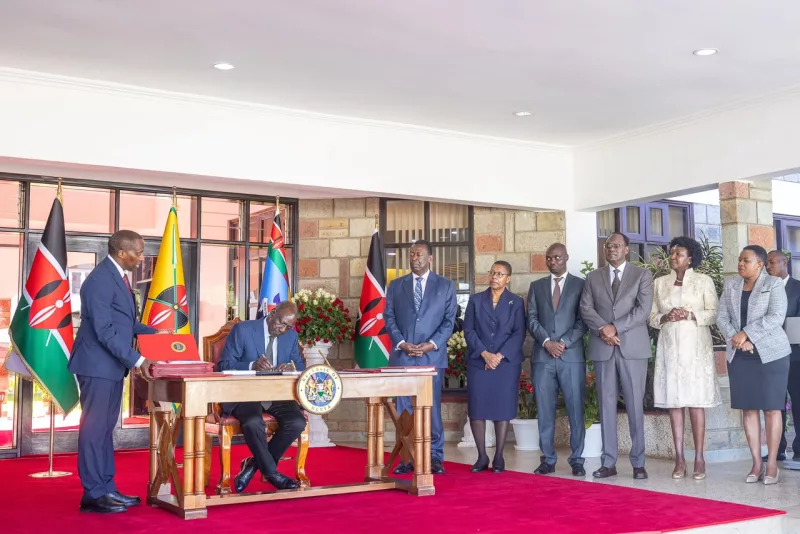
Ruto assented to the Tax Laws (Amendment) Bill, 2026 and the Kenya Revenue Authority (Amendment) Bill, 2026 at Eldoret State Lodge in Uasin Gishu County on Friday.
The Tax Laws (Amendment) Act introduces a 90-day reduction in VAT on petroleum products. The Cabinet Secretary for the National Treasury may extend the relief for another 90 days if necessary.
The measure extends a previous VAT reduction introduced in April, whose initial 90-day period and subsequent extension ended on October 14.
Parliament said the extension was necessary because the crisis in the Middle East, which had contributed to volatility in global oil prices, had persisted beyond the period initially anticipated.
“The Bill is therefore necessary as it will continue to give reprieve to the citizens,” the parliamentary brief said, adding that the measure would help protect households against increased transport costs and higher prices of essential goods and services.
The continued tax relief is intended to allow the Energy and Petroleum Regulatory Authority (EPRA) to maintain prevailing fuel prices and avoid a sharp rise that could increase transportation costs and the prices of other goods.
The Tax Laws (Amendment) Bill, sponsored by National Assembly Majority Leader Kimani Ichung’wah, was introduced in the National Assembly on October 8 and passed with amendments on October 14.
The law also introduces changes to excise duty on construction materials, targeting the construction and housing sector.
It changes the basis for calculating excise duty on tiles from weight to size, reflecting the fact that tiles are commonly sold by square metre. The weight-based tax had increased the cost of tiles after its introduction in June.
Excise duty on sanitary ware, including ceramic sinks, wash basins, baths, bidets, water closet pans, flushing cisterns and urinals, has also been reduced from Sh50 per kilogramme to Sh30.
The law further corrects the treatment of imported float glass and other glass products from the East African Community to ensure they are not subjected to excise duty contrary to the EAC Customs Protocol.
Parliament said the measures would reduce construction costs for both government and private sector projects, including affordable housing projects.
Separately, the Kenya Revenue Authority (Amendment) Act, 2026 seeks to strengthen the tax agency’s operations and improve revenue collection.
The law provides for substantive membership of all KRA board members, removing ex-officio membership. It also adds the Managing Director of the Kenya Ports Authority to the board to strengthen coordination between the two institutions.
KRA will receive guaranteed funding equivalent to at least two per cent of the revenue estimated to be collected by the authority in each financial year.
The law also provides an incentive equivalent to three per cent of revenue actually collected in any quarter above the amount estimated for that period.
The amendments further update the list of laws relating to revenue administration by removing repealed legislation and updating references to current laws.
The parliamentary brief said enhanced efficiency at KRA is expected to result in better revenue collection, “hence no need for an increase in taxes”.