

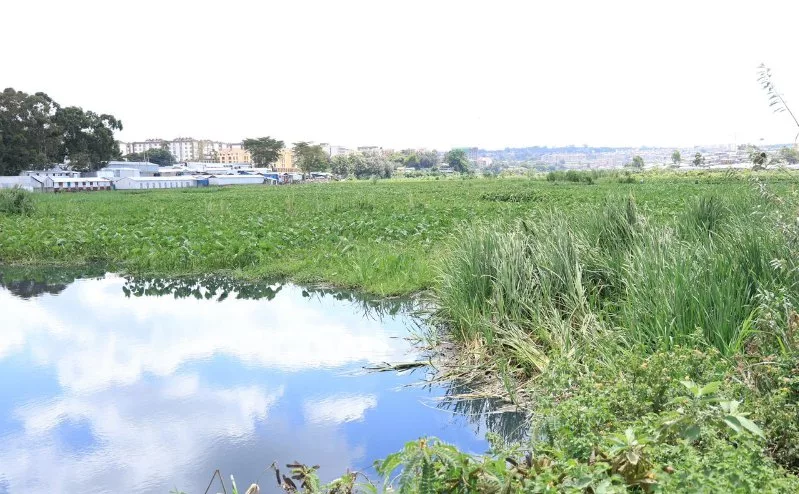
Two caterpillars are at work on an emergency spillway at Nairobi Dam, clearing a path to lower water levels as authorities race to address safety concerns ahead of the anticipated El Niño rains.
The heavy machinery is part of an urgent effort to secure the neglected reservoir, which authorities hope to transform from an environmental and public safety concern into a recreational attraction for Nairobi residents within a year.
The Nairobi Rivers Commission says the dam, last maintained in 1998, could regain its recreational value once challenges, including pollution, encroachment and damaged sewer infrastructure, are addressed.
Commissioner Mumo Musuva, accompanied by commission chief executive Brigadier (Rtd) Joseph Muracia, said a detailed technical assessment had been completed to guide the restoration.
“The Nairobi Dam will be restored back to its recreational value,” Musuva said on Tuesday.
He said the dam’s proximity to the Bomas International Convention Centre, Talanta Sports Stadium and Uhuru Gardens presented an opportunity to develop it as part of a wider tourism and recreation network.
“We are seeing the dam also being part of the Bomas International Convention Centre ecosystem and being part of Nairobi’s tourism. The dam is linked to Uhuru Garden, Talanta Sports Stadium, as all of them are interconnected,” he said.
The commission will announce the budget implications once the technical team completes its assessment.
Built in 1953 along the Ngong River, the dam was intended to help control flooding while providing a recreational space for city residents.
Decades of neglect have left it burdened with solid waste, while some sections have been encroached on by people who have erected temporary iron-sheet structures.
Some farmers have also planted arrowroots in the area, which are sold to unsuspecting Nairobi residents, according to information provided by authorities.
Musuva said the immediate priority was public safety upstream and downstream of the dam.
Authorities are lowering water levels in anticipation of heavy rains.
Previous warnings have highlighted the risk of flooding in downstream neighbourhoods, including Kibera, Nyayo Highrise, Dam Estate, Lang’ata, Nairobi West and Madaraka.
The World Meteorological Organisation has warned that El Niño is expected to intensify during the October-December 2026 period, potentially influencing weather patterns worldwide.
Authorities have forecast a near-100 per cent likelihood that the event will persist through February 2027.
Beyond lowering water levels, the restoration plan will involve removing encroachers and repairing sewer infrastructure to reduce pollution entering the dam.
Musuva said the commission was also exploring the establishment of a decentralised water treatment plant near Mbagathi Road to treat wastewater closer to its source.
“When the sewer lines break, pollution gets into the environment,” he said.
“Part of the medium and long-term strategy is having decentralised treatment plants that deal with localised waste.”
The Water Resources Authority had previously proposed decommissioning the dam to restore its ecological integrity.
Authorities have instead opted for rehabilitation as part of broader efforts to revive Nairobi’s environment.
The challenge now is to turn the restoration promise into a functioning public space while addressing the safety, pollution and infrastructure problems that have accumulated over decades.