


Health CS Aden Duale has sought to ease tensions with the Kikuyu community, saying his criticism of some leaders from the region should not be interpreted as hostility towards the community.
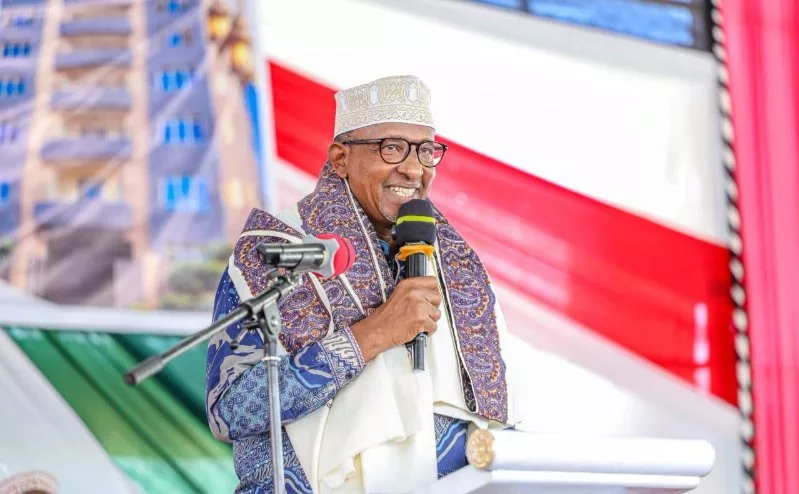
Speaking on Thursday in Nakuru County, where he was the chief guest during the commissioning of a landmark Waqf project in Ngala, Duale defended himself against accusations that some of his recent political remarks had targeted the Kikuyu community.
“I have absolutely nothing against the Kikuyu community. I have got many Kikuyu friends and, whether I stay in Nairobi or Garissa, I have Kikuyu neighbours,” Duale said.
He said his political record, including his service under former presidents Mwai Kibaki and Uhuru Kenyatta, demonstrated that he had no problem with the Kikuyu community.
Duale said he had been elected Garissa Township MP four times by a constituency comprising people from different communities, including Kikuyus, and had maintained close personal relationships with members of the community.
The CS said his political history also made it difficult to portray him as an opponent of the Kikuyu community, pointing to his role in governments led by Kibaki and Uhuru.
He recalled that he supported the Kibaki administration after the 2007-08 post-election violence and later served as Majority Leader during the Uhuru Kenyatta administration.
“And if there is one government that I served diligently and protected, it is President Mwai Kibaki and President Uhuru Kenyatta’s government when I was majority leader. So when I was protecting President Kenyatta’s government day and night, fighting with the opposition, didn’t I know that Uhuru was a Kikuyu?” Duale asked.
“When I joined other MPs in helping stabilise President Kibaki’s government after the post-election violence, when we left Raila Odinga and joined President Kibaki, didn’t we know that Kibaki was a Kikuyu?” Duale added.
The CS, however, maintained that his defence of the community did not prevent him from criticising what he described as misleading political narratives propagated by some leaders from Central Kenya.
“But when I see a section of Kikuyu leaders trying to mislead the community or destroy the country, then as a leader, I will speak my mind and give my opinion. President Ruto indeed got a lot of votes from the mountain. That is a fact. But President Ruto has also done, through actions in his government, to give top posts to people from the Central Region,” said Duale.
“In the 22-member Cabinet, the Deputy President is from the mountain, seven CSs are from the mountain, and 18 PSs are from the mountain as well. Chief of Defence Forces, Inspector General of Police, the KRA chairman, CBK governor, and many more. Surely, hasn’t that person done good to that community?” Duale asked.
His remarks come against the backdrop of increasingly sharp political exchanges over the 2027 elections, particularly claims about the numerical strength and political influence of the Central Kenya voting bloc.
Speaking in Mombasa last weekend, Duale directly challenged former Deputy President Rigathi Gachagua over his repeated references to Central Kenya’s numerical strength, including his claim that the region commands more than eight million voters.
Duale disputed the figure, arguing that voting patterns in the 2022 presidential election did not support the portrayal of Central Kenya as a single eight-million-vote bloc aligned to one political side.
“Rigathi Gachagua, who keeps boasting that he has eight million, let me debunk the eight million,” Duale said.
He argued that President William Ruto received about three million votes from the Central region in 2022, while former Prime Minister Raila Odinga received about one million, before accounting for other Kenyans residing in the region.
“The Central region gave Ruto three million votes and Raila Odinga one million. Your votes are three million. So that fallacy of eight million is what you need to tell us where you are getting it from,” he said.
Duale said political leaders should rely on official voter registration and election data rather than broad population estimates when making electoral calculations.
“Your population in Kenya is 11 per cent. You better know that we are smarter. We have the figures. At night we do the maths, we use the IEBC register, and we compare, and we are telling our people the truth,” he said.