



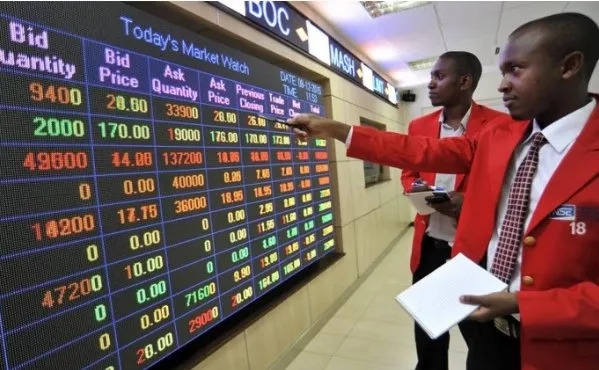
A broad sell-off at the Nairobi Securities Exchange (NSE) on Wednesday wiped out nearly Sh140 billion in market value, the biggest single-day loss in its history as investors rushed to lock in profits after a prolonged rally.
Market capitalisation fell 3.38 per cent to about Sh3.9 trillion, slipping below the Sh4 trillion threshold for the first time since August.
The NSE All Share Index (NASI), the market’s broadest benchmark, plunged 5.47 per cent to 237.59 points, while the NSE 10 declined 4.84 per cent, NSE 25 fell 4.16 per cent and the Banking Index dropped 4.14 per cent.
The NSE 20 Share Index was down 2.96 per cent.
The scale of Wednesday’s rout surpassed the three largest daily market-value losses recorded during the Covid-19 shock in March 2020.
The market lost about Sh125 billion on March 9, another Sh118 billion on March 12, and Sh116.7 billion on March 13, around the time the Government announced measures to contain the pandemic.
The latest sell-off was particularly severe in banking counters, which had been among the biggest beneficiaries of the NSE’s two-year recovery.
The rally has been underpinned by a strong improvement in bank earnings and balance sheets.
Central Bank of Kenya data shows that the banking sector’s quarterly profit before tax rose from Sh73.5 billion in March 2025 to Sh88.9 billion in June 2026.
Return on equity also increased to 24.1 per cent, while the sector remained strongly capitalised, with a capital adequacy ratio of 20 per cent, comfortably above the regulatory minimum of 14.5 per cent.
The sector’s asset base has also expanded.
By December 2025, total banking-sector assets had risen to Sh8.41 trillion, while quarterly profit before tax reached Sh90.4 billion.
That improved profitability has been reflected in share prices.
By Wednesday, Co-operative Bank led the banking retreat, falling 7.3 per cent to Sh33.55, followed by KCB, which shed 6.4 per cent to Sh84.25.
Equity declined 5.4 per cent to Sh96.25, while Absa Bank Kenya fell 5.3 per cent to Sh31.25.
Even so, the year to date gain for all Tier 1 lenders remained high, with Co-op Bank still up about 40 per cent since the beginning of the year.
KCB Group remained 28.1 per cent higher year-to-date, while Equity Group was up 44.1 per cent.
The correction extended beyond banks.
TotalEnergies lost 5.5 per cent, while Umeme and Africa Mega Agricorp declined 5.5 per cent and 5.7 per cent respectively.
However, the biggest single-company effect came from Safaricom, which commands a substantial share of trading activity at the NSE.
Its stock fell 3.8 per cent to Sh35.10, erasing more than Sh80 billion in market value.
The fall followed heightened investor uncertainty after the High Court nullified the Government’s sale of a 15 per cent stake in Safaricom to South Africa’s Vodacom Group.
The Government and Vodacom have said they will challenge the ruling, leaving the ownership transaction subject to further legal proceedings.
The sell-off was consequently broad, with 46 counters declining against only nine gainers, while 16 remained unchanged.
The domestic profit-taking came against an increasingly difficult international backdrop.
Global bond yields have risen sharply, making developed-market fixed-income assets relatively more attractive to investors seeking returns with lower perceived risk.
The US 10-year Treasury yield briefly reached 5.04 per cent on Tuesday, its highest level since 2007, while Germany’s 10-year Bund yield climbed to 3.6 per cent, its highest since June 2009.
“For frontier markets such as Kenya, higher developed-market yields can encourage foreign investors to reduce exposure to equities and redirect funds towards dollar-denominated assets,” capital market analyst, Gachuki Kahome said.
Foreign selling was already evident before Wednesday’s rout, with Standard Investment Bank (SIB) reporting $900,700 in net foreign outflows during the week ended September 11, following sustained selling pressure earlier in the month.
Rising oil prices have added another layer of risk.
Brent crude moved above $107 a barrel amid escalating Middle East tensions and fears of disruptions to supplies and shipping routes.
According to Kahome, the surge raises the cost of energy imports for oil-dependent economies such as Kenya, potentially worsening inflation, squeezing corporate margins and weakening consumer purchasing power.
“For investors, that combination of higher global yields, expensive oil and a market that had delivered substantial gains provided a strong incentive to secure profits.”
Even so, the Wednesday’s correction has not erased the NSE’s remarkable 2026 performance.
The NASI remains about 27.3 per cent higher year-to-date, while market capitalisation is still roughly 35.4 per cent above the start of the year.
The NSE 10, NSE 25, NSE 20 and Banking Index also remain substantially higher than their end-2025 levels.
Of the counters tracked across the market, 51 remain positive year-to-date against only 10 in negative territory.