


The government has identified major gaps that must be addressed to unlock the full economic value of bamboo.
Environment, Climate Change and Forestry CS Deborah Barasa listed five challenges that continue to hold back the multi-billion-shilling sector.
“First, processing capacity remains inadequate. We have grown the resource faster than we have built the factories, workshops and cottage industries needed to convert it into marketable goods,” Barasa said.
The CS decried the fact that markets remain fragmented and prices are not standardised.
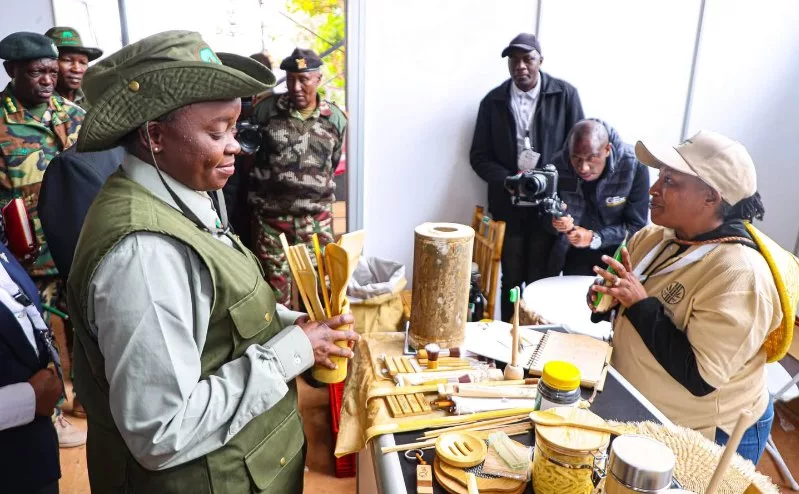
She spoke on Tuesday at Meru University of Science and Technology during the official opening of the inaugural National Bamboo Expo and Conference.
Barasa said farmers in one county are often unaware of what a fair price looks like, while buyers and sellers frequently operate without common standards or grading systems.
World Bamboo Day 2026 and the inaugural National Bamboo Expo and Conference were held under the theme, ‘Sustainable bamboo for climate action, economic growth and community empowerment’.
Barasa said technical skills and training are still limited.
“Treating, laminating, and engineering bamboo to construction-grade standards requires expertise that is not yet widespread enough in our counties or our technical institutions,” she said.
Barasa cited unequal access to land and capital, particularly for women who form the backbone of agricultural livelihoods in the country, as another significant challenge.
She warned that an inclusive bamboo economy cannot be built while a significant share of the population faces structural barriers to participation.
Barasa said institutional coordination between the national government, county governments, research institutions, and the private sector has not always matched the ambition set out in the Kenya National Bamboo Development Strategy and Action Plan 2025–2035.
In 2019, the government gazetted bamboo as Kenya’s 16th scheduled cash crop.
Barasa said the declaration was not symbolic, but rather a commitment to farmers, processors, investors, youth and women who stand to benefit most from a thriving bamboo economy.
She said her ministry last year launched the Kenya National Bamboo Development Strategy and Action Plan 2025–2035—a 10-year, Sh17 billion roadmap to move bamboo from the forest edge to the factory floor.
Barasa said bamboo sits at the intersection of the national challenges facing Kenya today: pressure on natural forests, a national housing deficit of over two million units and rising construction costs.
She said the construction sector consumes more than 2.4 million tonnes of steel annually, even as timber resources dwindle.
“Bamboo matures in three to five years rather than the decades required by hardwood, regenerates naturally after cutting, and studies show it can replace a sizeable share of steel in construction at a fraction of the cost. It is one of the few resources that can answer all of these needs at once.”
The Mount Kenya ecosystem remains Kenya’s most productive bamboo-growing zone, possessing immense potential for job creation and expanding opportunities across the forestry value chain.
Indigenous highland bamboo has grown for generations across Kenya’s five main water towers. They are the Aberdares, Mount Kenya, Mount Elgon, the Mau Forest Complex, and the Cherangany Hills, covering about 133,000 hectares (328,650 acres) of forest land.
Barasa said over the years, thousands of bamboo seedlings have been planted across the country in Meru, Kirinyaga, Nyeri, Bomet and beyond.
However, many farmers have been left grappling with a lack of markets and processing facilities.
Globally, bamboo is a $72 billion (Sh9.3 trillion) industry supporting the livelihoods of 1.5 billion people worldwide, with over 10,000 documented uses.
Under the national strategy, plans are underway to expand bamboo coverage to 150,000 hectares (370,658 acres) across forests, riparian zones, and farms.
The strategy aims, among other initiatives, to establish a National Centre of Excellence and 20 county incubation centres for technology and innovation.
The move is expected to create 750,000 green jobs within the first two years of planting.
The strategy will also position bamboo as a timber substitute, an alternative source for pulp and paper, furniture, construction materials, textiles, energy and food.