

Teacher unions have sharply differed over whether Junior schools should operate autonomously from primary schools where they are domiciled or continue operating under one management structure.
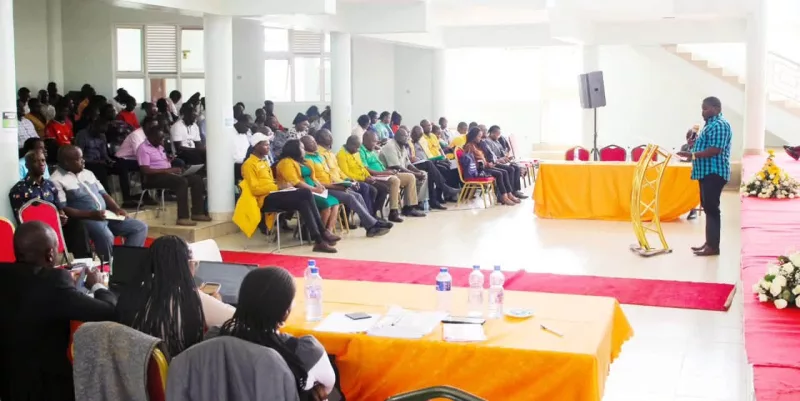
KUPPET and KNUT presented opposing views during public participation forums held on Wednesday in Homa Bay, Kisumu, Makueni and Taita Taveta counties.
The National Assembly Departmental Committee on Education is collecting public views on six education reform Bills aimed at reshaping Kenya’s education sector.
Among them is the Basic Education Bill, 2026, which seeks to overhaul the Basic Education Act, 2015.
Several of its clauses have elicited sharp divisions among teacher unions. One of the contentious provisions concerns the leadership structure of public schools.
The Bill proposes retaining the current framework under which public primary, comprehensive and senior schools are headed by one institution head appointed by the Teachers Service Commission.
KUPPET wants Junior schools to be separated from comprehensive schools and given their own management structures.
“Anywhere they have talked about comprehensive school should entirely be deleted and be replaced with Junior school so that we have an autonomous Junior school which shall have its own structure,” a KUPPET official said during the hearing at Tom Mboya University in Kisumu.
Under the Competency-Based Education (CBE) system, a comprehensive school is a unified institution that combines Early Childhood Development Education (ECDE), lower and upper primary and Junior Secondary School (JSS) under one management structure.
“We expect to have public primary, have senior school and also have public Junior school because once that is done clearly then you can be sure we will have different management taking place there, which is not the case,” another KUPPET official said.
KNUT, however, opposed granting Junior schools autonomy from primary schools where they are domiciled, citing concerns over reduced government resources.
“Anybody thinking that they will come and cause chaos in our schools by splitting some level of school away from the comprehensive school system, that one is not for us,” a KNUT official said.
Other contentious provisions in the Bill include a requirement for school heads to report parents who refuse to enrol their children in school for arrest and the classification of corporal punishment as a criminal offence.
Teachers argued that ensuring parents enrol their children in school is not their mandate.
They also said classifying corporal punishment as a criminal offence had exposed teachers to undue victimisation.
“That section should just start reading ‘children should not be subjected to torture’ because that particular article has made our teachers to suffer.”
The unions also asked the parliamentary committee to delete a provision restricting teachers contracted by the Kenya National Examinations Council (KNEC) from engaging in strikes during national assessments.
They argued that the proposal infringes on their constitutional right to strike.
The committee is on Thursday holding public participation forums on the six Bills in Machakos, Kisii, Embu and Kericho counties.
The public participation exercise, which started on September 14, will run until September 25.
The six Bills are the Tertiary Education Placement and Funding Bill, 2026; Pre-Service Education and In-Service Training Bill, 2026; Basic Education (Amendment) Bill, 2026; Kenya Institute of Curriculum Development (Amendment) Bill, 2026; Kenya National Educational Assessments Council Bill, 2026; and Kenya National Qualifications Framework (Amendment) Bill, 2026.