



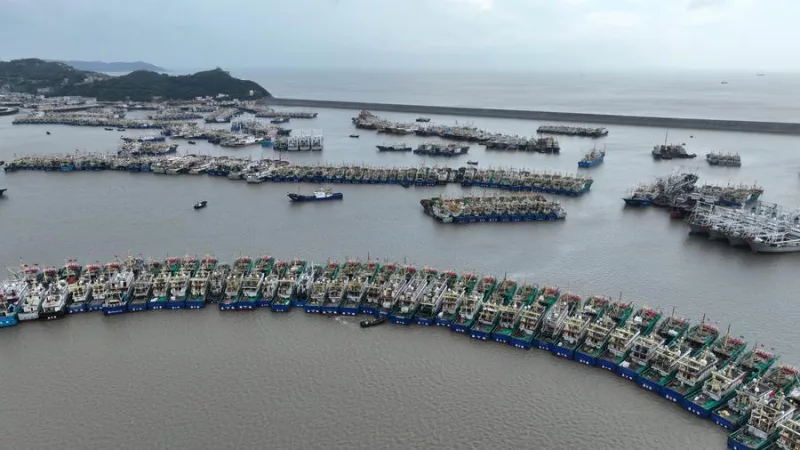
Chinese authorities have evacuated more than a million people from their homes in eastern China including Shanghai, as Typhoon Dolphin made landfall.
It packed maximum wind speeds of 150km/h (94mph) when it first slammed into Yuhuan in the Zhejiang province at 17:30 (09:30 GMT) before making a second landfall in the city of Wenzhou about an hour later, meteorological authorities said.
The typhoon halted transportation across the region – 1,400 flights were cancelled in Shanghai alone.
Chinese authorities had earlier issued their highest-level red alert for Dolphin, but by Monday morning they downgraded it to a tropical storm.
The storm is moving inland within China, and authorities are still warning of torrential rains, severe flooding and the risk of landslides through to Wednesday.
Heavy rain was forecast on Monday for the provinces of Shandong, Henan, Hubei, Anhui, Jiangsu, Zhejiang and the city of Shanghai.
Local governments have urged people to avoid outdoor activities, while several top tourist attractions remain closed, including parts of Disneyland and Legoland, and several viewing platforms along the Bund in Shanghai.
Footage on state media show ground-floor businesses flooded in the former French Concession in Shanghai – an area popular with tourists – and people walking through ankle-deep waters.
Several state media outlets have reported that a nine-year-old boy from Wenling, Zhejiang is missing after being swept into the sea. Chinese officials have not reported any casualties.
Parts of Zhejiang could receive 250mm to 500mm of rain over the next few days, forecasters say.
Authorities in Hangzhou, Zhejiang’s capital city, have waived parking fees in all public spaces for drivers seeking shelter amid the strong winds and floodwaters.
Elsewhere in the province, Wenzhou authorities have relocated some 900,000 residents and opened more than 1,000 emergency shelters, while about 390,000 people have been evacuated from their homes in the city of Taizhou.
In the coastal province of Fujian, maritime authorities have suspended dozens of passenger ferry routes and halted more than 100 offshore construction projects.
The storm moved over a long distance of 6,000km before making landfall, suggesting a lifespan of more than three times that of an average typhoon, according to China’s state broadcaster CCTV.
It also has a massive cirulation size and intense rainfall capacity, CCTV reported.
Misinformation around the storm has apparently spread rapidly on the Chinese internet, with state media reporting that two people have been detained for distributing such content.
One of them, a 60-year-old man, created a fake video with AI that claimed someone in Shanghai had fallen from a building during the storm.
Another man, 32, had re-edited storm footage posted by other social media users in a way that was deemed as misleading.
Dolphin brought torrential rains to the Philippines, parts of northern Taiwan and Japan’s Okinawa island before bearing down on China.
Eight people have died in the Philippines because of heavy monsoon rains brought on by Dolphin and storms earlier in the week, says the Office of Civil Defence. More than 7,000 people are sheltering at evacuation centres nationwide.
In Okinawa in Japan, five elderly people suffered non-life-threatening injuries, according to the prefectural government.
Three of them fell because of the strong winds, it said.
Meanwhile in Hong Kong, weather observatory posted a record high temperature of 36.9C on Sunday as the typhoon swept warm air over the city.
Typhoon season in the western Pacific typically occurs between May and October, when typhoons are considered more commonplace.
This year is a strong El Niño year, which experts say means typhoons can grow to be more intense.