
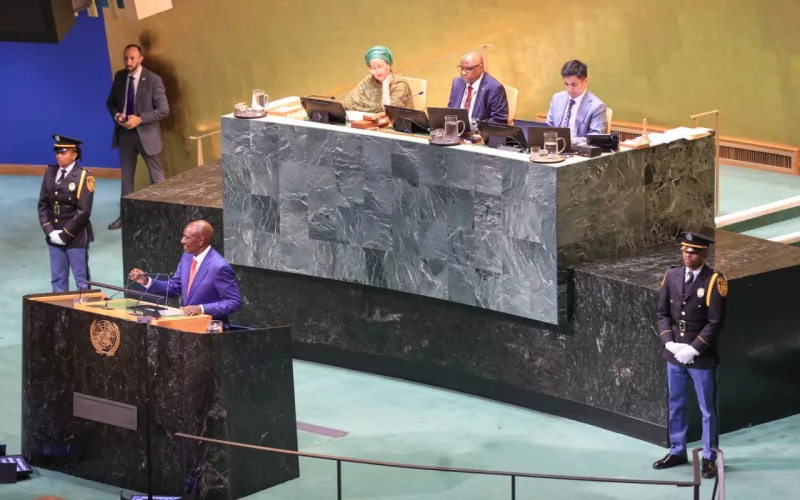
President William Ruto has renewed Kenya’s call for reforms to the international financial system and the United Nations Security Council.
The Head of State argued that global institutions must reflect the realities of today’s world rather than inequalities inherited from the past.
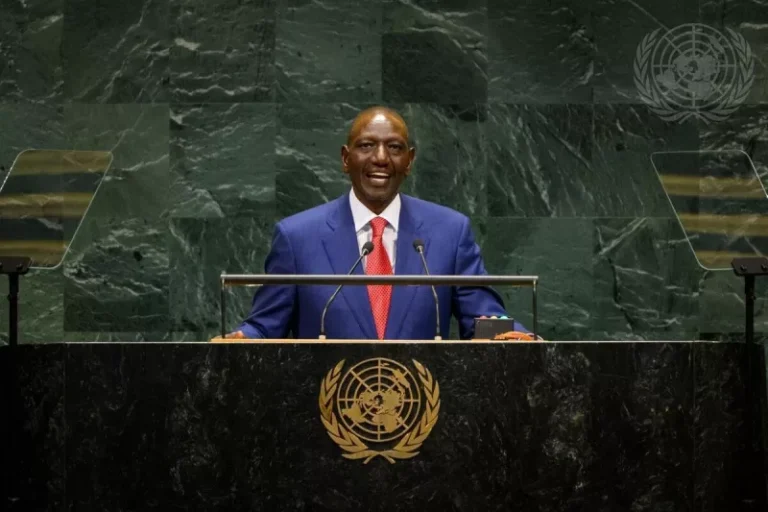
Addressing the 81st session of the United Nations General Assembly in New York on Wednesday, Ruto said Africa’s exclusion from permanent representation on the Security Council was inconsistent with the principle of sovereign equality on which the UN was founded.
He noted that while every UN member state has one vote in the General Assembly, five countries hold permanent powers on the Security Council that the other 188 do not.
“Every nation is sovereign and equal under the Charter. Yet on the gravest questions of war and peace, five nations possess a permanent power that the other 188 do not,” Ruto said.
He pointed out that Africa has 54 member states, representing more than a quarter of the General Assembly, but has no permanent voice in the body responsible for international peace and security.
“The world has transformed. The Council has not. We cannot manage transformation with institutions that refuse to transform themselves,” he said.
Ruto said reform should deliver equitable and permanent African representation, with all the prerogatives and privileges attached to permanent membership.
The President also criticised the slow pace of Security Council reform, noting that negotiations began in 2009 after the General Assembly moved the process into intergovernmental negotiations in 2008.
“Seventeen years later, we are still negotiating,” he said, while noting that member states had agreed in the Pact for the Future that addressing the historical injustice against Africa should be a priority in Security Council reform.
Ruto linked the question of political representation to the wider reform of the international financial architecture, saying both were rooted in the same concern over unequal global institutions.
He cited global public debt of $102 trillion in 2024 and said developing countries, despite accounting for less than a third of that debt, paid about $1 trillion in interest that year.
He said 46 developing countries now spend more on interest than on either health or education.
“The countries that most need capital frequently pay the highest price to obtain it. Developing countries have recently borrowed at rates two to four times higher, on average, than the developed nations,” he said.
“The question, therefore, is not simply whether finance is available. It is who can access it, at what price, for how long and under whose assessment of risk.”
Ruto called for multilateral development banks to lend more and for longer periods, mobilise private capital at scale and expand the use of guarantees and risk-sharing instruments to reduce the cost of viable investments.
He also called for greater access to long-term and local-currency financing to enable developing countries to fund long-term infrastructure without relying excessively on short-term, expensive debt.
The President singled out sovereign credit ratings as another area requiring reform, citing a UNDP estimate that subjectivity in credit ratings has cost African countries about $75 billion through excessive interest costs and foregone lending.
“Capital must price risk; it must not price prejudice,” he said.
Ruto, however, said reforms to the international financial system should be matched by greater responsibility by governments, including prudent debt management, credible projects, respect for contracts and action against corruption.
He said Africa’s voice should also increase in institutions governing global finance, arguing that the continent should have a greater role in decisions affecting the obligations it carries.
“Africa has a stake in the burden; Africa must have a share in the decisions,” he said.
On peace and security, Ruto said the rising number of conflicts showed the need for the UN to move beyond responding to wars after they have escalated.
He said the world recorded 65 state-based armed conflicts last year, the highest number in eight decades of global conflict data, with 13 reaching the scale of war.
He said interstate conflicts had doubled for the second consecutive year, while one-sided violence against civilians had reached levels not seen since the 1994 Rwandan Genocide.
Ruto said the UN Charter gave the organisation a duty to prevent conflict, defend peace and make collective security effective, rather than merely count casualties and organise relief after diplomacy had failed.
“When collective security breaks down, schools close, hospitals collapse, families flee, and economies are consumed by war. Peace is not separate from development. It is its first condition,” he said.
The President argued that reform of both the Security Council and international financial institutions was necessary to restore confidence in multilateralism and ensure that global rules, representation and access to capital reflected the sovereign equality proclaimed by the UN Charter.
“If we seek a United Nations that delivers for all, then all must have a meaningful voice, a fair opportunity, and a stake in the system,” Ruto said.