



The Judicial Service Commission is under pressure to fast-track the recruitment of a substantive Chief Kadhi, over a year after the death of Sheikh Athman Abdulhalim left the country’s highest Islamic judicial office vacant.
Stakeholders in the Muslim community and the legal fraternity say the prolonged absence of a substantive Chief Kadhi risks weakening coordination and leadership within Kadhi’s Courts at a time when demand for their services is increasing.
Sheikh Abdulhalim died on July 9, 2025, and the position has since been held in an acting capacity by Senior Principal Kadhi Sheikh Sukyan Omar Hassan.
The JSC advertised the position on January 16, 2026, raising expectations that the long-standing vacancy would soon be resolved.
However, nearly seven months after the advertisement, there has been no public communication on the progress of the recruitment process.
Mombasa Senator and High Court advocate Mohamed Faki has now called on the commission to move with urgency, arguing that the vacancy is no longer an administrative matter that can be left unresolved.
“Even now, the office of the Chief Kadhi remains vacant one year after the death of the former Chief Kadhi. There are administrative issues that require urgent attention,” Faki said.
He said the lack of communication following the advertisement had raised concern among stakeholders who expected the recruitment process to move forward.
“I am aware there was an advertisement for the position of Chief Kadhi, but after that, nobody has heard anything about it for almost a year,” he said.
The Chief Kadhi is the senior-most judicial officer in the Kadhi’s Court system and plays an important role in the administration and coordination of the courts, which have jurisdiction over questions of Muslim law relating to personal status, marriage, divorce and inheritance where all parties profess the Muslim religion and submit to the court’s jurisdiction.
Faki said the prolonged vacancy was particularly concerning because Kadhi’s Courts were already operating under pressure from rising caseloads and inadequate staffing.
He called for greater investment in the courts, saying the Judiciary had historically paid limited attention to the infrastructure and staffing needs of Kadhi’s Courts despite the critical role they play in providing access to justice.
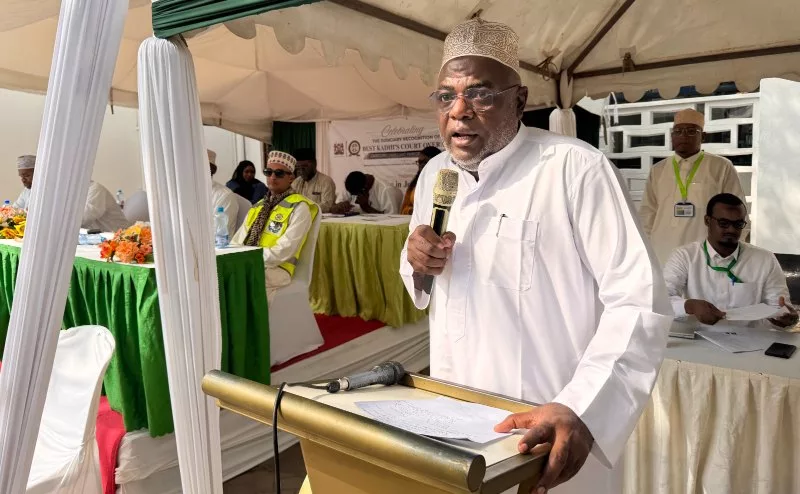
The Mombasa Senator was speaking during celebrations to mark the recognition of the Mombasa Kadhi’s Court as Kenya’s best-performing Kadhi’s Court in the overall caseload performance category.
The Mombasa station handled 2,832 cases during the 2024-25 financial year, an increase from 2,484 cases recorded in the previous financial year.
Faki said the rising caseload demonstrated the need for the Judiciary to increase the number of Kadhis and strengthen the infrastructure supporting the courts.
Kenya currently has 43 serving Kadhis, a number Faki described as inadequate for a country where demand for Kadhi’s Court services continues to grow.
“Even if we assigned one Kadhi to each county, four counties would still remain without one. Moreover, some stations require more than one Kadhi because of the heavy workload,” he said.
He cited Mombasa, which has three Kadhis, as an example of a station facing significant demand, while Msambweni has only one Kadhi despite handling a substantial caseload.
Faki said expanding the Kadhi establishment should go hand in hand with improving access to court services in areas where residents have to travel long distances to seek justice.
He pledged to petition the JSC to establish a Kadhi’s Court at Shanzu Law Courts to serve residents of Shanzu, Utange, Mtwapa and the wider Kisauni area.
The senator also praised Kadhi’s Courts for maintaining high levels of integrity and professionalism, saying his more than two decades of legal practice had given him an opportunity to interact extensively with the courts.
He said he had not encountered allegations of corruption involving Kadhis and attributed the confidence in the courts to their adherence to Islamic law and judicial principles.
“If you appear before a Kadhi’s Court, especially in succession matters, you are assured of justice. There are no unnecessary delays or underhand dealings because the decisions are guided by the Holy Qur’an and the Sunnah of the Prophet,” he said.
The calls came as the Mombasa Kadhi’s Court was recognised for its performance, with station head Abdulaziz Mohamed attributing the achievement to teamwork, innovation and collaboration with the Court Users Committee.
Mohamed said the station had deliberately focused on improving the services it could provide despite operating with limited resources.
He said the court had strengthened teamwork, introduced innovations, improved internal systems, mobilised external partnerships and enhanced accountability, while placing the Court Users Committee at the centre of decision-making.
Mohamed said the station would continue working to expand access to justice, accelerate digital transformation, improve efficiency and promote Alternative Justice Resolution mechanisms.
The recognition has also highlighted the role played by non-governmental organisations in supporting Kadhi’s Courts, particularly in areas where public investment has been insufficient.
Helping Hands Pwani financed the renovation of the Mombasa Kadhi’s Court, helping improve the physical environment in which judicial services are delivered.
The organisation’s Executive Director Habib Omar said many Kadhi’s Courts across the country continued to struggle with inadequate infrastructure despite serving thousands of Muslims.