

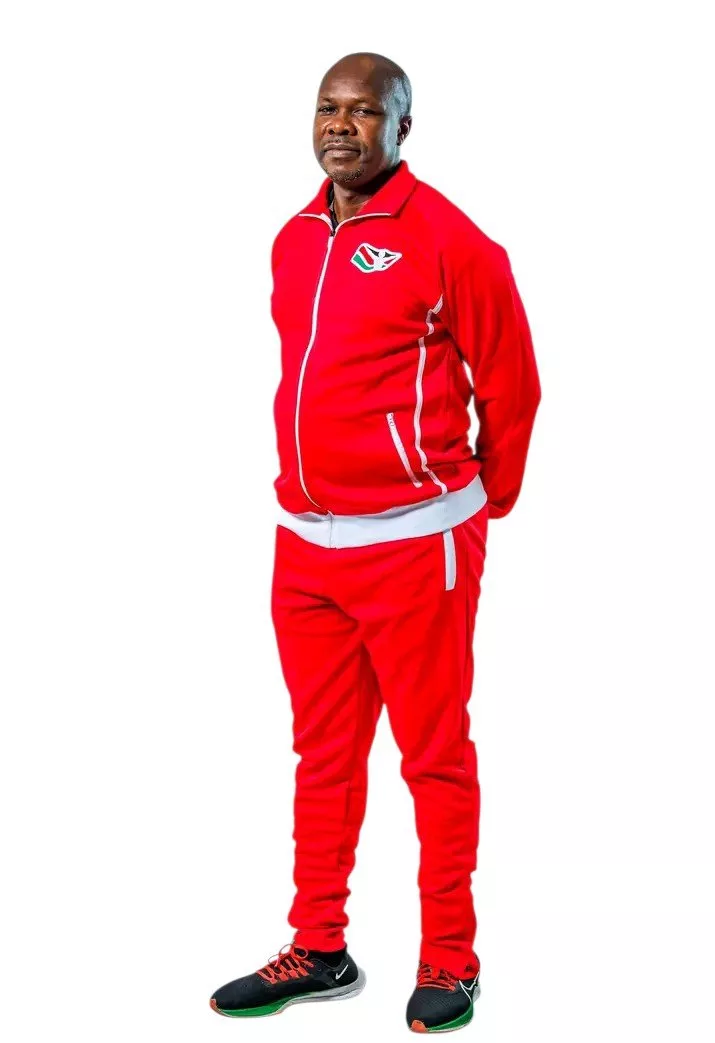
When Geoffrey Omondi took charge of Malkia Strikers as head coach, he stepped into a world built on trophies, tradition and expectation.
He took charge of a proud volleyball dynasty just as Kenya’s once-unquestioned supremacy was beginning to come under serious threat. His challenge was to preserve its rich heritage while giving the team fresh energy before the crown slipped away.
The Malkia Strikers still wore the aura of champions, carrying decades of trophies, experience and expectation. But the winds of African volleyball were changing direction.
A new generation of younger, faster and more formidable challengers was surging towards the summit, daring to unsettle a Kenyan dynasty that had ruled African volleyball for generations.
Instead of guarding the old formula like a treasured relic, Omondi has chosen to tear it open and rebuild from within. His revolution is powered by youthful legs, sharper accuracy, faster movement and the belief that adaptability, rather than nostalgia, will keep Kenya on top.
Now, with the African volleyball caravan heading towards Nairobi, Omondi’s revolution is approaching the edge of the precipice. The young players, the new rhythm and the reinvented Malkia must now withstand the roar of home expectation and the relentless challenge of Africa’s best.
The tournament, scheduled for August 23 to September 5 in Nairobi, will place Omondi and his players under the intense scrutiny that comes with defending an African crown in front of a home crowd.
For a coach who has spent much of his career developing players and turning ambitious teams into contenders, the challenge is both professional and personal.
“I’m gunning for the African Championship. I’m yet to win that trophy, and that is my next goal,” Omondi said. It is a deceptively simple statement that captures the scale of his ambition.
For Kenya, this is no ordinary championship campaign. They are defending a kingdom built through generations of triumph and chasing an 11th African crown that would further gild their remarkable volleyball legacy.
Omondi is attempting something few coaches are afforded the luxury to do: rebuilding a dynasty without stepping away from the throne. Since March 2025, his tenure has been a constant balancing act between preparing a new generation and keeping Kenya’s winning machine running.
Omondi’s tenure since March 2025 has been a story of controlled disruption. He has deliberately unsettled the familiar, moving beyond established stars to give younger players a chance to step into the light and become part of a faster, more fearless Malkia generation.
“Rather than going out to the market to shop for new players, I went into detail for every player, strengthening their weaknesses and refining their strengths,” he explained.
The philosophy is rooted in a belief that improvement does not always require replacing players.
Sometimes, Omondi argues, the answer lies in identifying what a player does poorly, working relentlessly on it and turning the weakness into another weapon. It is a coaching philosophy shaped by his own journey.
Before moving permanently to the technical bench, Omondi was a national team player and spent part of his playing career with Co-operative Bank, gaining first-hand experience of the demands of elite volleyball. His transition into coaching subsequently took him through different levels of the game.
He worked with Co-operative Bank before taking charge of Trailblazers Men’s Volleyball Club, where he helped transform a relatively new side into a competitive force.
Trailblazers reached the Kenya Volleyball Federation (KVF) playoffs under his leadership, reinforcing his reputation as a coach capable of building rather than merely inheriting teams. His next major challenge came at Kenya Pipeline.
Appointed in September 2024 after Paul Gitau’s departure, Omondi inherited a club with a proud history but also a need for renewal. He responded by concentrating on individual development, tactical discipline and consistency.
The results have since strengthened his argument. In July 2026, Kenya Pipeline completed a domestic double, winning both the KVF National League title and the Kenya Cup.
The achievement gave Omondi momentum as he turned his attention fully to the national assignment. But his approach to coaching is not based solely on trophies.
He places considerable emphasis on what happens inside training, where players are expected to understand not just what they are doing but why they are doing it. “My ability to change the game, especially when trailing, has been my strength,” he said.
That adaptability will be tested severely in Nairobi. The African championship is expected to bring together some of the continent’s strongest teams, including traditional rivals such as Egypt, Cameroon and the Democratic Republic of Congo.
Kenya will therefore have little room for tactical conservatism. The old formula of overpowering opponents with experience and physical strength is being supplemented by greater speed and precision. For Omondi, that transformation is essential if Kenya are to remain ahead of a rapidly evolving African game.
His coaching credentials have provided the technical foundation for the project. He holds an FIVB Level Two coaching qualification and has worked across men’s, women’s and youth volleyball, giving him experience of different playing styles and developmental needs.
He has also served within national youth structures and previously coached Wafalme Stars, Kenya’s senior men’s national team.
Those experiences have helped shape a coach who appears comfortable moving between development and high-performance environments. His appointment to Malkia Strikers was itself a statement of confidence from the Kenya Volleyball Federation.
He emerged from a competitive recruitment process that included more established names, demonstrating the federation’s willingness to entrust the next stage of the national team’s evolution to a coach whose reputation was built largely through development.
Omondi has embraced the responsibility without appearing intimidated by the job’s stature. “Any senior coach at a club level should be able to take over Malkia Strikers because we all go through rigorous training,” he said.
That confidence is important because the national team job comes with a different kind of pressure. At club level, a coach can often rebuild over several seasons. International tournaments offer no such luxury.
Players arrive in camp for limited periods, opponents are closely analysed, and every match can determine whether a campaign ends in disappointment or celebration. For Malkia Strikers, the pressure is amplified by the weight of history.
Kenya has long been one of Africa’s leading volleyball nations, and their supporters expect nothing less than a title challenge whenever the continental championship comes around.
Hosting the tournament makes the expectations even greater. The matches will be staged at the Kasarani Indoor Arena and Ulinzi Complex, giving Kenya the advantage of familiar surroundings and strong home support. But Omondi understands that home advantage can easily become another source of pressure.
“Hosting helps, but again it has a lot of pressure,” he admitted. That pressure will extend beyond the court.
For the federation, the championship is an opportunity to showcase Kenya as a major volleyball destination. For the players, it is a chance to perform before family, friends and supporters. For Omondi, it is the biggest examination yet of a rebuilding project that has attracted considerable attention.
The coach has already begun the difficult process of reducing his provisional squad. Training initially involved 25 players, with the technical team expected to trim the group before naming the final 18-member squad for the championship. Every selection will carry consequences.
The introduction of younger players means Omondi must decide how much responsibility they can shoulder in a tournament where Kenya are expected to win.
At the same time, established players must adapt to a system that demands greater speed and accuracy. The challenge is not simply to change personnel. It is to change habits.
Omondi’s preference for high-speed volleyball requires players to process situations quickly, move efficiently and execute under pressure. That places considerable emphasis on technical preparation and sports science.
His coaching background has increasingly incorporated modern approaches to player monitoring, tactical analysis and individual improvement. The objective is to make Malkia Strikers less predictable.
A team capable of changing its rhythm can disrupt opponents who have prepared for a traditional Kenyan style. It is also a philosophy that reflects Omondi’s belief in adaptability.
He has spoken repeatedly about his willingness to make changes when circumstances demand them. “I’m gunning for the African Championship,” he said, making the ultimate objective clear.
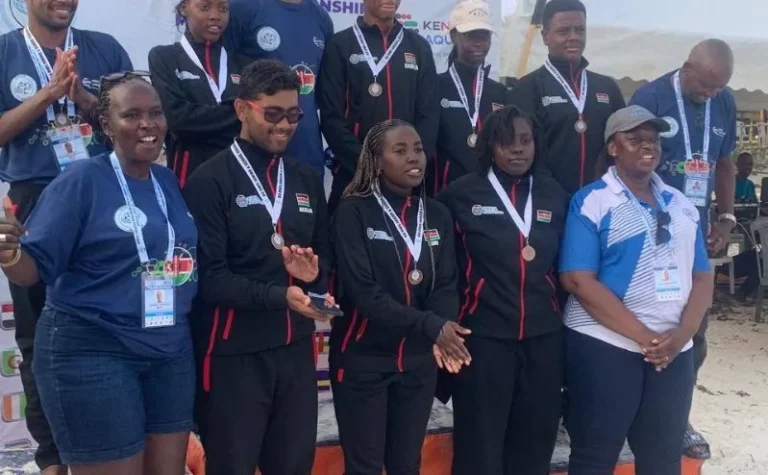
Malkia Strikers during a past event/HANDOUT
A strong performance will be important in the qualification pathway towards the 2028 Los Angeles Olympic Games and the 2027 FIVB World Championship. For a team undergoing generational change, those objectives provide both motivation and urgency.
The Malkia Strikers therefore enter the tournament carrying several responsibilities at once: defend their African crown, develop a new generation, remain competitive against increasingly sophisticated opponents and position Kenya for the next Olympic and world championship cycles.
It is a formidable list. Omondi’s work at Kenya Pipeline has offered evidence that he can manage such expectations. When he arrived at the club, his approach was not to embark immediately on a wholesale overhaul.
Instead, he concentrated on extracting more from the players already available to him. “Rather than going out to the market to shop for new players,” he said, “I went into detail for every player.”
The result was a team that eventually delivered two domestic trophies. The challenge now is to reproduce that transformation at the international level, where the margins are smaller and the opponents are stronger.
His experience with youth teams may prove particularly valuable. Malkia Strikers’ future depends on finding the next generation of players capable of carrying the national team beyond the current cycle.
That process cannot be separated from the present. Young players must be exposed to high-level competition while experienced players provide leadership and stability. Omondi’s technical bench has been strengthened for that task.
He works alongside assistant coaches David Muthui and Esther Chepkosgei, team trainer Azenga Mavisi and former Malkia Strikers captain Brackcides Agala, who has moved into coaching after her playing career. Agala’s transition is particularly significant.
Coach Omondi with Malkia Strikers’ players/HANDOUT
She brings an understanding of the national team environment and can help bridge the gap between the generation that built Kenya’s reputation and the players expected to protect it.
For Omondi, the broader objective is to create a system rather than simply assemble a successful tournament team. That is why individual development remains central to his philosophy. He wants players to understand their weaknesses and take responsibility for improving them.
“Every player” must be developed, he has stressed through his coaching philosophy, rather than relying on recruitment to solve every problem.
The approach also reflects a broader shift in Kenyan sport, where national teams increasingly need sustainable talent pathways instead of depending on a small group of established stars.
Malkia Strikers have been among the country’s most successful sporting brands, but sustained dominance requires constant renewal. The danger for any successful team is that yesterday’s winning formula eventually becomes tomorrow’s weakness.
Omondi appears determined not to allow that to happen. His greatest test will be whether the younger Malkia Strikers can perform when the stakes rise.
Training sessions offer one environment. A packed Kasarani arena, an African championship match and the expectation of an entire volleyball nation provide another. The coach knows that distinction. “Hosting helps,” he said, “but again it has a lot of pressure.”
That pressure could either overwhelm the new-look team or accelerate its development. Omondi will be hoping for the latter.
His own career has been built on taking teams at different stages of development and pushing them towards something greater.
From player to coach, from Co-operative Bank to Trailblazers, from youth national teams to Wafalme Stars, from Kenya Pipeline to Malkia Strikers, his path has been one of gradual progression.
The domestic double with Pipeline has strengthened his credentials. The African championship will test them. For all the talk about systems, speed, youth and sports science, the measure of Omondi’s revolution will ultimately be found on the scoreboard.
Malkia Strikers have a title to defend. They have a new generation to introduce. They have Olympic and World Championship ambitions. And they have a home crowd waiting to see whether the rebuild can produce another chapter in Kenya’s long volleyball history.
Omondi does not hide from the scale of the challenge. “I’m yet to win that trophy,” he said of the African championship. “That is my next goal.”
The statement carries a curious mixture of ambition and unfinished business. For a coach who has already shown he can turn rebuilding projects into championship teams, Nairobi represents the biggest opportunity yet.
It is where his Malkia Strikers experiment will meet the unforgiving reality of African championship volleyball. And it is where Omondi’s promise of a faster, younger and more adaptable Kenya will finally have to prove itself.