



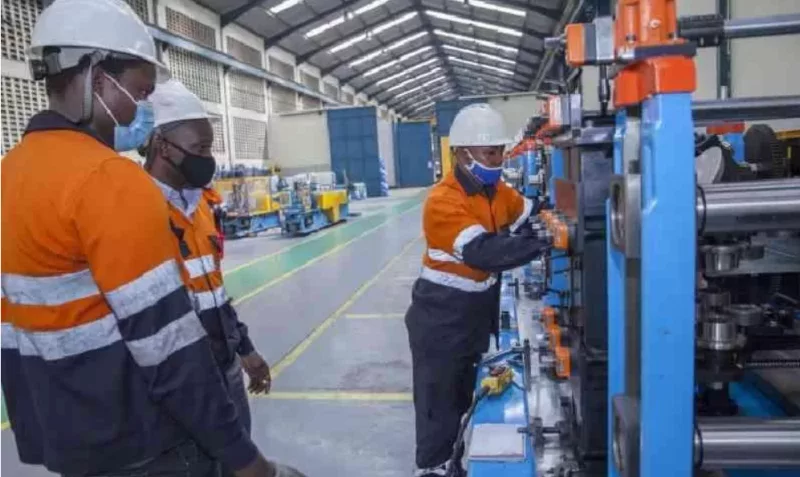
East African manufacturers, including Kenya, are operating below capacity and postponing investments amid shortages of raw materials, expensive financing and inconsistent trade policies, a regional study now indicates.
This is threatening the region’s efforts to expand industrial production and reduce import dependence.
A survey by the East African Business Council (EABC) backed by the African Development Bank (AfDB) found that 79 per cent of surveyed firms were operating below 75 per cent of their production capacity, while 67 per cent had delayed investments.
The findings highlight the gap between East Africa’s agricultural and livestock resources and its ability to process them into higher-value manufactured goods, particularly in leather, textiles and edible oils.
About 78 per cent of surveyed firms faced technology gaps, while 76 per cent believed they could source more production inputs within the region.
Leather and footwear firms face the greatest capacity constraints, with 86 per cent operating below 75 per cent of capacity.
The study found that 79 per cent of businesses in the sector had postponed or cancelled investments.
In textiles and apparel, 74 per cent of firms operated below the same capacity threshold, while 61 per cent had delayed investments. Among edible-oil manufacturers, 75 per cent operated below 75 per cent of capacity, with 59 per cent postponing or cancelling investments.
The findings point to opportunities to expand regional manufacturing through better access to industrial inputs, affordable financing, modern technology and stronger connections between producers and buyers.
According to EABC executive director Ahmed Farah, the region is losing opportunities to add value to commodities it already produces in substantial quantities.
East Africa produces approximately 370,000 tonnes of hides and skins annually but imported about $566 million (Sh73.3 billion) in footwear, footwear parts and leather goods in 2025.
Exports of hides and semi-processed leather stood at approximately $46 million (Sh6 billion).
In textiles, the region produces about 119,000 tonnes of cotton lint annually but processes only 37 per cent locally.
Imports of textiles, apparel and used clothing reached $3.24 billion (Sh419.8 billion) in 2025, compared with exports of approximately $970 million (Sh125.6 billion).
“The edible-oils sector faces a similar imbalance, with imports of approximately $3.1 billion (Sh401.5 billion) against exports of $1.2 billion (Sh155.4 billion). Regional production meets only about 37 per cent of consumption,” the report indicates.
Confederation of Tanzania Industries Executive director Frank Dafa called for stronger integration of agriculture and livestock production with manufacturing, alongside investment in technology, skills and infrastructure.
He also urged governments to improve coordination in applying the Common External Tariff (CET), rules of origin and duty remission measures, while using public procurement to support regional producers.
EABC–AfDB Project Steering Committee member Sylvester Kazi said regional trade instruments should operate as a coherent system, with evidence-based reviews of exemptions and stronger support for local sourcing.