


Kenya is seeking to shift forestry from mainly a conservation activity to a source of investment, jobs, and economic growth, backed by new climate funding, commercial tree-growing plans, and forest restoration projects.
This follows the country’s approval of $229 million (Sh29.6 billion) in new external finance for forest- and landscape-based economic development.
According to the Forest & Climate Leaders’ Partnership (FCLP) 2026 Forest Finance Roadmap, the funding includes $200 million (Sh25.87 billion) from the World Bank and $29.2 million (Sh3.7 billion) from the Green Climate Fund for Kenya’s Lake Region.
However, experts now argue that the bigger economic question is no longer simply how much money is being committed to forests, but whether Kenya can turn restoration, commercial tree growing and sustainable forestry into a bankable industry capable of generating jobs, supporting farmers, supplying manufacturers and attracting long-term private capital.
That ambition is emerging as the country struggles to translate its 15 billion tree-growing programme into measurable gains in forest cover and plantation output.
The Kenya National Bureau of Statistics’ Economic Survey 2026 shows that the area of newly established forest plantations fell to 4,400 hectares in 2025 from 4,900 hectares a year earlier, while national forest cover remained at 8.8 per cent.
The figures expose the gap between tree-planting campaigns and the more difficult task of establishing commercially productive forests that survive, mature and feed industries.
The FCLP report points to one possible answer, treating forests as part of the wider economic system rather than as an environmental expenditure.
“In parallel, Kenya increased its 2025-26 fiscal year forestry budget by approximately $38.7 million (Sh5 billion) and maintained a higher allocation of about $143.8 million (Sh18.6 billion) for the 2026-27 financial year,” the report says in part.
Its Kenya case study says the Industrial Wood Sector Vision 2050 estimates that the country will ultimately require about Sh176 billion to develop commercial tree growing and wood processing, where Sh134 billion will be for commercial tree growing and Sh42 billion for processing.
The report stresses that this is an investment requirement and prospective pipeline, not money already mobilised.
The vision projects a much larger forestry industry, with GDP contribution potentially rising from about Sh5 billion today to Sh137 billion by 2050 and full-time jobs increasing from 15,000 to 85,000 annually.
It also envisages household participation rising from 2.7 million to 7.5 million growers.
The Ministry of Environment, Climate Change and Forestry has increasingly framed this shift as green industrialisation.
The Industrial Wood Sector Vision says private-sector investment in more productive plantations and efficient processing will be central to achieving the projected growth.
It also proposes public-private partnerships around public plantations, greater integration of smallholder growers into formal markets and new financing mechanisms to unlock investment along the wood value chain.
This changes the economic proposition of tree growing.
The report envisions that a farmer planting trees is not simply providing an environmental service, but that those trees can eventually become timber, poles, furniture, construction materials, biomass, fibre and other industrial inputs.
The report says that around the farm, tree nurseries can become businesses, while seed collection, planting, pruning, harvesting, transport, sawmilling, furniture manufacturing and construction can create additional employment.
Principal Secretary in the State Department for Forestry Gitonga Mugambi is already calling for stronger collaboration between government, private investors, researchers and communities to develop Kenya’s forestry value chain.
He argues that investment, research, supportive policies and market development would be necessary to turn forests and bamboo into a competitive source of jobs and green growth.
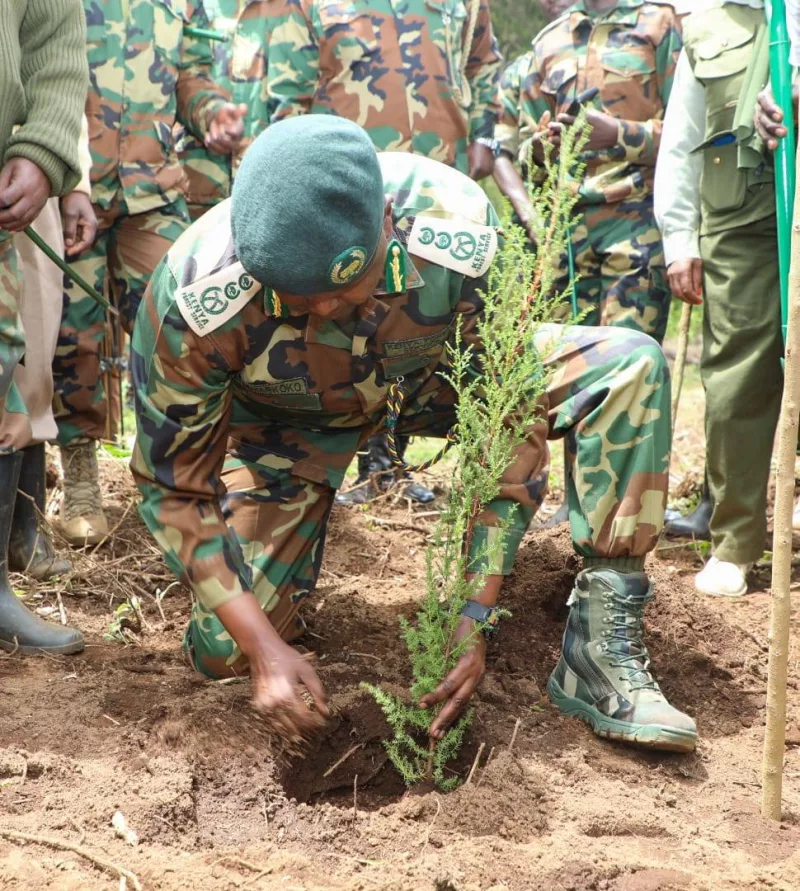
“Kenya has planted more than one billion trees in two years, compared with 38 million during the previous administration. We have the infrastructure, trained personnel and community support to accelerate progress towards the 15 billion trees target,” Mugambi said.
Kenya had earlier in the year launched the National Commercial Forestry Strategy 2025-2035, which seeks to expand climate-smart plantations on public, communal and private land, develop high-value wood and non-wood products, strengthen value addition and certification, and attract investment into the sector.
The strategy is particularly significant for dryland Kenya, where commercial forestry is increasingly being viewed alongside restoration rather than as a competing use of land.
The ministry has also developed a Sh15 billion portfolio of climate-resilience and forest-restoration projects, including agroforestry and commercial forestry investments across 24 counties.
The projects were presented to potential development partners and investors in July as part of efforts to mobilise capital for restoration and green jobs.
President William Ruto has also increasingly linked environmental restoration to employment and economic development.
In a statement on Kenya’s carbon-market potential, Ruto said expanded carbon markets could generate hundreds of millions of dollars in income and create hundreds of thousands of green jobs, while resources from such markets could support landscape restoration, forest expansion, tree growing and agroforestry.
“We must see in green growth not just a climate imperative but also a fountain of multi-billion-dollar economic opportunities that Africa and the world are primed to capitalise on,” Kenya’s President William Ruto said in his opening speech.
The FCLP report says the global forest-finance system remains heavily dependent on public and development finance, with private capital still needing to be unlocked at a much larger scale.
For sustainable forest bio-economies, at least $1.73 billion was mobilised globally by multilateral development banks, development finance institutions and climate funds in 2025/26, of which $1.16 billion came from private capital.
Certified forest products alone attracted $2.3 billion in private finance in 2023.
For Kenya, the lesson is that public money may need to take the first-loss risk while commercial investors enter later.
The FCLP recommends concessional, catalytic and patient capital, including guarantees and blended finance, to reduce investment risks in restoration, sustainable forestry and forest-based enterprises. It also calls for better infrastructure, skills, processing capacity and traceability.
This is particularly important because forestry has a long investment cycle. A commercial tree farmer cannot expect the same quick returns available from annual crops.
The report says global demand for roundwood could rise by as much as 49 per cent between 2020 and 2050, while growing use of engineered wood in construction could add between 50 million and 250 million cubic metres of annual demand from 2030 to 2070.
At the same time, global planted-forest expansion slowed in 2025, highlighting a potential supply gap.
For Kenya, that could create an opportunity to replace some imported wood products with locally grown and processed timber.
But illegal logging, weak enforcement, fragmented supply chains and inadequate processing infrastructure remain barriers.
The National Crime Research Centre has also identified networks involving individuals, businesses, officials and middlemen as part of the forest-crime economy.