


Police and multi-agency officers have raided an alleged illegal donkey slaughterhouse operating from a warehouse in Kalimoni Ward, Juja Sub-County, Kiambu County.
The raid was conducted on Wednesday, September 23, 2026, following reports of donkey carcasses being dumped at various locations within Juja.
This gave an indication that some of the meat being consumed in the area and far apart could be of donkeys.
A multi-agency team comprising officers from the National Police Service, National Government Administration Officers and Kiambu County Government raided the premises after receiving actionable intelligence.
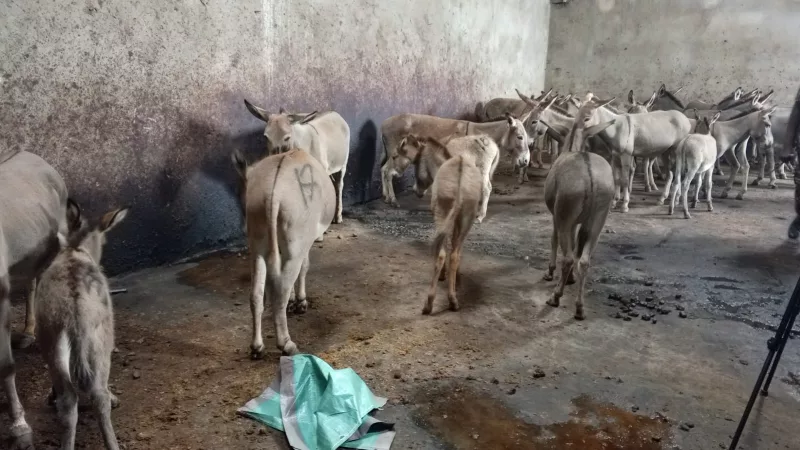
Inside the gated compound, measuring approximately 50 by 70 feet, officers discovered 30 live donkeys of different ages kept inside a two-storey building.
The animals were reportedly in poor condition and appeared to have been deprived of food, raising suspicions that they were being prepared for slaughter later that night.
Police also recovered several blood-stained knives and clothing, sacks containing donkey slaughter waste, polythene bags similar to those allegedly used to dispose of donkey waste and carcasses, and waterproof paper bags suspected to have been intended for packaging donkey meat.
A jerrycan containing sulphuric acid was also found at the premises. Investigators suspect the chemical may have been used to suppress the smell of meat and slaughter waste.
No suspect was found at the premises during the raid. However, a neighbour told officers that activities at the compound were usually heard at night, approximately once a week.
Police and county authorities have launched efforts to identify and apprehend the proprietor of the facility and other individuals suspected to be involved in the alleged illegal slaughter and meat trade.
The 30 live donkeys were rescued and moved to a nearby private farm, where they will be fed and kept safely as authorities make arrangements for their disposal.
Crime scene investigation officers from Juja processed and documented the scene as investigations continue.
Monitoring of the area and efforts to identify those behind the suspected illegal slaughter operation are ongoing, officials said on Thursday.
Donkey meat is not illegal in Kenya. Kenya’s population of donkeys is under threat after the High Court lifted a 2020 ban on donkey slaughterhouses, allowing them to resume selling the meat and hides to Asian markets.
A new study on the theft and illegal trade in donkeys and donkey products has called for sweeping legal, policy and enforcement reforms, warning that Kenya risks losing its donkey population unless authorities dismantle organised criminal networks behind the illicit trade.
The report recommended coordinated action by government agencies, law enforcement, prosecutors, border control authorities and civil society to curb what it describes as an increasingly sophisticated criminal enterprise.
The study found that criminal syndicates driven by high international demand for donkey hides operate through clandestine slaughterhouses and cross-border smuggling networks that circumvent veterinary inspections and leather industry regulations.
Researchers warn that the illicit trade has contributed to a sharp decline in Kenya’s donkey population, which fell from 1.8 million in 2009 to 1.1 million in 2019, depriving rural households of an essential source of transport, farm labour and income.
The research sought to examine the current patterns of donkey theft and illegal trade, understand the criminal networks behind the business, assess its socio-economic impacts and evaluate the effectiveness of existing interventions aimed at curbing the vice.
The National Crime Research Centre (NCRC) launched the landmark report detailing the extent of theft and illegal trade in donkey skins and related products in Kenya, shedding light on what it describes as an emerging security and socio-economic challenge.
The report, titled Theft and Illegal Trade in Donkey Skins and Related Products in Kenya, is the first comprehensive national study examining the scale, drivers and impacts of donkey theft and the illicit trade in donkey skins. According to the NCRC, the findings expose the complex nature of the illegal trade, including the involvement of organised criminal actors, sophisticated supply chain networks and the growing threat posed by transnational organised crime.
The study urged the Ministry of Agriculture and Livestock Development, the Directorate of Veterinary Services and county governments to enact a comprehensive Donkey Protection Law that would regulate the entire donkey value chain, strengthen animal welfare and introduce specific offences and tougher penalties for donkey theft and illegal slaughter.
Researchers also recommend declaring donkeys a threatened livestock species and fully implementing the African Union moratorium on donkey slaughter for skins by shutting down illegal slaughter operations and tightening regulatory oversight.
The report further proposed the introduction of a national donkey identification and traceability system, backed by stricter livestock movement controls, verified certificates of origin, rescue centres and holding grounds for recovered animals.
To reduce reliance on slaughter, the study encouraged investment in sustainable donkey-based enterprises such as milk production and other non-extractive value chains. It also calls for closer collaboration among East African Community member states to tackle cross-border trafficking and links between donkey theft, wildlife crime and the bushmeat trade.
Other recommendations include digitising livestock movement permits, introducing mandatory clearance for inter-county donkey transport and increasing inspections of slaughterhouses, meat processors and hide collection centres to improve traceability.
The report urged the Ministry of Interior, the National Police Service (NPS) and the Directorate of Criminal Investigations (DCI) to formally recognise donkey theft and illegal bush slaughter as emerging forms of organised crime. It recommended adopting a Rapid Response Initiative model involving police, veterinary and public health officials to coordinate investigations and emergency responses.
Researchers also wanted donkey theft recorded alongside cattle rustling in official crime statistics to improve monitoring and resource allocation.
The study advocates intelligence-led investigations targeting entire criminal syndicates—including financiers, brokers and transporters—rather than focusing solely on low-level offenders.
It further recommended expanding public awareness campaigns through village barazas, community policing forums and security meetings while strengthening anti-corruption measures at roadblocks and transit checkpoints through digital surveillance and stricter internal oversight.