
The latest controversy began with a presidential directive that triggered anxiety among thousands of Burundian nationals, many of whom camped at the Burundi High Commission seeking clarity and intervention from their government.
Some of the President’s own public statements have since triggered confusion, forcing government officials into damage-control mode.
It started with what appeared to be a routine State House meeting with a delegation of small-scale traders who had gone to present their grievances against the Kenya Revenue Authority.
The traders had earlier taken to the streets to protest the increase in the minimum tax benchmark for consolidated cargo imports from Ksh.2.5 million to Ksh.3.2 million.
At State House, President Ruto yielded to their demands.
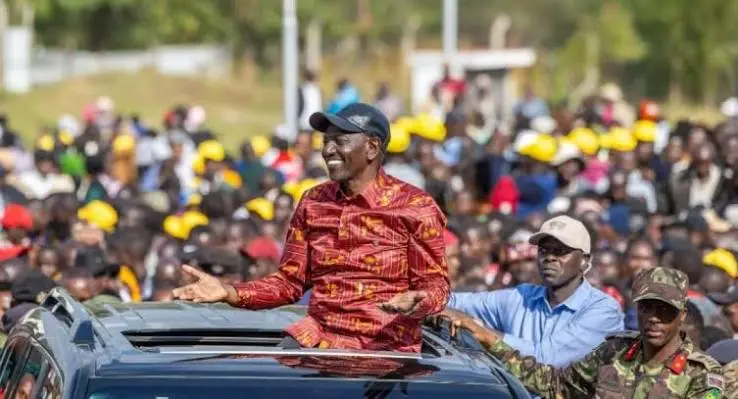
“It will not even be Ksh.2.5 million. It will be Ksh.2 million,” President Ruto stated.
But in what appeared to be a separate and unexpected directive, the President made another pronouncement.
“By Monday next week, those businesses should be closed,” he remarked.
The statement triggered panic among foreign traders, many of them Burundian nationals, who feared for their businesses and safety.
Government officials subsequently scrambled to contain the situation, with the government spokesperson urging foreign nationals, particularly Burundians living in Kenya, to register their identities with their respective embassies.
Trade Cabinet Secretary Lee Kinyanjui also warned Kenyans against xenophobic behaviour, while Foreign Affairs Principal Secretary Korir Sing’Oei sought to reassure the Burundian community in Kenya.
What had begun as a presidential pronouncement had evolved into a diplomatic and communication crisis.
State House spokesperson Hussein Mohammed later issued a statement giving foreign nationals from East African Community countries 90 days to regularise their presence in the country.
The government has also faced questions over university funding.
In July, President Ruto announced that all university students who qualified for funding would be supported.
“All students who qualify will be funded,” President Ruto stated.
While some interpreted the statement to mean that university education would be fully funded, the government later clarified that a new law was being developed to provide a framework for university funding.
However, the proposed legislation raised further concerns, with questions emerging over whether it could shift a greater financial burden onto students through increased reliance on loans.
As the new academic year began, some first-year students were left stranded and uncertain about how their education would be financed, with the government initially explaining that it was waiting for the new law to provide guidance.
“We are waiting for the law,” Dr. Beatrice Inyangala, Principal Secretary for Higher Education, stated.
The government later reversed its apparent policy position.
“Learners will continue being funded based on the current framework,” Education Cabinet Secretary Migos Ogamba stated.
The President’s public pronouncements have also triggered questions over the future of Tata Chemicals Magadi.
During a visit to Magadi in Kajiado County, President Ruto declared that the company should leave.
“The people of Magadi must leave,” Ruto stated, referring to the company.
The debate subsequently evolved from concerns over the benefits accruing to the local community to questions surrounding historical land ownership and the occupation of 240,000 acres of land. It later shifted to Kenya’s continued export of raw materials without local value addition.
As questions mounted over the government’s position, Mining Cabinet Secretary Hassan Joho moved to explain the issues surrounding the company’s operations.
“They have not paid Ksh.1 billion to the community and Ksh.17 billion to the county,” Joho explained.
A company that had initially been ordered to leave was later reported to be engaging with the government, prompting the Mining CS to issue a statement clarifying the situation.
The developments come just weeks after Head of Public Service Felix Koskei issued a circular to Cabinet Secretaries, Principal Secretaries and government entities raising concerns over weaknesses in government communication.
Koskei noted that the government had remained largely reactive and, at times, issued conflicting narratives that had contributed to an erosion of public trust.
He also cited notable gaps in crisis communication and subsequently announced the establishment of the National Crisis Communication Standing Committee.
For now, however, the government continues to confront crisis after crisis, with questions persisting over whether clearer communication at the point of decision-making could prevent controversies that later require intervention from the very office where they began.