



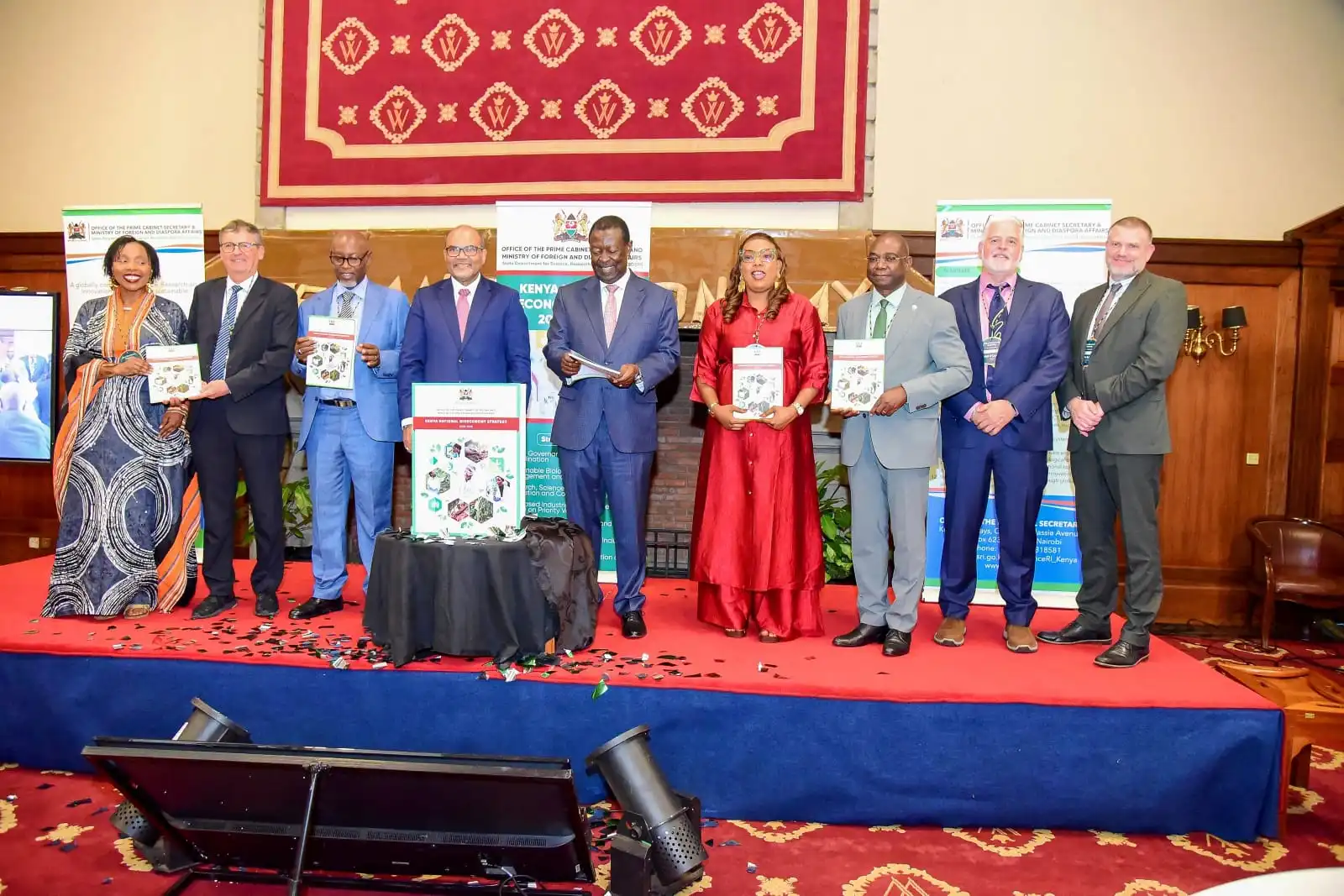
Kenya is turning to the bioeconomy to reduce reliance on imported food, cut post-harvest losses and create new opportunities from biological resources, State Department for Science, Research and Innovation Principal Secretary Prof Shaukat Abdulrazak has said.
Abdulrazak said the government plans to apply biofertilisers, bioengineering, bioinformatics, biogenomics and emerging technologies such as artificial intelligence across agriculture and other sectors to raise productivity and make better use of nutrients and water.
“Under the bio-economy we will be using the nutrients more effectively and efficiently. It could be a fertiliser, it could be water and we’ll be looking at specific technologies so that we can be able to maximise productivity of food as well as we are managing post-harvest losses,” he said.
He said one of the government’s objectives was to move away from food imports by strengthening local production and value addition.
“The expectation is basically to move from importation of food to be able to produce ourselves and be able to add value,” Abdulrazak said.
His remarks came during the launch of Kenya’s National Bioeconomy Strategy 2026–2036 in Nairobi, a 10-year framework aimed at using biological resources, research and innovation to develop new products, businesses and industries.
The launch was attended by government officials, researchers, private-sector representatives and development partners and was supported by the International Centre of Insect Physiology and Ecology (icipe) in partnership with the government and other regional and research institutions.
From raw materials to industries
Prime Cabinet Secretary Musalia Mudavadi, who launched the strategy, said Kenya needed to move beyond producing and exporting biological resources in their raw form.
He said the country should instead use science, technology and innovation to develop products that can compete in regional and international markets.
“Our mission must be to increase domestic value addition, develop competitive bio-based products and industries, commercialize innovations, and support enterprises that are capable of competing successfully in regional and global markets,” Mudavadi said.
He said Kenya has several advantages for developing the sector, including its biological diversity, agricultural production, scientific and research capacity, youthful population and growing innovation ecosystem.
Mudavadi said the strategy could also respond to challenges including unemployment, economic volatility, exposure to external trade shocks and climate change.
The strategy cuts across agriculture, manufacturing, healthcare, energy, biotechnology and other areas where biological materials and scientific knowledge can be converted into products and services.
A continent sitting on biomass
The opportunity extends beyond Kenya, with icipe Director General Dr Abdou Tenkouano saying agriculture generates significant amounts of biomass across Africa that could provide raw materials for new industries.
Tenkouano said agriculture contributes between 23 per cent and 35 per cent of GDP in many sub-Saharan African countries.
“At its core, the bioeconomy uses scientific knowledge and innovation to transform biological resources into economic and social benefits in a sustainable way,” he said.
He said processing biomass and strengthening supply chains could create opportunities in food systems, sustainable construction, biobased chemicals, biopharmaceuticals and biopackaging.
The approach, he said, could also support distributed manufacturing, allowing production to take place closer to where biological resources are generated.
Tenkouano said East Africa was already moving towards a regional bioeconomy framework, with the East African Community adopting its regional strategy in 2022.
He said the strategy focuses on food security, health and wellbeing, bioenergy and sustainable industries.
Kenya’s new national strategy makes it the fourth African country with a dedicated national bioeconomy strategy, after Ethiopia, Namibia and South Africa, according to Tenkouano.
When banana waste becomes a product
One of the examples raised during the discussions was how agricultural waste can be converted into products with commercial and social value.
Stockholm Environment Institute Director Niall O’Connor cited research into banana fibre and leaves being used to produce sanitary towels.
“One was looking at banana fibre leaves for sanitary towels. That’s a product that many people don’t have access to, it’s costly, but now suddenly we can make it locally at affordable prices,” O’Connor said.
He said such innovations illustrate how research can identify alternative uses for materials that would otherwise be discarded while creating businesses around locally available resources.
O’Connor said the focus should be on taking promising ideas from research and helping them reach markets.
“We want to look at that type of research, how can we support ideas to develop into profitable jobs, how do we support ideas to look at markets, scale up and how can they sell not just locally but nationally in Kenya, maybe regionally also?” he said.
He said adding value to resources could also improve returns for farmers.
“This is the potential to give better income to them because we’re using their resources, adding value to their resources, not just extracting their resources,” he said.
The financing gap
The transition from research and innovation to commercial businesses could, however, depend on whether entrepreneurs and farmers can access finance.
O’Connor said banks would need to reconsider conventional lending models, particularly when dealing with smallholder farmers and emerging bioeconomy enterprises.
“We’ve got to look at ways of particularly working with banks to make them think beyond the current approaches, how do they work with smallholders, how do they de-risk investments to smallholders to encourage that whole sector to develop?” he said.
He said successful case studies and evidence could help demonstrate the commercial potential of the sector and attract more private investment.
O’Connor also called for greater mobilisation of capital within Kenya and Africa so that more of the profits generated from bioeconomy activities remain on the continent.
Mudavadi said the government intends to progressively increase investment in research and development towards two per cent of GDP.
He said public investment should help attract private capital and strategic partnerships, while an investment and financing roadmap would help identify viable opportunities and connect enterprises with appropriate funding.
A jobs pipeline for young people
Job creation is another major part of the strategy, with Abdulrazak saying the government wants to connect research institutions, universities and industry more closely to commercial opportunities.
“The bottom line is, how can we use bioeconomy to create more jobs, opportunities for our youth? How can we be able to create more wealth as well?” he said.
Abdulrazak said the government was targeting a Sh100 billion bioeconomy programme and working towards a broader institutional framework to support research, innovation and commercialisation.
He said the Bio Kenya project, supported by the European Union, was being developed towards a centre of excellence, with longer-term plans for a bioeconomy institute and a bioeconomy university linked to research institutions.
Tenkouano also called for stronger university-industry partnerships, saying innovation and entrepreneurship should create opportunities for young people while supporting income generation for families.
He said African countries also needed greater cooperation in financing, research, education, training and standards to build the sector.
Mudavadi said the government would judge the strategy by its economic outcomes, including the number of businesses established, innovations commercialised, investments mobilised, value chains strengthened and jobs created.
“The success of this strategy will ultimately be measured by the businesses established, the innovations commercialised, the investments mobilised, the value chains strengthened, and most importantly, the jobs and livelihoods created for Kenyans,” he said.
The strategy also places Kenya within a wider African push to develop bioeconomy industries, with Tenkouano saying the continent’s regional strategies and national plans would provide a basis for expanding markets, research collaboration and value chains.