

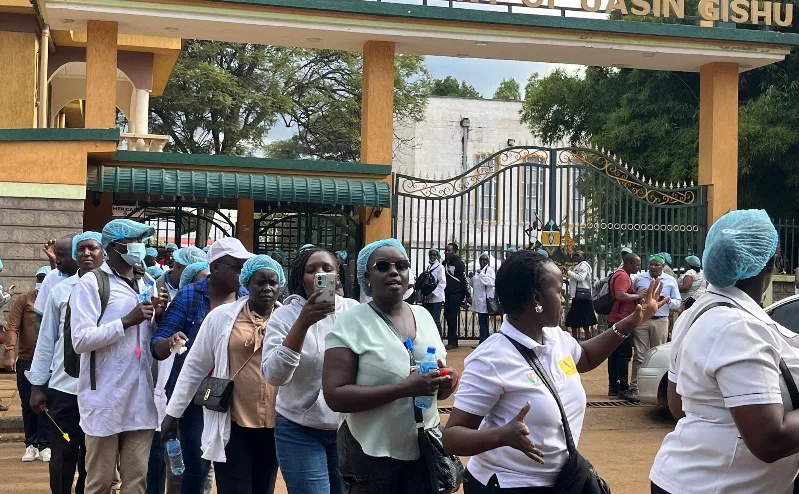
Uasin Gishu Governor Jonathan Bii has snubbed striking health workers who stormed the county offices demanding he address their grievances.
The workers on Wednesday stormed the county headquarters for the third time and blocked the main entrance for more than an hour, but neither Bii nor his health executive Janet Kurgat was available to address them.
Bii and Kurgat also did not respond to calls from the Star seeking comment on the health workers’ strike, which has paralysed operations at all 138 health facilities in the county.
The workers were led by union officials, including David Martin, Dennis Cheruiyot and Richard Korir, who urged the governor to stop snubbing them as patients suffer without medication at county hospitals.
“Other counties are making efforts to resolve issues raised by health workers, but Bii and his team have refused to meet us so that we discuss the issues we have,” Cheruiyot said.
He said the workers would remain on the streets for as long as it takes until the county government yields to their demands.
The strike has entered its fourth week, disrupting hospital services across the North Rift as nurses, clinical officers and laboratory technicians remain off duty.
Moi Teaching and Referral Hospital has recorded an increased number of patients as county hospitals in Uasin Gishu, Nandi, Trans Nzoia, Elgeyo Marakwet and Baringo struggle to provide services.
The unions representing the health workers have threatened to extend the industrial action to private hospitals this week if county governments fail to resolve their grievances.
The threat came as bishops and Muslim religious leaders urged the government to urgently intervene and end the strike, saying the dispute was putting patients’ lives at risk.
The religious leaders, led by Reverend Thomas Kiptoo and Abubakar Bini, urged the government and health workers to return to the negotiating table.
“Health is a very critical sector concerning lives, and the government should have stopped everything to deal with this matter,” Bini said.
He said resources being spent on non-core operations should instead be directed towards resolving the grievances raised by the health workers.
The unions have cited several unresolved issues, including the delayed conclusion of the 2025–29 collective bargaining agreement, implementation of the 2017 return-to-work agreement and absorption of universal health coverage workers into permanent and pensionable terms.
Delayed promotions and failure to remit statutory deductions are also among the issues raised by the unions.
Kenya National Union of Nurses official Kevin Kimutai and Kenya Union of Clinical Officers official Xavious Wamalwa have vowed that the workers will not return to duty until their grievances are addressed.
The unions are also engaging their colleagues in the private sector in a bid to broaden the strike.
“We are talking to our colleagues in the private sector so that we join hands to push for our demands and rights aimed at improving health services,” Wamalwa said.
Kimutai said nurses remained the backbone of healthcare delivery and warned that hospitals would face even greater disruption if the dispute dragged on.
“We have been negotiating for a long time to avert the strike. We will not resume work until our demands are met,” he said.
“It is our desire as health workers to serve patients without such disruptions, but we cannot do so if our rights are ignored,” he said.
Wamalwa said county governments should sign CBAs with all the unions before healthcare workers could return to duty.