



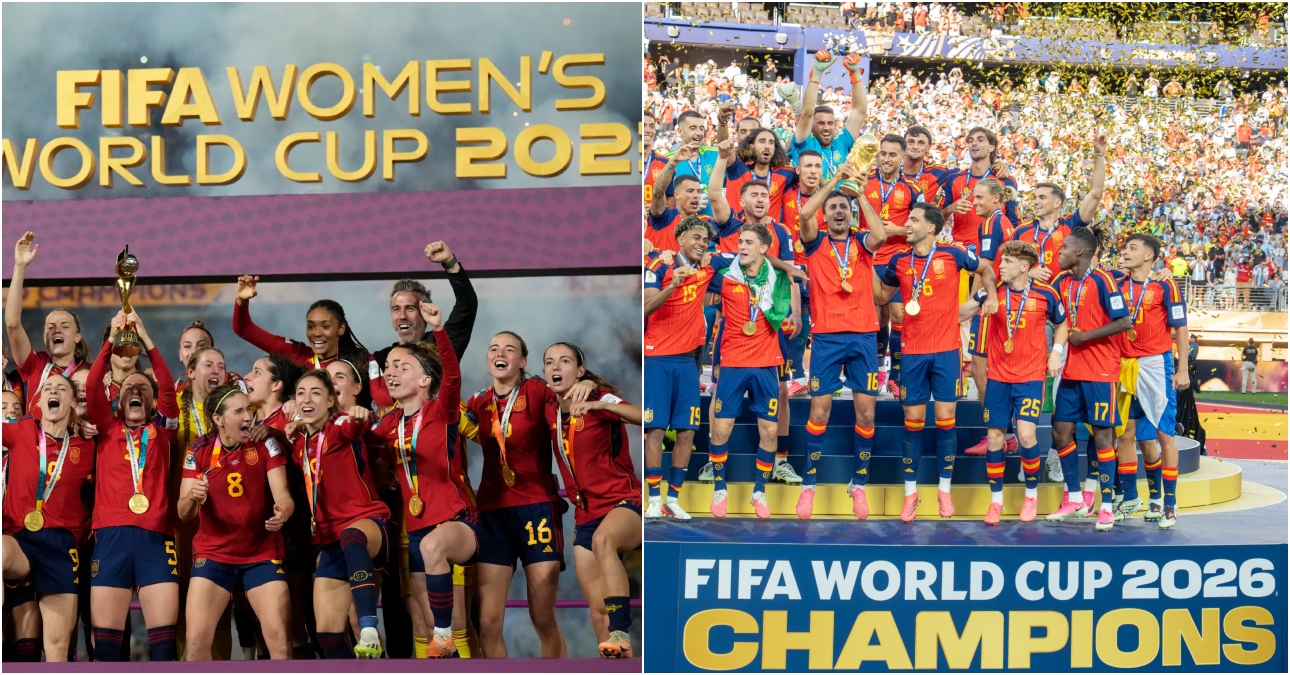
Spain have etched their name into football history after becoming the first nation to simultaneously hold both the FIFA Men’s and FIFA Women’s World Cup titles, cementing their status as the dominant force in the global game.
The achievement follows La Roja’s 1-0 victory over Argentina in the 2026 FIFA World Cup final, adding the men’s crown to the Women’s World Cup title won in Australia and New Zealand in 2023.
The historic feat is the culmination of nearly two decades of investment in player development, coaching and a clearly defined football philosophy.
Spain’s rise began with the men’s golden generation that won UEFA Euro 2008, the 2010 FIFA World Cup and Euro 2012. While that era eventually faded, the country’s football federation continued producing elite talent through renowned academies led by Barcelona’s La Masia and Real Madrid’s youth system.
The women’s game has experienced a similar transformation. Spain lifted its maiden FIFA Women’s World Cup in 2023 after defeating England 1-0, becoming only the second nation after Germany to have won both the men’s and women’s World Cups.
The victory also came after Spain had already conquered the FIFA U-17 and U-20 Women’s World Cups, highlighting the strength of its development pathway.
Three years later, Luis de la Fuente’s youthful men’s side completed the circle. Led by stars including Lamine Yamal, Nico Williams and Pedri, Spain blended technical brilliance with tactical discipline to overcome defending champions Argentina in the 2026 final.
The triumph also followed their UEFA Euro 2024 success, underlining the consistency of a generation that has quickly become one of the finest in modern football.
Spain’s unprecedented double is more than a statistical milestone. It reflects a footballing model built on continuity, possession-based play and long-term planning qualities that have turned the country into the benchmark for success in both the men’s and women’s game.