

ISUZU East Africa is betting on a Sh3.1 billion Parts Distribution Centre currently under construction in Lukenya, Machakos county, to strengthen its dominance in Kenya’s new vehicle market.
This, as it also pushes to expand its footprint across the East African region.
The automotive assembler and distributor, which commands more than half of Kenya’s new vehicle sales, says the facility will significantly enhance aftersales support, customer service, and spare parts availability, helping it retain market leadership while positioning itself as a regional mobility solutions provider.
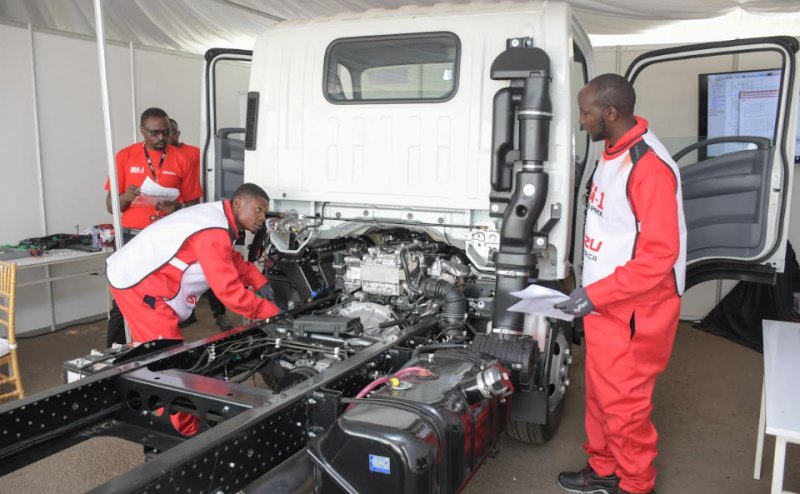
Speaking during the opening of the fourth Isuzu East Africa Grand Prix Technical Competition, managing director Rita Kavashe said the company expects the facility, whose groundbreaking was conducted in August 2025, to be completed by the end of this year.
“The new Parts Distribution Centre is a key milestone in our strategy to expand aftersales support and improve service delivery to our customers across Kenya and beyond,” Kavashe said.
The centre will house trained technicians, advanced vehicle diagnostic tools, and standardised service processes aimed at raising aftersales service standards in the region.
The investment comes as Isuzu continues to dominate Kenya’s new vehicle market amid rising demand for commercial vehicles supported by lower lending rates, infrastructure projects, and growing economic activity.
According to Kenya Motor Industry Association (KMIA) data, new motor vehicle sales rose by 12.2 per cent in the first four months of 2026, with total industry sales increasing to 4,802 units from 4,280 units during a similar period last year.
Isuzu accounted for 2,521 units, up from 2,077 vehicles sold during the same period in 2025, translating to a market share of 53 per cent. CFAO Mobility followed with 1,352 units while Simba Corporation sold 395 vehicles.
Industry players attribute the improved performance to cheaper credit following a series of interest rate cuts by the Central Bank of Kenya.
The benchmark lending rate has fallen from 12 per cent last year to 8.75 per cent, boosting access to vehicle financing and supporting business expansion.
Kavashe said demand for commercial vehicles has remained strong, driven by last-mile distribution, agriculture, construction, retail trade, and government infrastructure projects.
“Demand for medium-duty trucks remains high and the industry has struggled to fully satisfy orders because the order books are full,” she said.
The company is also deepening its local manufacturing strategy. In November 2025, Isuzu East Africa completed localization of the mu-X sport utility vehicle, becoming the first assembly plant outside Thailand to produce the model.
Kavashe described the milestone as a significant boost for Kenya’s automotive manufacturing industry, reinforcing the firm’s commitment to local assembly, affordability, and industrial development.
Under its Medium-Term Plan 2026-2030, Isuzu aims to transform itself into a commercial mobility solutions company offering smart and connected transport ecosystems.
“The future of mobility in East Africa will be shaped not only by products and infrastructure, but by skills, technology, partnerships, and local industrial capability,” Kavashe said.
She noted that investments in the Lukenya Parts Distribution Centre, vehicle localisation, technician training, and connected vehicle technologies will strengthen Kenya’s industrialisation agenda while enhancing regional competitiveness and delivering greater value to customers.
by MARTIN MWITA