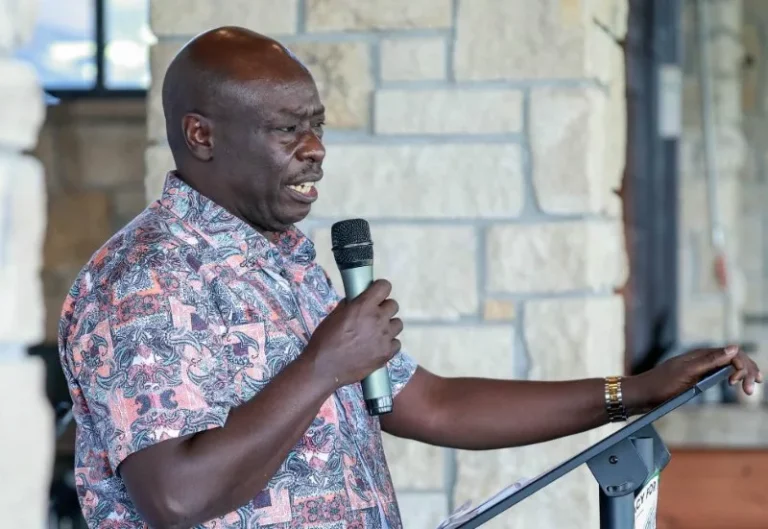



Narok Senator Ledama Olekina has proposed scrapping interest on HELB loans to help young people establish themselves economically after graduation.
Undergraduate and TVET loans issued by the Higher Education Loans Board (HELB) attract a subsidised interest rate of four per cent per annum on the outstanding balance, in addition to an annual ledger fee of Sh1,000.
According to the loans agency, interest on HELB loans begins accruing immediately after the first disbursement for direct-entry undergraduate students, while Jielimishe loan advances for professionals attract an annual interest rate of 10 per cent.
Late or defaulted repayments attract penalties capped at Sh5,000 per month for undergraduate loans and can result in borrowers being listed with the Credit Reference Bureau (CRB).
Olekina argued that the interest burden is weighing heavily on young people, many of whom remain unemployed years after completing their studies.
“We must scrap interest on Helb loans. Our youth deserve opportunity, not debt. When jobs are scarce, imposing a four per cent interest burden is unjust, especially on loans funded by taxpayers. President Ruto must act on this now,” Olekina said in a statement posted on X.
Provisional Helb data contained in the 2026 Economic Survey shows that 340,109 government-sponsored students were placed in universities and TVET institutions during the 2025/26 academic year, against a total university enrolment of 722,485 students.
Of these, 716,417 students received Helb loans amounting to Sh62 billion. A further 4,900 students sponsored themselves at the Open University of Kenya during the same period.
The data also shows that total capitation and loan repayments for the year stood at Sh31.57 billion, down from Sh36.6 billion in 2024/25.
Loan repayments alone fell by 21 per cent to Sh4.1 billion in 2025/26, compared with Sh5.2 billion recovered in the previous financial year.
A key factor behind loan defaults is the high unemployment rate among graduates, which leaves many without a stable income to begin repayment.
Even for those in employment, low entry-level salaries and the rising cost of living make it difficult to set aside money for servicing their loans.
For borrowers who have already fallen behind on repayments, accumulating penalties often make the outstanding balance appear overwhelming.
As a result, some avoid engaging with Helb altogether, mistakenly believing they must clear the entire debt at once.
However, the agency allows defaulters to negotiate flexible and manageable repayment plans.
“The good thing is, as you start paying your loan, the amounts reduce,” Helb says.
Many defaulters welcomed Olekina’s proposal, with some urging him to raise the matter directly with President Ruto.
Several said they had been unable to secure employment years after leaving university.
“Well said. I recently got a text message from Helb asking me to repay my loan. It has been years of struggle to get an income opportunity, so how can one repay a loan without a stable income?” one commenter asked.
“I support this 100 per cent. You can’t tax a broke comrade whose chances of getting a job are not guaranteed. Helb loans should be interest-free,” another wrote.
“I stayed without formal employment for three years. The interest and fines Helb charged me are almost equal to what I borrowed. Now I am paying nearly double,” another said.
“Also, PSC jobs shouldn’t require Helb clearance from people who have never been employed and are trying to get jobs,” another observed.
Others proposed consolidating all bursary and student loan funds into a single education financing kitty to make higher education accessible to all.
Some challenged Olekina to rally his colleagues in the Senate to use their legislative powers to push through reforms.
Early this month, Embakasi East MP Babu Owino said he had fronted a bill to scrap Helb loan interest, arguing that education is the government’s responsibility.
“Helb interest should be scrapped off because the government’s role is to educate you, but the government gives you a loan. So, who should educate whom?” he posed.
“The government should educate you, not your parents,” Babu said on May 4.