



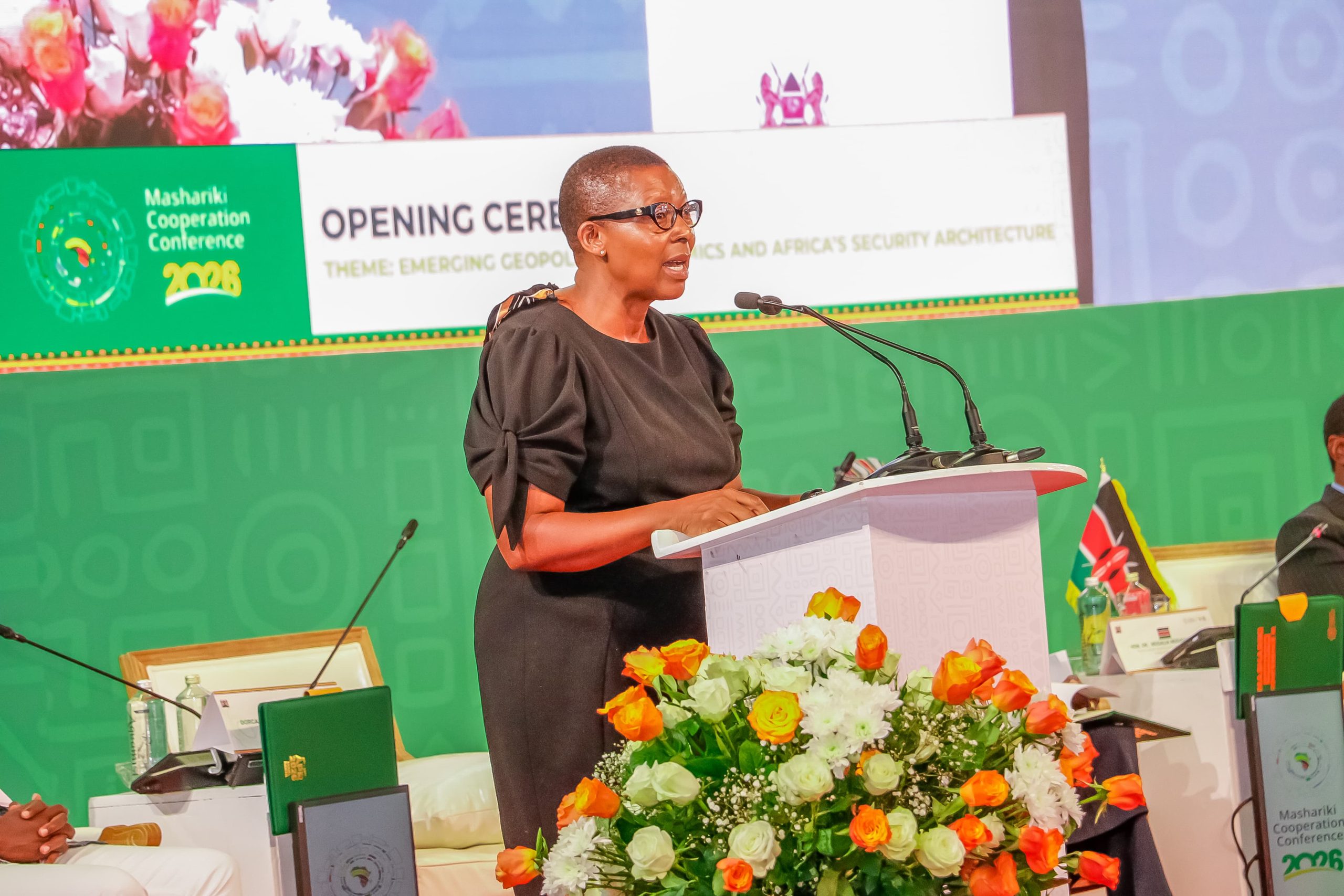
There is a nexus between security and the rule of law, something that creates legitimacy when securing a country, Attorney General Dorcas Oduor said on Thursday.
This, she said, is why security agencies in the country are guided by the constitution.
Oduor said for successful security operations, the rule of law must fully be observed.
She spoke during the opening ceremony of the third edition of the Mashariki Cooperation Conference in Diani, Kwale county.
Oduor said without the rule of law, security operations lack legitimacy, thus lack public trust.
Intelligence today, she noted, is not just about monitoring enemies.
It includes understanding the socioeconomic pressures that lead to instability.
“I wish to emphasise a dimension of this challenge that often lacks attention: the centrality of law, legal institutions and the rule of law to Africa’s security architecture,” Oduor said.
She said security is not only a matter of tools and equipment.
“It is, at its foundation, a matter of governments. It is a matter of constitutions that constrain power and protects rights,” the AG said.
“The rule of law is not a constraint for security. It is the foundation on which legitimate and a lasting security is built.”
She said when institutions act outside the law, they risk generating the mistrust that undermines national cohesion.
“In Kenya, we believe security and the law must work together. Our security agencies do not operate in a vacuum. They are guided by the constitution and laws like the National Intelligence Service Act,” Oduor said.
This, she said, gives security officers the power to protect the nation while respecting citizens’ rights.
The aim is to ensure the legal system is faster and smarter than those who seek to break it.
“Adequacy is measured by agility. We must move beyond group compliance to operational effectiveness,” Oduor said, adding that the pursuit of peace must never cost the country the constitution.
She said her office offers legal advice ensuring operations align with national laws and international obligations.
“The Office of the Attorney General is the gatekeeper of legitimacy,” the AG said.
Just like no nation is an island of safety in an ocean of instability, silos are the greatest allies of the country’s enemies, Oduor noted.
She said although there is cooperation among security agencies and other institutions in Kenya, domestic synergy alone is insufficient because modern threats like cyber warfare and transnational organised crime ignore borders.
“Our response must equally be borderless. We must work towards a synchronised African security architecture where information sharing is governed by formalised legal protocols and legal systems,” the AG said.
She said Africa must engage international partners from a position of unity and principled self-determination.
“Africa welcomes partnerships, but it must be premised on equality, transparency and respect for African agencies,” Oduor said.
“We should not accept arrangements that weaken our institutions on instrumentalised security cooperation for geopolitical competition on African soil.”
She said Kenya believes in an African-led security architecture, anchored in the rule of law, respectful of democratic governments, financed by African resources and open to principled international partnerships.
Oduor said intelligence is the foresight, but the law is the foundation.
“The law transforms information into legitimate action and collaboration transforms individual efforts into continental security architecture,” the AG noted.
Africa, blessed with natural wealth, a youthful population, and immense strategic significance, finds itself at the centre of intensifying global competition.
“This competition brings opportunity but also the risk of fragmentation and external dependency,” Oduor said.
“We are witnessing shifting alignment, strategic competition, technological disruption and new forms of insecurity that do not respect borders.”
She said the threats confronting Africa are evolving and governments are no longer merely fighting insurgency, but algorithms, asymmetrical influence, while violent extremism that continues to decimate regions, and civil wars that have created catastrophic humanitarian crises.
She said climate-induced displacement today drives geopolitics, water scarcity, food insecurity and global deaths.
“These are no longer territorial concerns. They are pertinent security challenges. When resources are low, fragility increases,” she said.
Prime Cabinet Secretary Musalia Mudavadi said there is a growing need to advance an African identity in the security domain.
Mudavadi said an emerging trend, the privatisation of peace, is dangerous and Africa must not get into that bandwagon.
He said with multilateralism in crisis, transactional approaches to peace and security are emerging manifesting in incentivised peace.
“The pursuit of private gains in peace negotiations and the growing treatment of peace as an economic asset,” Mudavadi said.
“In fact, in some quarters now, it is opined that foreign policy increasingly treats diplomacy as a transaction and sovereignty as a negotiable property.”
He said Africa is witnessing re-armament instead of post-conflict reconstruction that delivers peace dividends intended for economic development of the citizens.
The Foreign Affairs CS said broadly, some diplomacy scholars and commentators contend that traditional diplomacy is gradually being supplanted by deal-making, effectively turning peace into a private enterprise.
Mudavadi said there is a growing trend towards outsourcing of security interventions as demonstrated by the proliferation of private military and security companies, as well as mercenaries on the continent.
“It seems the state may be ceding its monopoly on matters of security,” he said.
He urged security and intelligence experts to act collectively, proactively and preventive, deeply intertwined with justice and human dignity.