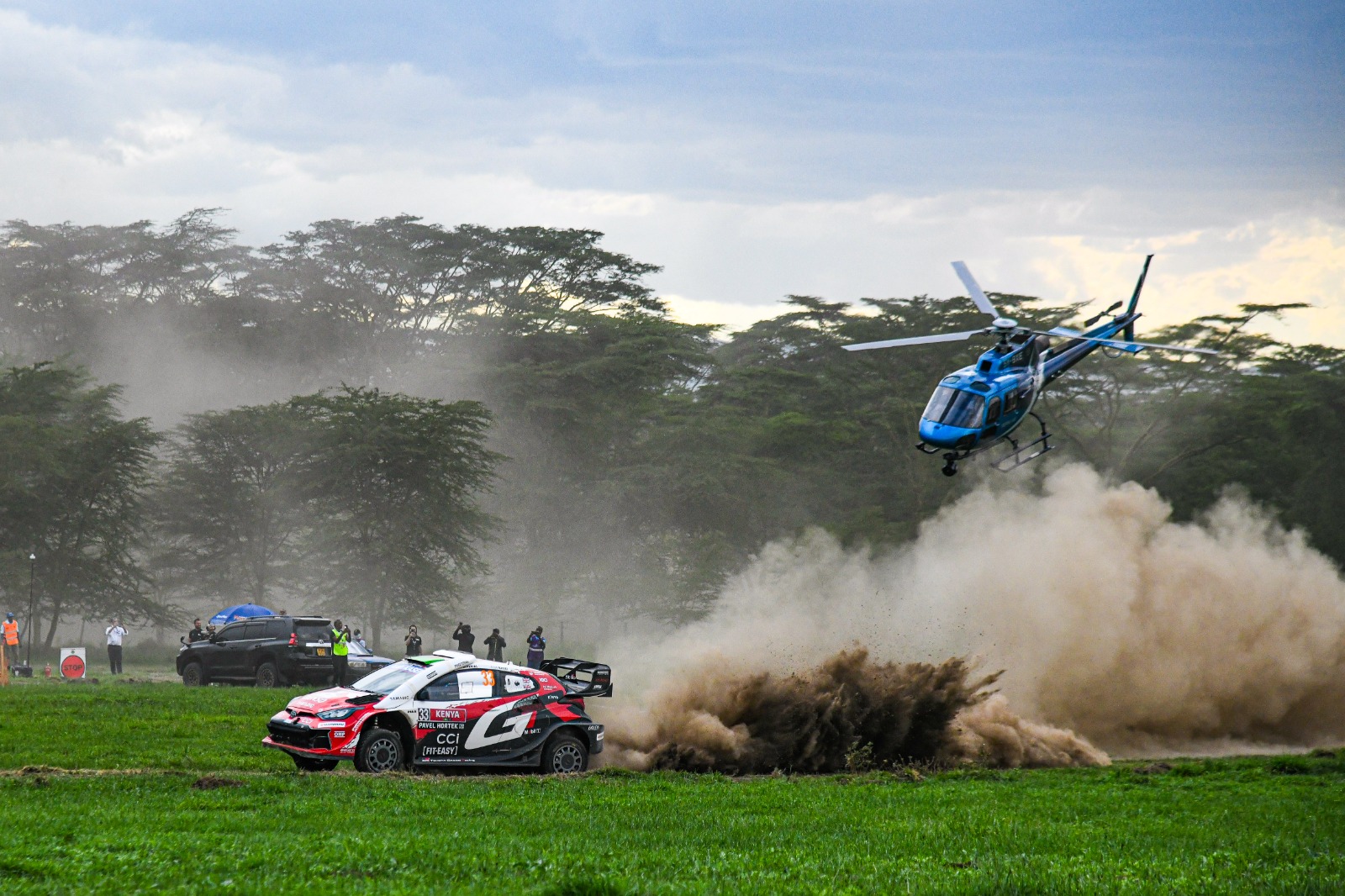
When the Safari Rally roared into life in 1953 as part of the coronation celebrations of Queen Elizabeth II, few could have imagined it would grow into one of the most iconic and unforgiving spectacles in global motorsport.
Known at the time as the East African Coronation Safari, the inaugural edition stretched a staggering 5,160 kilometres across Kenya, Uganda and Tanganyika, now Tanzania.
Fifty-seven local crews took part, piloting what were considered the world’s finest machines: Volkswagen Beetles, Tatra T-600s, Ford Zephyrs and Mercedes-Benz 170s.
It was less a race than an adventure, a test of endurance, patience and resilience.
Alan Dix, navigated by Johnny Larsen, steered a Volkswagen Beetle to victory. From the outset, the Safari was defined not by outright speed, but by survival — of the 57 starters, only 15 made it to the finish, a statistic that would become part of the rally’s enduring folklore.
The rally’s brutal combination of torrential rains, deep mud, searing heat and unpredictable terrain quickly earned it a reputation as the ultimate test of man and machine.
Simply completing the course was considered a badge of honour. By 1956, the event had attracted international crews, including Dutch driver Maurice Gatsonides, drawing global attention to the East African challenge.
A year later, the Safari was officially recognised by the Fédération Internationale de l’Automobile (FIA) and included on its calendar, marking its arrival on the world stage.
To accommodate international competitors, the event was shifted to the Easter weekend, avoiding clashes with European races, a move that further cemented its global appeal.
By 1973, the Safari Rally had earned its place on the newly formed World Rally Championship (WRC) calendar, elevating it into the elite tier of motorsport events.
Kenya’s own Joginder Singh etched his name into history in 1965 as the first local winner, navigating a Volvo PV544 alongside Jaswant Singh.
He would later dominate the WRC-era Safari, claiming victories in 1974 and 1976 in a Mitsubishi Lancer 1600 GSR, performances that immortalised him as one of the rally’s greatest icons.
Tanzania’s Bert Shankland conquered the rally in 1966 and 1967 in a Peugeot 404, highlighting the growing continental footprint of the event. Yet it was not just the winners’ list that defined the Safari; it was the event’s identity.
Legendary Kenyan driver Patrick Njiru, a four-time national champion, recalls the rally as motorsport’s ultimate crown jewel. “There is nothing like the Safari Rally. It is an event every driver wants to win. When I participated in 14 rallies, it felt so great,” Njiru said. “The day I won Group N in the 1990s, it felt as though I was on top of the moon.”
Njiru’s journey mirrors the rally’s grit. At the 1987 Safari, he became the first black driver to finish since 1979, and in 1990, he became the first African to finish in the top 10.
In 1994, he finished fourth overall and won the Group N class in a Subaru Impreza WRX. In its golden age, the Safari stood shoulder to shoulder with Monte Carlo and the RAC Rally, forming the “Big Three” that defined the WRC calendar.
Each had its unique identity: Monte Carlo tested drivers on snow and ice, the RAC Rally challenged them through night-time forests and fog, while the Safari was about exploring raw, untamed Africa.
“We had Monte Carlo, RAC and the Safari Rally, which were historic events in the old WRC calendar with eight rounds,” Njiru recalled.
“RAC was unique in night driving. Safari was unique with our Taita Hills, Kyulu Hills, Cherangani Hills and Aberdares. The terrains varied: clay, mud, black cotton and red soil. It was a pure test of man and machine. Monte Carlo started on snow, then the Safari mud, then RAC night driving with fog lights.”
Faster cars, such as the Lancia Stratos, appeared as early as the mid-1970s, but the Japanese-led technological push of the 1990s, driven by Toyota, Subaru and Mitsubishi, redefined “futuristic” in the context of the Safari.
In 1994, legendary Kenyan driver Ian Duncan claimed victory behind the wheel of a Toyota Celica GT4 Turbo, cementing the era of highly advanced turbo cars.
Duncan emphasised the rally’s gruelling nature: “Safari Rally is not just about speed. You have to look after the car, read the conditions, and be patient because anything can happen. That’s what makes winning it so special.”
In 1996, the rally evolved, shifting from its punishing 5,000km endurance format to a more structured 1,000km-plus special stage layout.
The change allowed faster, lighter cars to push the limits, but the Safari’s DNA remained untouched: unpredictable, punishing, relentless.
Then came the fall. In 2003, at the height of its global appeal, the Safari Rally dropped off the WRC calendar due to financial constraints, a devastating blow that silenced one of the sport’s loudest roars.
What followed was a long, determined road back.
After a 19-year absence, Kenya reclaimed its place on the world stage in 2021, backed by government support, infrastructural upgrades in Naivasha, and strict FIA compliance.
“The Safari Rally is one of the most iconic events in the history of the WRC,” former FIA president Jean Todt said upon its return.
Modern editions have delivered drama in abundance.
The 2026 rally in Naivasha was particularly punishing, with torrential rains turning the course into a battlefield.
A historically high number of punctures and tyre-related issues plagued competitors, driven by intense mud, hidden rocks and exceptionally brutal terrain.
Some of the world’s elite drivers, including the Toyota Gazoo Racing trio of Sébastien Ogier, Elfyn Evans and Oliver Solberg, alongside Hyundai’s Thierry Neuville, were forced to retire, a ruthless reminder that Safari remains the toughest test in rallying.
Amid the chaos, moments of magic endured. Japan’s Takamoto Katsuta finally claimed his maiden WRC victory after years of near misses.
His pursuit began in 2021 when he placed second behind teammate Ogier.
The following season in 2022, he finished third; in 2023, he narrowly missed the podium to finish fourth; and in 2024, he rebounded to second.
The 2025 edition was heartbreakingly cruel, as Katsuta retired after his car rolled on the final stage. His triumph in 2026, clocking a cumulative 3:16:05.6, marked not only his first Safari win but also his first WRC victory in over 90 rallies.
The rally’s unique theatre, with cars tearing through wildlife territory and engines echoing across the savannah, continues to captivate global audiences. Yet the Safari now stands at a crossroads.
The 2026 edition marked the final year of Kenya’s five-year agreement with the WRC Promoter and the end of direct government funding. President William Ruto announced that the State would step back from financing the rally.
“This is the last Safari Rally where we will be spending public money to promote. From next year, this event will be fully funded and supported by the private sector,” he stated.
The announcement ushers in a transition to a commercially driven model while signalling a shift in priorities.
The decision aligns with Kenya’s broader fiscal strategy, as the country grapples with tightening budgets, rising debt obligations and the need to rein in expenditure.
Hosting the Safari Rally has not been cheap, often exceeding Sh400 million annually in promoter fees alone. While the rally remains a powerful driver of tourism, global branding and local economic activity, the government now wants that burden shared or absorbed entirely by corporate/commercial partners.
The timing of the withdrawal, coming as Kenya approaches the final stretch of its WRC contract, raises questions about the rally’s future, even as it offers the opportunity for a self-sustaining, commercially viable model.
Many of the WRC legs continue to enjoy strong government support. Japan’s FORUM8 Rally thrives on national and regional backing, Portugal’s Vodafone Rally de Portugal benefits from state and local investment and rallies in Croatia, Sardinia, the Canary Islands and Sweden rely on public sector support.
In Greece, the historic EKO Acropolis Rally is underpinned by government investment, underscoring the role of government backing in sustaining global rally events.
Last week, the FIA announced the return of the WRC to Scotland from 2027 to 2029 under a three-year agreement, secured by Motorsport UK in partnership with the Scottish government and local councils.
Kenya, meanwhile, has pledged to continue logistical and institutional support even as it withdraws direct funding.
The shift aligns with the WRC’s evolving model, which increasingly favours commercially viable, self-sustaining events over those dependent on public subsidies.
By attracting major corporate sponsors such as KCB Group, SportPesa, and Kenya Airways, the Safari Rally can build a more stable financial ecosystem, reducing vulnerability to government priorities.
Private sector involvement also promises to sharpen the event’s commercial edge, unlocking new revenue streams through enhanced marketing, premium hospitality, and expanded fan engagement.
The WRC Promoter remains keen on extending Kenya’s presence on the calendar beyond 2026.
Ahead of the 2026 rally, Sports Principal Secretary Elijah Mwangi revealed that Kenya was close to securing a fresh five-year agreement.
“We did appoint a negotiation team to engage with the organisers,” Mwangi said. “All indications are that we will secure another five years of hosting the Safari Rally in the WRC.”
Drivers who have competed in Kenya also hope for its return. Ogier described it as “a special event in the championship,” while Neuville called it “very different from what we are used to. You cannot reproduce it elsewhere.”
Katsuta reflected: “Such a tough rally in Safari Rally Kenya 2026. So many moments, but we survived and got our first WRC victory. We keep pushing and improving.”
Four-time world champion Juha Kankkunen added: “The Safari Rally is the toughest rally in the world. You need endurance, patience and a bit of luck to survive.”
Even as boardroom talks gather pace, the rally’s extreme terrain continues to spark debate.
Drivers call for greater technical flexibility to withstand its brutal conditions.
Solberg said: “It’s the toughest, hardest rally — the coolest adventure. Just make the cars a little bit stronger.”
Neuville echoed: “The rally is so extreme and so different. We need special specifications because you cannot prepare a car for just one rally in a championship.”