


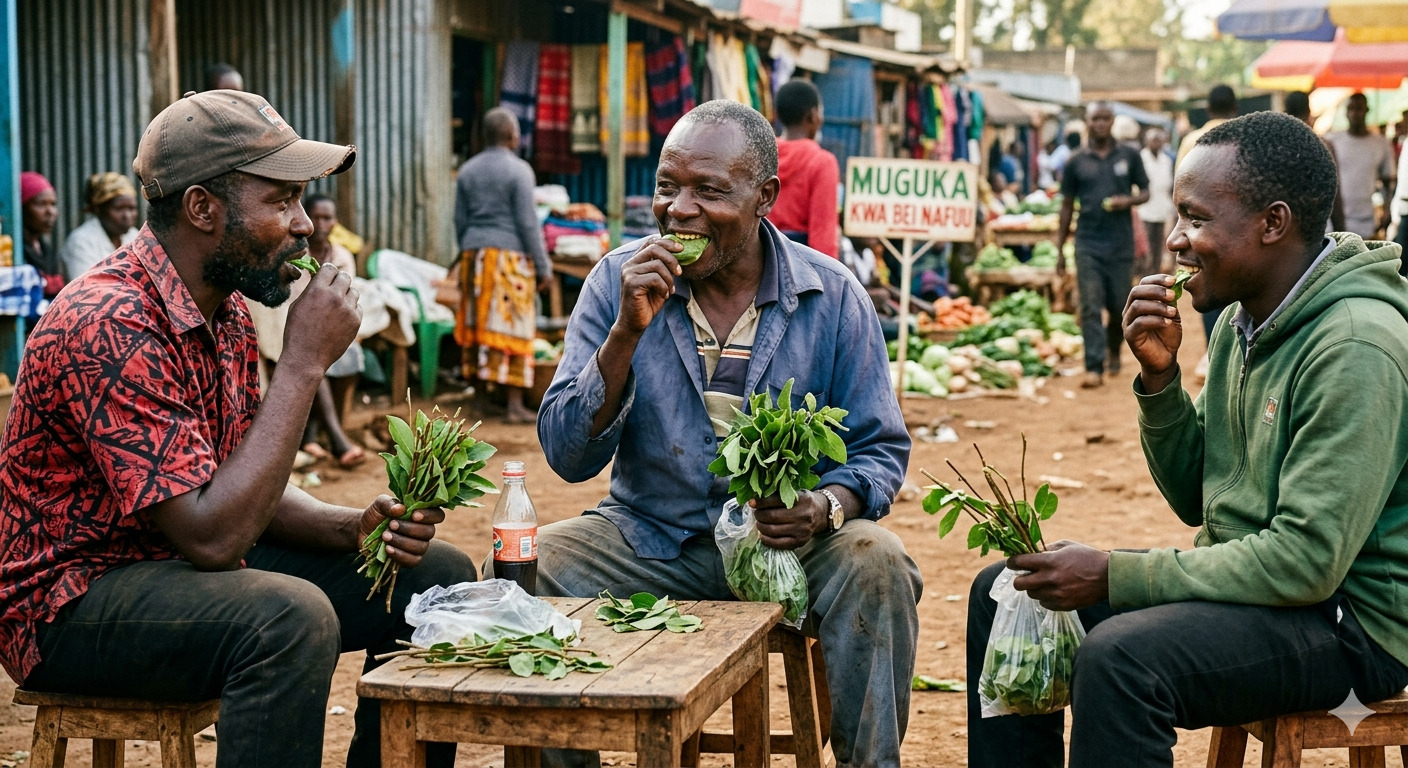
By mid-morning, the wooden benches outside kiosks at Nduluni trading centre in Kitui County are already occupied.
Bundles of fresh muguka lie stacked on wooden counters, their bright green leaves still moist from the morning delivery. Vendors untie sacks and quickly divide the twigs into smaller bundles for sale. The first customers arrive in ones and twos, greeting each other before settling onto the benches.
They pluck the tiny leaves from the twigs and chew slowly.
Hours pass this way.
Some of the men have come from nearby farms. Others step away from boda boda stages or small businesses in the market. Conversations drift between politics, football, and village gossip. A few chew quietly, staring into the distance, while others laugh loudly as the stimulant begins to take hold.
People come and go, but the benches rarely stay empty.
By midday, the Muguka chewing bases are fully alive, and the rhythm continues into the afternoon. For many in the trading centre, muguka chewing has become a normal part of daily life.
Only later in the day does another routine quietly intersect with it.
As the final school bells ring across nearby villages, children begin walking home in small groups along dusty paths that pass through the trading centre. Their uniforms are streaked with the red soil of thethe dry semi-arid Kitui, and their schoolbags hang heavy with exercise books.
Some quicken their pace as they pass the kiosks. Others glance briefly at the men chewing before continuing down the path toward their homes.
Among them is a 13-year-old girl, Jane Mutheu (not her real name) from Nduluni village.
As she approaches one of the kiosks, she spots her father seated among the men, leaning back on a wooden bench and chewing muguka while listening to a lively conversation.
He does not notice her passing.
She continues down the dusty path towards home.
Growing up around the chewing bases
For Jane, the sight is no longer surprising.
She remembers when afternoons used to feel different.
“When I was younger, my father would come home earlier,” she recalls. “He would ask about school and sometimes help me read.”
Evenings then followed a simple routine. After supper, she would sit with her books while her father checked her homework or asked her questions from her textbooks. If she struggled with something from class, she could ask him to explain.
But over the past few years, Jane says, the pattern began to change.
The muguka bases at the trading centre became busier, and her father started spending more time there with friends and other men from the village.
“When school ends, I walk home hoping someone will be there,” she says. “But many times my father is already at the muguka base.”
When she reaches home, the compound is often quiet.
She begins the household chores immediately. Water must be fetched from a nearby source. Firewood must be arranged for cooking. Sometimes her younger siblings are already waiting for supper while their mother finishes casual work in nearby farms.
Homework comes later, after everything else.
“Sometimes I try to read after cooking,” she says. “But if I don’t understand something, there is no one to ask.”
In the evening, she may pass the trading centre again while running errands.
“I see my father still there with the other men,” Jane says softly. “They are laughing and chewing.”
School levies make the situation even more difficult.
When teachers send pupils home to collect money, she worries about how it will be found.
“My mother tries very hard,” she explains. “But sometimes it is difficult.”
On those evenings, exhaustion replaces homework.
“Sometimes I just cook and sleep,” she says quietly.
Still, she holds firmly to her dream.
“I want to become a nurse one day,” she says. “I want to help people in my community.”
Learning without guidance
In a nearby village, a 14-year-old boy, Paul Mutua (not his real name) describes a similar reality.
He says muguka chewing has become a daily presence in his community. From late morning into the evening, groups of men gather at kiosks and roadside stalls to chew and talk for hours.
“When I get home, my parents sometimes stay out chewing,” Paul says.
Without guidance, schoolwork becomes harder.
“If I have homework, I try to do it myself,” he explains. “But sometimes you need someone older to explain.”
Mathematics assignments are particularly difficult.
“Some questions need someone to show you the method,” he says. “If there is no one, you just leave it.”
He remembers when his father used to help him revise his schoolwork.
“He would ask me questions from my books,” Paul says. “Now it rarely happens.”
School levies also disrupt learning.
“When teachers send us home for money, sometimes I stay away for several days before I can return,” he says.
Missing lessons makes catching up difficult.
“You feel worried because the others have already continued learning,” he says.
Despite the challenges, he remains determined.
“I still want to finish school and get a good job,” he says. “Education is important.”
Teachers seeing the impact.
At Nduluni Comprehensive School, teacher Mutemi Kyalo says the effects of changing family routines are increasingly visible in the classroom.
From his desk at the front of the class, he can often tell which students receive consistent support at home and which ones struggle on their own.
“We are noticing more learners who lack follow-up from home,” he says. “Homework is not supervised, and some parents rarely attend school meetings.”
Over time, the absence of parental engagement begins to affect a student’s confidence.
“The child begins to feel alone in their education journey,” Kyalo explains.
Sometimes the signs appear in declining concentration or unfinished assignments. In other cases, students repeatedly miss lessons after being sent home for unpaid levies.
“Some learners are chased away from school for relatively small amounts of money,” he says. “When that happens several times, the learner begins to disengage.”
A similar pattern is visible at Kitooni Comprehensive School, where teacher Timothy Mitau says many families are struggling with shifting responsibilities at home.
“In many homes, parental responsibility has been left to mothers,” he explains. “We deal with absent fathers while women struggle to support the family.”
School levies often become a major challenge.
“Payment of school levies has become difficult, and some learners are sent home for as little as Sh2,000,” he says.
As the term progresses, the interruptions accumulate.
“Learning becomes a nightmare because the school has to send learners home for PTA money that pays PTA teachers and supports school operations,” he says.
Behind many of these cases, Timothy adds, lies the same quiet reality.
“Many men spend their earnings in muguka bases,” he says. “This has also contributed to the rise of single-parent families in the area.”
Health and social concerns
Health workers say the effects of prolonged muguka consumption are also appearing in clinics.
At Yatta Health Centre, clinical officer Japheth Muli says the stimulant is increasingly linked to medical and social problems.
“Excessive muguka consumption is becoming a social and health concern in our communities,” he says.
Many users spend long hours chewing, which can lead to dependency and reduced productivity.
“We are also seeing health complications such as peptic ulcer disease and dental problems,” he says.
But the broader consequences often appear within families.
“When income and time are spent sustaining the habit, family responsibilities are neglected,” he explains. “Children’s education is often affected.”
Community leaders raise an alarm
Local administrators say the consequences are becoming more visible across villages.
Alice Ndimu, Assistant Chief of Makusya sub-location, says the issue frequently arises in community meetings.
“As the local administration, we are concerned about what Muguka is doing to our families,” she says.
Broken marriages, irresponsible parenting, and children missing school are becoming common concerns.
“When parents prioritise chewing muguka instead of their responsibilities, the whole family suffers,” she says.
Youth drifting toward the trade
Community advocates warn that young people are also being drawn into the muguka economy.
Damaris Simu, an anti-gender-based violence advocate and communications officer at International Solidarity Foundation, says exposure at an early age is normalising the habit.
“Many young people are dropping out of school because they get involved in the muguka trade or begin using it early,” she says.
Teenagers who spend time around chewing bases sometimes begin experimenting with the stimulant themselves.
When young people see adults chewing every day, it shapes what they think adulthood looks like,” she says.
A challenge that calls for policy attention
Education stakeholders say the issue also calls for closer collaboration between communities and government institutions.
Officials at the Ministry of Education have consistently emphasised the importance of parental engagement in improving academic outcomes. Teachers in Kitui say that the message is becoming increasingly urgent in communities where children are navigating school without consistent supervision at home.
“When parental support weakens, the burden shifts entirely to the school,” says Mutemi Kyalo. “But education cannot succeed without the involvement of families.”
Local leaders say the situation also requires attention from the Ministry of Interior and National Administration, which oversees local administration and community governance structures across the country.
Assistant chiefs and village elders often become the first point of contact when social challenges begin affecting households.
In Makusya sublocation, Ndimu says community forums are increasingly discussing awareness campaigns and parental responsibility initiatives aimed at protecting children’s education.
“When children’s learning is affected, it becomes a concern for everyone,” she says.
As evening settles over Nduluni trading centre, the benches outside the kiosks remain crowded.
Fresh bundles of muguka are shared as conversation drifts into the night.
Down the dusty path leading away from the market, the 13-year-old girl sits outside her home under the fading light, her schoolbooks spread beside her.
For a moment, she studies quietly, trying to understand a difficult assignment on her own.
From the trading centre in the distance, the sound of laughter drifts through the evening air.
Between the noise of the chewing bases and the quiet determination of children like her, the future of many families in Kitui is slowly being written.