



Kenya’s private sector now wants the government to fast-track negotiations for a Kenya–United States bilateral trade agreement, saying a long-term deal is critical to safeguard gains made under AGOA.
The call follows the formal signing into law of legislation reauthorising the African Growth and Opportunity Act by US President Donald Trump, extending the preferential trade programme through December 31, 2026, with retroactive effect from September 30, 2025.
US has, however, given strict conditions on eligibility while putting Sub-Saharan countries on notice over corruption and human rights, and opening up markets for US businesses.
US Trade Representative Jamieson Greer on Tuesday said to meet AGOA’s rigorous eligibility requirements, countries must establish or make continual progress toward establishing a market-based economy, the rule of law, political pluralism and the right to due process.
“Additionally, countries must eliminate barriers to U.S. trade and investment, enact policies to reduce poverty, combat corruption and protect human rights,” Greer said.
Industry leaders have welcomed the reprieve but cautioned that the short-term extension underscores the urgency of concluding a permanent trade framework between Nairobi and Washington.
“To compound on the gains made through AGOA and provide a long-term and sustainable framework, we urge the governments of the United States of America and Kenya to conclude negotiations for the Kenya–US bilateral agreement,” Kenya Association of Manufacturers CEO, Tobias Alando, said.
Kenya and US have been negotiating for a bilateral tarade pact since July 2020 but a deal has never been realised mainly as a result of regime changes in both countries.
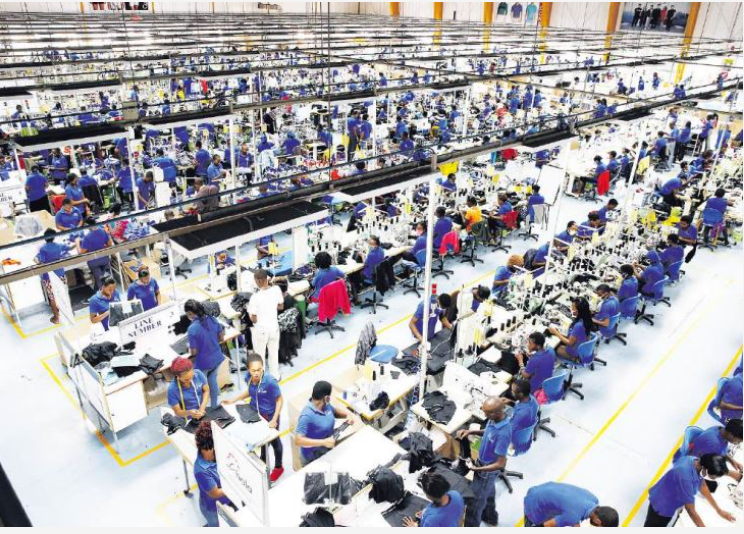
The AGOA extension offers immediate relief to Kenyan exporters, particularly in apparel, textiles and agribusiness, sectors that have relied heavily on duty-free access to the U.S. market.
The Kenya Private Sector Alliance (KEPSA) said the decision protects more than 66,000 direct jobs and hundreds of thousands of livelihoods linked to AGOA-driven value chains.
“The signing of this Act provides the immediate certainty required to maintain investor confidence and protect existing jobs,” KEPSA chief executive Carole Kariuki said.
“While the current extension is shorter than the three years initially passed by Congress, we take note of the U.S. administration’s intent to modernise the programme.”
In 2024, Kenya exported about $470 million (Sh60.8 billion) worth of apparel to the U.S. under AGOA.
Overall exports to the American market stood at $788.6 million (Sh101.8 billion) in 2025, compared to imports of $930.8 million (Sh 120.1 billion) , making the US one of Kenya’s most important trading partners, accounting for roughly nine per cent of the country’s external market.
KAM noted that the extension comes with a renewed spotlight on governance and trade reforms across Sub-Saharan Africa.
“Compliance with AGOA’s rigorous eligibility standards is not optional,” Alando said, “Eliminating trade barriers, fighting corruption and strengthening institutions are essential not just for AGOA, but for Kenya’s broader competitiveness.”
Since its inception in 2000, AGOA has helped integrate African economies into global trade, spurred manufacturing growth and generated foreign exchange.
The private sector argues, however, that periodic renewals create uncertainty. A bilateral trade agreement, they say, would lock in market access, encourage higher-value manufacturing and anchor long-term US investment.
The latest extension follows months of coordinated advocacy by Kenya’s private sector and government, including high-level engagements during the 2025 United Nations General Assembly in New York and the Kenya–US Investment Forum held in September 2025.
KAM and KEPSA have both credited the government, led by President William Ruto, for sustaining diplomatic pressure and advancing trade talks with Washington.
However as the clock ticks toward 2026, business leaders say AGOA has bought Kenya time—but not certainty.
The extension is welcome, Alando said, but a Kenya–US bilateral trade agreement is the only way to secure a predictable, long-term future for exporters, workers and investors on both sides of the Atlantic.
by MARTIN MWITA