


The National Social Security Fund (NSSF) projects a yearly return of 18 per cent over the next 28 years through its stake in the Rironi–Mau Summit Road project.
The road is a key section of the Northern Corridor touted as a transformative artery for regional trade and logistics.
The public retirement scheme’s participation in a Public-Private Partnership (PPP) concession with the China Road and Bridge Corporation (CRBC) is one of the most significant direct infrastructure projects by a Kenyan pension scheme.
The road corridor is being developed and tolled under a model designed to allow investors to recoup costs and realise operating profits through user fees over 28–30 years.
Total revenue projections for the concessionaire run into the hundreds of billions in toll receipts, dwarfing initial construction outlays and signaling lucrative long-term cash flows for equity shareholders, including NSSF.
Speaking during a media roundtable in Nairobi, NSSF revealed that it anticipates a return of 13-15 per cent in dollar form, translating to 18 per cent in local currency terms for 25 per cent equity in the first phase of the road, estimated to cost $743 million (Sh95.8 billion).
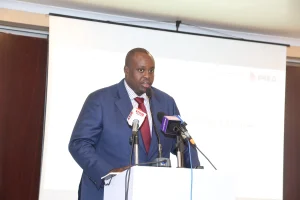
“This project presents a shift towards assets that match our long-duration liabilities — delivering stable, predictable returns while driving national development,” NSSF managing trustee, David Koross, said.
“We are investing in an infrastructure asset class that is expressly allowed under the Retirement Benefits Authority (Investment) Regulations.”
Traditionally, the bulk of NSSF’s nearly Sh558 billion portfolio has been anchored in fixed income instruments — predominantly government securities — and quoted equities, with real estate and other alternatives occupying smaller slices.
According to the RBA, government bonds and related instruments alone can account for more than half of pension scheme allocations, reflecting a conservative bias driven by risk management and liquidity considerations.
In this mix, average returns from bonds and equities typically range from mid-single digits to low-teens annually, with performance heavily influenced by market cycles.
Although billed as safe, government papers often yield less punch than what long-duration infrastructure concessions can potentially offer.
The fund’s investment income and net asset growth for 2025 were bolstered by a rebound in bond and equity markets, underpinning a reported 22 per cent overall return — itself a material uptick from the prior year.
The return rate of 18 per cent will likely outstrip typical returns from the Fund’s core asset classes — and dwarf what more liquid government bonds have historically delivered.
Koross said that the plan to invest in road infrastructure signals willingness by trustees to embrace illiquid, long-term infrastructure risk in exchange for premium yield profiles.
Current pension investment guidelines allow schemes to allocate to infrastructure via specific vehicles and under defined asset ceilings, balancing the pursuit of higher yield with strict safeguards on solvency and member protection.
The RBA’s investment rules prioritise preservation of capital and diversification — mandating maximum exposures to various asset categories and ensuring schemes hold sufficient liquid assets for benefit obligations.
Speaking at a recent media briefing, RBA boss, Charles Machira, said that pension schemes must ensure that any allocation to long-dated infrastructure investments upholds the dual goals of return maximisation and liquidity management to meet member payouts.
For NSSF members — whose contributions have surged following implementation of the NSSF Act and whose assets under management have climbed sharply — the Rironi–Mau Summit Road project represents more than a balance-sheet entry.
Timothy Kisau, an investment manager, told the Star that NSSF’s decision to invest in the road infrastructure epitomises a strategic push to harness domestic capital for growth-oriented, real-asset investments that deliver both economic value and financial return.
Even so, critics have raised concerns about tying workers’ retirement savings to capital-intensive, illiquid infrastructure that may not easily be converted to cash in downturns, or where future traffic patterns — and hence toll revenue — are uncertain.
The Nairobi-Mau Summit highway expansion will be financed through a blended debt-and-equity model involving the National Social Security Fund (NSSF) and two Chinese state-owned firms.
The project will be funded on a 75 per cent debt and 25 per cent equity basis, a structure the government says reflects Kenya’s limited headroom for new public debt and growing reliance on public-private partnerships.
NSSF will contribute 45 per cent of the equity portion (around Sh12 billion) in one phase of the project, partnering with China Road and Bridge Corporation (CRBC).
Initially, it was to give between Sh20 billion and Sh25 billion for the project in the initial plan.
The debt component will be sourced from Chinese commercial banks and state-backed lenders such as the Export-Import Bank of China.
The projectis split into two phases. The first phase will cost Sh111 billion and involves expanding two sections of a 139-kilometre highway from single-lane roads into four- and six-lane dual carriageways.
This phase will be implemented by CRBC in partnership with NSSF. The Chinese firm will construct 81 kilometres between Nairobi and Gilgil via Naivasha, and another 58km through Maai Mahiu
The second phase, valued at Sh87 billion, will be delivered by Shandong Hi-Speed Road and Bridge International, upgrading a 94-kilometre stretch into a six-lane highway. SDRBI will build the stretch from Gilgil to Mau Summit.
by VICTOR AMADALA