
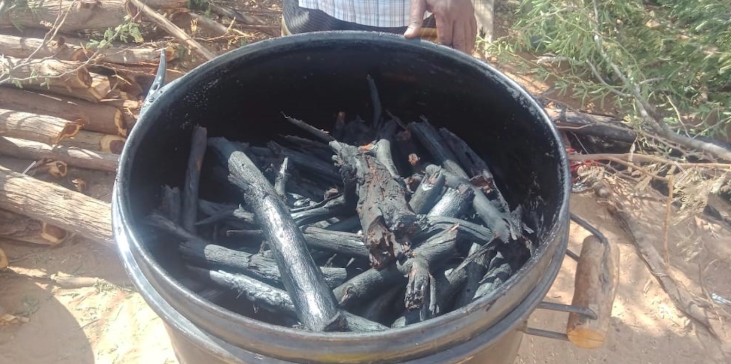
The plan is outlined in the National Strategy and Action Plan for the Control of Mathenge in Kenya 2025–35. According to the strategy, traditional charcoal production methods with a 10 per cent recovery rate could yield slightly over one million tonnes of high-grade charcoal annually from Prosopis biomass obtained through clearing operations.
“Using traditional production methods of 10 per cent recovery, Prosopis biomass from clearing operations can produce slightly over one million tonnes of high-grade charcoal with an approximate value of Sh54 billion per year. This can contribute to national charcoal demand if the industry is well regulated,” the strategy states.
The document further estimates that tax revenue from weed-based charcoal could reach Sh11 billion annually, while directly creating employment for more than 500,000 people. These figures are expected to more than double with the adoption of modern and efficient charcoal technologies achieving recovery rates of between 25 per cent and 30 per cent.
The strategy shows that Turkana county has 10 million tonnes of fresh biomass and five million tonnes of dry biomass, equivalent to 0.5 million tonnes of charcoal. The county can produce 30 million bags of charcoal valued at Sh24 billion.
Baringo county has 0.5 million tonnes of fresh biomass and 0.25 million tonnes of dry biomass, enabling production of 1.5 million bags of charcoal valued at Sh1.2 billion.
Isiolo county has one million tonnes of fresh biomass and 0.5 million tonnes of dry biomass, translating to three million bags valued at Sh2.4 billion.
Garissa and Tana River counties together have 4.5 million tonnes of fresh biomass and 2.25 million tonnes of dry biomass, with the capacity to produce 13.5 million bags valued at Sh10.5 billion.
Taita Taveta can produce three million bags valued at Sh2.4 billion, while Kajiado can generate 1.5 million bags worth Sh1.2 billion.
Other counties affected by Mathenge can collectively produce 15 million bags valued at Sh12 billion. In total, the affected counties can produce 67 million bags of charcoal valued at Sh54 billion.
The strategy notes that utilisation of the massive biomass from clearing operations, combined with extensive planting of native trees, will support the Bottom-Up Economic Transformation Agenda.
This will be achieved through value addition of Prosopis products, industrialisation, development of a Micro, Small and Medium Enterprises economy and job creation.
Financial requirements for implementing the strategy are estimated at Sh20 billion. The funds will be mobilised from government ministries, development partners and the private sector.
Mathenge (Prosopis juliflora), a tree native to South America, was intentionally introduced to Kenya due to its adaptability to dry conditions, rapid growth and ability to provide fuelwood, livestock fodder, human food and bee forage. It also offers shade, stabilises soil through its extensive root system, controls soil erosion and improves soil fertility by fixing atmospheric nitrogen, as it belongs to the legume family.
However, the species has become invasive, colonising large parts of Kenya’s arid and semi-arid lands. Its rapid spread is driven by prolific seeding, a strong ability to regenerate at high densities and the absence of a coordinated control strategy.
Currently, Prosopis covers about 11,658 square kilometres of land, equivalent to approximately 1,165,771 hectares. It is predominantly found on public, community and private land across 22 counties. The worst-affected counties are Turkana, Tana River, Garissa and Baringo.
Other significant invasions are recorded in Taita Taveta, Kilifi, Samburu, Isiolo, Mandera, Marsabit, Wajir, Kajiado, Kwale, Lamu, Tharaka Nithi, Meru, Mombasa, Kitui and West Pokot.
As part of containment efforts, the Kenya Forestry Research Institute recently signed a memorandum of understanding with Riziki Nature-Based Solutions.
The partnership aims to strengthen collaboration on managing invasive species, including Mathenge, through research, destumping, capacity building and sustainable nature-based solutions.
by GILBERT KOECH