


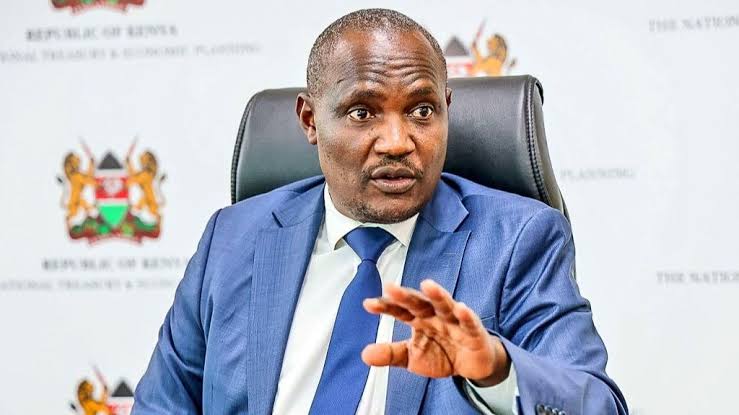
MPs yesterday challenged Treasury Cabinet Secretary John Mbadi over the proposed sale of the state’s shares in Safaricom, seeking assurance on possible job losses and proceeds being diverted to unrelated projects.
The lawmakers questioned the safeguards in place, saying past experiences show that large windfalls often end up plugged into recurrent spending and budget gaps.
The government is intending to offload up to 15 per cent of its 35 percent controlling shares at the telco.
Already, the government has identified a South Africa–based company, Vodacom, as the strategic partner.
“What assurance do we have that the funds will be ringfenced for the infrastructure projects,” Nyaribari Masaba MP Daniel Manduku said.
Kitui Rural MP David Mboni reinforced the need for public assurance the billions raised from the proposed sale of shares are channelled to the intended purpose.
“How do you secure the money so that the proceed goes to the intended purpose?” Mboni asked.
In his response, Mbadi assured Sh204 billion the government targets to raise from the sale of Safaricom shares will strictly be used to finance commercially viable infrastructure projects.
He told MPs that the money will not be used to support the 2025–26 budget as claimed.
The CS said the funds would be ring-fenced for projects capable of generating returns, arguing the move would ease pressure on taxpayers and reduce reliance on debt.
“The money is not to fill our fiscal deficit, it will be used to set seed capital for commercially viable infrastructure projects,” he said.
“Kenyans objected to any more taxes and borrowing; therefore, we have to think of innovative steps of raising revenues.”
Some of the sectors that will be prioritised include energy, roads, water and airports.
The lawmakers also raised concerns about the impact of the transaction on Safaricom’s workforce, warning that changes in ownership could trigger restructuring and job losses.
The CS said the agreement shields employees from any job losses for three years after the acquisition of the shares.
“Through the transaction, Vodacom has made various commitments, including no acquisition-related redundancies within three years of the transaction, ensuring that the chairman and independent directors remain Kenyan, as well as Vodacom’s continued support of the Safaricom foundation,” Mbadi said.
Kitui MP Irene Kasalu however raised concerns about the window period, saying three years is too short.
“The three years are too short and you know this country it is very difficult to get a job,” Kasalu said.
Mbadi was speaking when he appeared before the joint sitting of the Finance and National Planning and Public Debt and Privatization committees of the National Assembly.
The committee jointly chaired by Kuria Kimani (Finance) and Shurie Abdi (Balambala) has started a stakeholders’ engagement with regards to partial divestiture of the government’s shareholding in Safaricom PLC.
The Treasury CS was also put to task over the manner the government settled on Vodacom without opening the whole process to competition.
Mbadi defended Vodacom as a strategic partner in the deal, saying the global firm’s long history in the telecommunications industry makes it a reliable and experienced player.
Selling directly to Kenyan retail investors, he said, would have depressed the share price and denied the state value for money.
He said the transaction, expected to raise about $1.576 billion (Sh204.3 billion), was structured to maximise proceeds, protect market stability and attract foreign currency inflows.
“Selling Safaricom shares directly to Kenyans would not have given us value for money because we would have sold at a discount,” Mbadi told lawmakers.
“If we released additional shares into the market and asked Kenyans to bid, they would simply follow the prevailing market price. Once you increase supply, you distort the price and the law of supply and demand takes effect. That is Economics 101.”
He added that a large retail offer would have required underwriting, which would raise transaction costs, and this would coincide with another major planned divestiture, the Kenya Pipeline Company.
Mbadi argued that this risked saturating the market and weakening pricing for both assets.
The Treasury CS also told the committees that the National Treasury engaged KCB Capital as transaction adviser to conduct an independent valuation of Safaricom shares.
In the process, the government incurred around Sh3 billion being 1.36 per cent of the Sh204 billion.
“This was within the 1.8 per cent that the law allows,” Mbadi said.
The transaction is expected to raise Sh204.33 billion, representing a premium of about 19 per cent over the listed share price, based on a market price of around Sh28.5.
by LUKE AWICH