



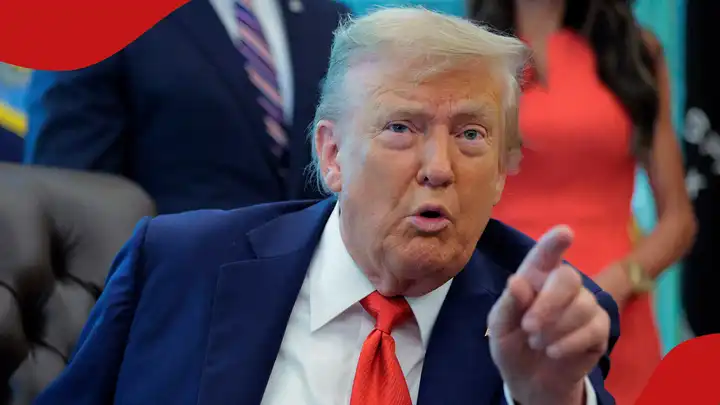
On Monday, August 25, US president Donald Trump threatened to impose additional tariffs on goods from nations that impose digital taxes unless they repeal the law. Donald Trump argued that countries imposing a Digital Services Tax disadvantaged US tech firms. In a post on Truth Social, Trump said that such legislation was designed to harm and discriminate against American tech firms. Why did Trump threaten additional tariffs? The 47th US president argued that the laws grant a pass to companies from China, a rival to the US in the tech industry. “I put all countries with digital taxes, legislation, rules, or regulations, on notice that unless these discriminatory actions are removed, I, as president of the US, will impose substantial additional tariffs on that country’s exports to the US, and institute export restrictions on our highly protected technology and chips. This must end now,” Trump reiterated. According to Business Standard, Trump has long maintained that taxes on digital services unfairly target US tech giants like Facebook parent company Meta, Alphabet, the owner of Google, and Amazon.
The US has increasingly employed export restrictions on technologies that it considers essential for economic or national security, such as cutting-edge semiconductors from companies like NVIDIA Corp for Artificial Intelligence (AI). Has Kenya imposed a Digital Services tax? Under the Finance Act 2025, National Treasury Cabinet Secretary (CS) John Mbadi cut the Digital Service Tax by 50%. Mbadi declared a reduction in the Digital Service Tax rate from 3% to 1.5%. The CS clarified that to keep tax laws in line with economic demands, the Exchequer periodically examines them to find any obstacles to business and makes necessary revisions. President William Ruto has introduced multiple taxes for local and international companies. Photo: William Ruto. Source: Facebook What is Digital Service Tax? According to the Kenya Revenue Authority (KRA), income produced or accrued in Kenya from businesses that operate online or over an electronic network, including services offered through a digital marketplace, is subject to DST.
The tax was implemented on January 1, 2021 and is payable upon service provision, meaning it is now paid on an accruals basis instead of a cash basis. “DST is due monthly, on or before the 20th day of the following month that the digital service was offered,” KRA indicated. Non-resident individuals who send messages by radio, cable, optical fibre, television transmission, internet satellite, or other comparable methods are exempt from DST. Which tariff did Trump impose on Kenya? READ ALSO Trump advisor says US may take stakes in other firms after Intel Kenya’s exports to the US face a 10% tariff. This came after Trump failed to extend the deadline for reciprocal tariffs, which he claimed were ‘fair’. As part of the protectionist tariff revisions, which mainly targeted countries with huge surpluses in goods trade with the US, the world’s largest economy, Kenya was among those with the lowest tax rates.
Source: TUKO.co.ke