


Spouses cannot, in ordinary circumstances, testify against one another in criminal cases because they are incompetent witnesses, the High Court has ruled.
According to Mombasa High Court Judge Anne Ong’injo, permitting an accused person’s spouse to testify against him or her is equivalent to an attack on their right to remain silent.
Basing her argument on Section 127 of the Evidence Act, she said the law is meant to protect the sanctity of marital communication and confidences in recognition of the unique bond that exists between spouses.
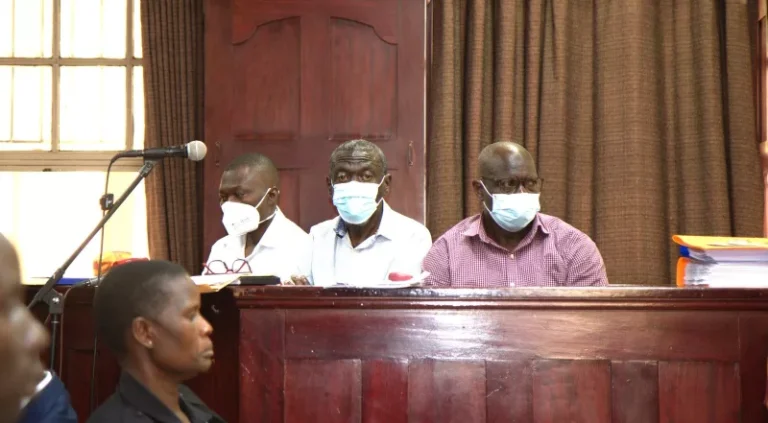
Justice Ong’injo made the finding as she blocked a woman from testifying against her husband in a case in which the man is accused of killing his brother-in-law.
“For the reasons explained above, it is my finding that Ms Amina Suleiman is not a competent and compellable witness, therefore, she cannot be made to testify against the accused person herein, who is also her husband, on behalf of the state,” said the judge.
In the case, Mr Maxwell Mwaingolo is accused of murdering Rama Kombo Malau on January 30, 2018 at Kiembeni Bombo village in Kisauni sub-county.
Pleaded not guilty
Mr Mwaingolo pleaded not guilty to the charge and the case is set for trial.
In March this year, the Office of the Director of Public Prosecutions made an application to call Ms Suleiman as a witness.
The prosecution based its application on the provisions of Section 127 (3) of the Evidence Act, which provides that an accused person’s spouse is a competent and compellable witness where the offence relates or affects the intended witness.
“Ms Suleiman recorded a statement with the police, the deceased is her biological brother, therefore, her evidence will help this court to bring justice to the case,” the prosecution argued.
It also argued that following the gruesome murder of her brother, Ms Suleiman was still experiencing psychological torture.
However, Mr Mwaingolo, through his advocate, opposed the request, maintaining that his wife is not a competent and compellable witness.
Psychological torture
Section 127 (3) of the Act states that in criminal proceedings, the wife or husband of the accused shall be a witness for the prosecution or defence without the consent of such person in cases of bigamy, sexual offences, an act or omission affecting the person or property of the spouse or the children.
Justice Ong’injo argued that an accused person’s spouse can only be permitted to testify against them in a criminal case where the deceased is a spouse of the accused or is their child.
Also, the judge considered the fact that Mr Mwaingolo had categorically declined to give consent for his wife to give evidence, and that he did not call her to testify against him.
Justice Ong’injo further said the prosecution ought to have filed a formal application, or at the very least filed an affidavit sworn by Ms Suleiman, affirming the arguments of psychological torture and being the biological sister of the deceased.
“In the absence of the said affidavit, the allegations by the prosecution are just mere averments and this court shall treat them as such. As it is, this court is incapable of ascertaining the kind of relationship that existed between the deceased and Ms Suleiman, and whether or not she is being coerced to testify against her husband,” said the judge.
The court ruled that the application by the state to call Ms Suleiman as a witness is devoid of merit and cannot be allowed. BY DAILY NATION