


The Ethics and Anti-Corruption Commission (EACC) clarified Monday that it has no constitutional mandate to bar candidates from contesting elections.
The anti-graft body said the responsibility rests with the Independent Electoral and Boundaries Commission (IEBC).
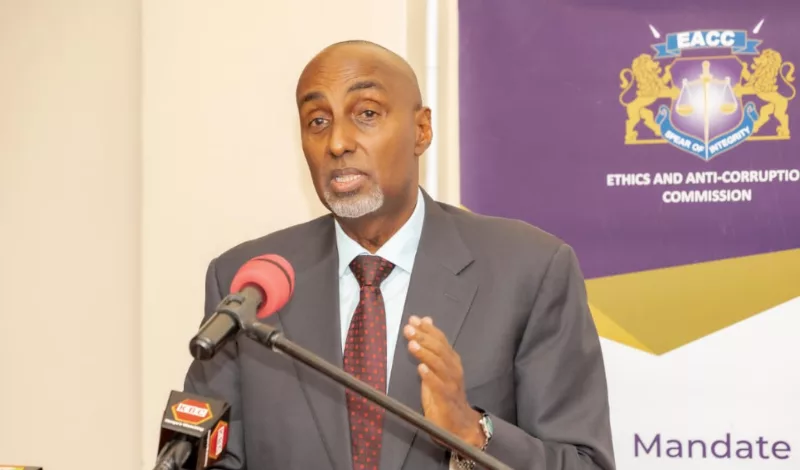
EACC Chief Executive Officer Abdi Mohamud said the commission’s role under Chapter Six of the Constitution is to assess the integrity and ethical suitability of candidates and submit recommendations to the IEBC, which is mandated to determine eligibility and register candidates.
He spoke in a speech read on his behalf by Director, Ethics and Leadership Pascal Mweu.
Speaking during a workshop for media practitioners on integrity in leadership and elections, Mohamud said the commission had faced criticism from members of the public who expected it to directly disqualify candidates deemed unethical from seeking elective office.
He said the misunderstanding stemmed partly from EACC’s role in integrity verification for individuals seeking appointment or election to public positions.
Mohamud disclosed that the commission receives more than 20,000 self-declaration forms from aspiring candidates during election years and works with IEBC to develop integrity-verification criteria.
He said EACC submitted reports containing recommendations on candidates it considered unsuitable to contest in the 2017 and 2022 General Elections.
The CEO said the commission had made significant progress in investigating public officers suspected of using forged academic and professional certificates to secure employment or positions of authority.
He disclosed that EACC had investigated 228 allegations involving forged academic and professional certificates, recommending prosecution in 134 files forwarded to the Director of Public Prosecutions.
Of the cases, 60 are currently pending before courts, while 50 have been concluded, resulting in 45 convictions and five acquittals.
Mohamud said the commission had also recovered Sh41.2 million obtained through employment or benefits secured using forged academic and professional certificates.
He warned that elected leaders were among those investigated and prosecuted over certificate forgery, adding that EACC would intensify scrutiny of documents submitted alongside self-declaration forms ahead of the 2027 elections.
“We will continue with the investigation and take necessary action,” he said.
Mohamud said the commission was aware of allegations of voter bribery during recent by-elections and pledged to investigate the claims as political campaigns for the 2027 general election gather momentum.
He said EACC would gather evidence and pursue prosecution of individuals involved in electoral bribery, adding that evidence of such offences could also be presented in court during election petitions.
The commission also cautioned public officers against participating in political campaigns in violation of the Conflict of Interest Act, warning that those found culpable would face legal action, including criminal prosecution.
Mohamud announced that EACC would soon launch a public sensitisation campaign to educate voters on the moral and ethical requirements expected of individuals seeking elective office.
The campaign will include the establishment of reporting desks to receive complaints relating to corruption, ethical violations, voter bribery and public officers engaging in partisan political activities.
He urged media practitioners to partner with the commission in amplifying messages on integrity and accountability to voters, political aspirants, political parties and the wider public ahead of the elections.
“Safeguarding democracy, peace and prosperity is a shared responsibility. EACC is taking its fight against corruption, unethical conduct and bad governance into the electoral process,” he said.
EACC Commissioner Col (Rtd) Alfred Mshimba said the commission had submitted the names to the Independent Electoral and Boundaries Commission (IEBC), but all the individuals were ultimately allowed to participate in the elections.
Mshimba said some of those flagged in 2017 were subsequently arrested, charged and convicted of corruption-related offences, while others were removed from office through impeachment proceedings over violations relating to Chapter Six of the Constitution.
He said the cases had contributed to the misuse of public resources, mismanagement of public offices and lost opportunities, raising questions about the effectiveness of integrity safeguards during the electoral process.
Mshimba also disclosed that in the 2022 general election, EACC submitted the integrity records of 241 individuals for consideration, but only five were disqualified.
The commissioner questioned whether institutions and the country were doing enough to ensure integrity was given adequate consideration when electing leaders, arguing that the constitutional requirements on leadership and integrity should not be treated as mere formalities.