


More than 300,000 wild animals are hunted annually for bushmeat across the Southern Kenya–Northern Tanzania landscape, feeding an illicit trade valued at Sh779 million ($6 million) a year, a new assessment reveals.
The findings point to an increasingly organised commercial network in which hunters, transporters, processors and dealers supply distant markets, raising concerns about the ability of conservation interventions to protect wildlife.
The assessment by WWF-Kenya and Traffic, an organisation working globally on wildlife and plant trade, warns the trade could push some species to extinction despite investments to curb it.
Geoffrey Chege, WWF-Kenya’s biodiversity, research and innovation manager, said the study, conducted at the beginning of 2026, identified the wild meat trade as a significant threat to biodiversity.
He said the trade was expanding despite efforts to contain it.
The study covered the 134,000 square kilometre Southern Kenya–Northern Tanzania (Soknot) landscape, which includes the Mara–Serengeti, Amboseli–West Kilimanjaro and Tsavo–Mkomazi ecosystems, as well as the areas connecting them.
It drew on 110 respondents from government and private-sector law enforcement agencies, civil society organisations and communities. More than 220 bushmeat hotspots were recorded, with between three and five tonnes of wildlife meat reportedly crossing the border daily.
In Kenya, the assessment focused on areas including Kajiado, Narok and the Maasai Mara landscape, where more than 22 herbivore species are hunted.
The scale of the problem is reflected in respondents’ accounts. Half said bushmeat hunting and trade had increased over the past five years, while 23 per cent said it had declined. Another 19 per cent said it had remained unchanged and eight per cent were unsure of the trend.
The report traces the trade’s evolution from subsistence hunting, in which an individual hunter carried meat on foot for local consumption, to semi-organised village and small-town supply chains involving hunters, processors and butchers using motorcycles.
Today, the network is more complex, involving transporters, sellers, top dealers, surveillance and intelligence, as well as communication and coordination systems.
Motorcycles are used to transport meat from hunting areas before consignments are transferred to vehicles and trucks for longer journeys to distant markets.
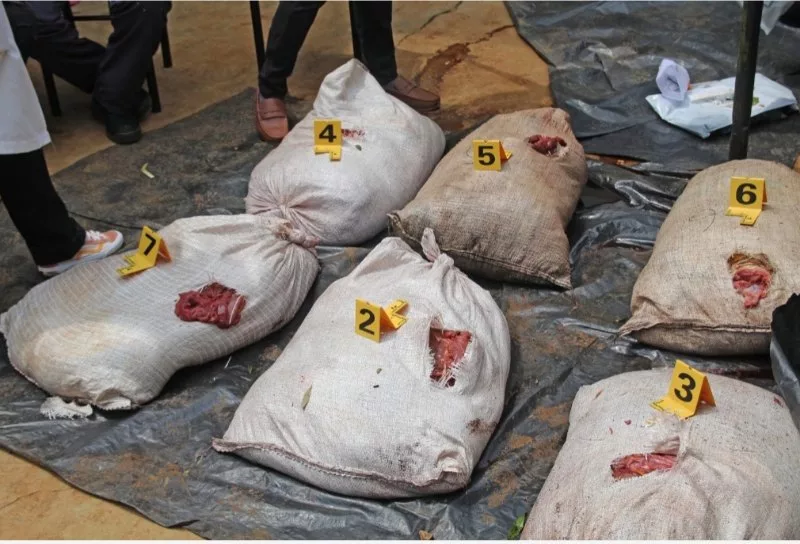
The report says bushmeat can be transported hundreds of kilometres from its source to markets. Most of the meat seized is from zebra, dik-dik, giraffe, eland, wildebeest, lesser kudu, hartebeest, impala and buffalo.
The commercial incentives are significant. The assessment identifies income generation, profit margins of up to five times the initial investment, youth unemployment and strong market demand as drivers of the trade.
Purchasing patterns also challenge the assumption bushmeat is mainly consumed by poorer households.
According to the report, 52 per cent of respondents identified people with high purchasing power as buyers, while 33 per cent pointed to upper-middle-income consumers.
Asked why bushmeat was preferred, 49.26 per cent cited the belief it contained no synthesised chemicals, 21.87 per cent said it tasted better and 14.01 per cent believed it had more nutrients. Another 0.42 per cent said it cured diseases, while 14.4 per cent did not respond.
WWF-Kenya chief executive Jackson Kiplagat warned the trade threatened a nature-based economy whose benefits depend on protecting wildlife.
“Kenya being a nature-based economy should be managed in a way that give benefits to its people,” he said.
Kenya Wildlife Service chief of security operations Oswald Sangawe said the agency was coordinating multi-agency teams to disrupt the trade.
He said hundreds of motorcycles had recently been forfeited to the state after being seized with bushmeat.
The report identifies another challenge: wildlife is often killed as animals move between protected areas, yet up to 65 per cent of wildlife live outside protected areas.
Growing human populations have also contributed to the blockage of wildlife corridors and dispersal areas.
Existing interventions may not be reaching the areas where they are most needed.
The assessment found 70 per cent of bushmeat hotspots fell outside communities benefiting from demand-reduction initiatives, while 50 per cent of urban consumer markets were beyond the reach of awareness interventions.
It calls for stronger laws and enforcement, alternative economic opportunities, and sustained social and behaviour change efforts.
The findings suggest disrupting the trade will require more than intercepting individual hunters or seizing motorcycles.
Conservation efforts must also address the commercial networks, consumer demand and economic incentives sustaining the market.