



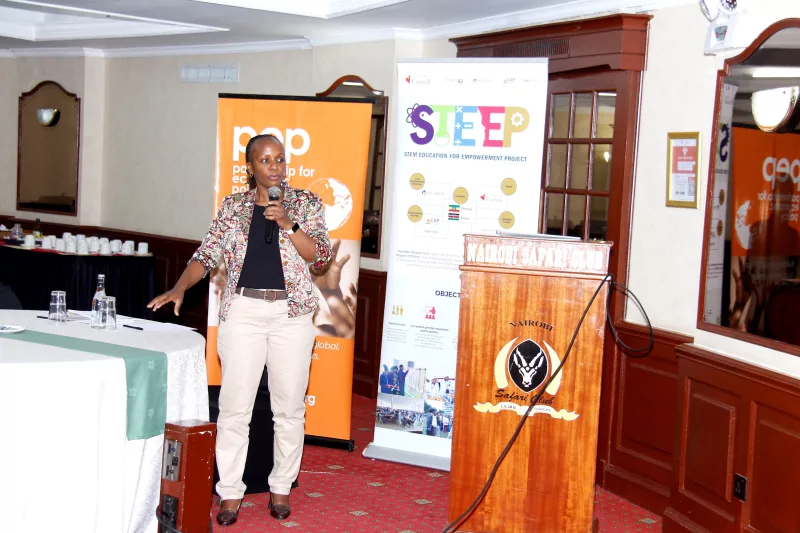
A new study on the STEM Education for Empowerment Project (STEEP) found that some young women who initially expected to remain dependent on their parents, work as domestic workers or operate M-Pesa shops shifted into technical careers after receiving STEM training.
STEM stand for science, technology, engineering, and Math.
The study documented participants moving into land surveying and mapping, independent plumbing, industrial mechatronics and electrical engineering, highlighting the potential of technical training to alter career choices among young women.
One participant who had initially planned to remain at home and depend on her parents became an independent plumbing contractor after completing the programme.
The findings contained in a policy brief titled Scaling STEM training can improve young women’s employment in Kenya, assessed the impact of STEEP on employment and earnings among young women.
“These findings show us what is possible when young women are given the opportunity to develop technical skills, confidence and practical workplace experience,” said co-author of the research Phyllis Machio.
The programme combines technical and soft-skills training, mentorship and work-based learning in market-relevant vocational courses. Training runs for about four months followed by a two-month internship.
The study found that 63 percent of STEEP participants were employed, compared with 48 percent of applicants who were not selected and 52 percent of young women in a second comparison group.
“The girls were excited that they were defying societal expectations and doing things that were traditionally considered as mainstays for men. They were electricians, and they were plumbers, and they were excited to be doing the jobs,” Machio added.
Econometric analysis estimated that participation increased the likelihood of employment by up to 26 percentage points compared with one comparison group and 18 percentage points compared with the other.
Participants also recorded higher average monthly earnings of Sh6,826, compared with Sh5,216 among non-selected applicants and Sh5,513 in the second comparison group. The researchers estimated that monthly earnings were up to 22 percent higher than the second comparison group. STEEP policy brief (2)
The programme also helped challenge perceptions around jobs considered unsuitable for women.
One participant said she was happy to be doing plumbing despite perceptions that women cannot work as plumbers.
The researchers found that structured life-skills training, female role models and hands-on internships were important in encouraging participants who had initially been hesitant about STEM to pursue technical careers. STEEP policy brief (2)
However, the study cautioned that training alone does not eliminate barriers facing women entering male-dominated occupations.
Participants reported discrimination and harassment in workplaces, while others faced difficulties obtaining formal certification after completing their training. The six-month programme was also considered too short by some participants.
The study recommends expanding the STEEP model to marginalised counties and embedding life-skills training and female mentorship into TVET STEM programmes.
It also calls for stronger partnerships between the National Industrial Training Authority (NITA) and employers to provide internships linked to employment, as well as stronger workplace safeguards for women entering STEM careers. STEEP policy brief (2)
Women currently account for only 38 per cent of STEM enrolment in Kenya’s TVET institutions, underscoring the gap that policymakers and employers face in building a larger female technical workforce. STEEP policy brief (2)