


High taxes, unreliable utilities, expensive credit, county levies, land problems and climate shocks are compounding the burden on investors, threatening Kenya’s efforts to attract private capital and create jobs.
A new World Bank report warns that a combination of governance, regulatory and structural weaknesses is holding back private investment.
The Kenya Country Private Sector Diagnostic, published in September 2026, says Kenya has strong fundamentals for private-sector-led growth but has struggled to translate economic growth into sufficient investment, productivity, exports and formal jobs.
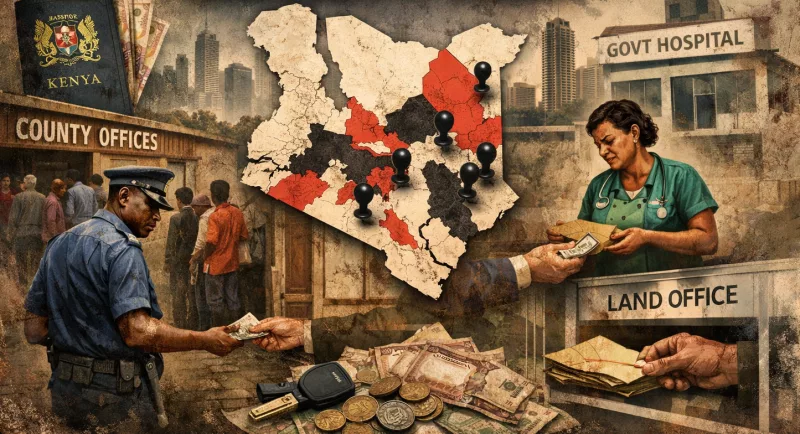
The report shows governance and corruption are key concerns among investors, while corruption and red tape raise the cost of doing business in the country.
One-third of firms surveyed experienced at least one request for a bribe, while 25.3 per cent identified business licensing and permits as a major or very severe constraint.
The World Bank says governance weaknesses are undermining investor confidence at a time when Kenya is seeking more private capital to drive economic growth.
The report also describes Kenya’s business environment as constrained by regulatory uncertainty, high compliance costs and governance weaknesses.
Businesses are also facing multiple national and county-level levies, frequent tax changes, cumbersome administration and perceptions of unequal treatment.
Sixty-four per cent of firms identified tax rates as a major or very severe constraint in the 2025 World Bank Enterprise Survey, while 38.6 per cent cited tax administration.
The World Bank says Kenya’s corporate income tax rates are broadly comparable with those of regional peers, but the wider tax system creates uncertainty through multiple levies, frequent changes and administrative requirements.
“Uncertainty and frequent changes in the tax system” are described in the report as major constraints to private investment.
The report also points to the National Tax Policy of 2023, saying its non-binding nature allows frequent, piecemeal changes through annual Finance Bills.
Devolution has also introduced another layer of complexity.
The World Bank says business permits, property rates, market fees and other charges vary considerably across counties.
This is resulting in an uneven regulatory environment for businesses operating in multiple jurisdictions.
The report says such requirements “can be applied inconsistently and vary widely across counties”, raising the cost of doing business.
The County Licensing (Uniform Procedures) Act of 2024 and regulations issued in 2025 are intended to standardise licensing, reduce duplication and promote digital processes.
But the World Bank says that even where laws and regulations exist, “their implementation faces severe lags”.
Businesses are also paying heavily for unreliable basic services. Electricity tariffs of about $0.26 per kilowatt-hour are among the highest in the region, while about 75 per cent of firms reported frequent power outages.
About 60 per cent of firms own or share a generator, adding another cost to production.
Water is another major constraint, with more than 37 per cent of firms reporting insufficient water, compared with 17.2 per cent among lower-middle-income countries.
The World Bank says these infrastructure weaknesses continue to raise operating costs despite improvements in roads, ports and other transport infrastructure.