


Tea time in many schools is often a tedious and sometimes chaotic process, with students lining up for their turn to fill a cup.
The process may appear simple, but it can result in spillage, wastage, and hygiene concerns as many hands come into contact with the serving equipment.
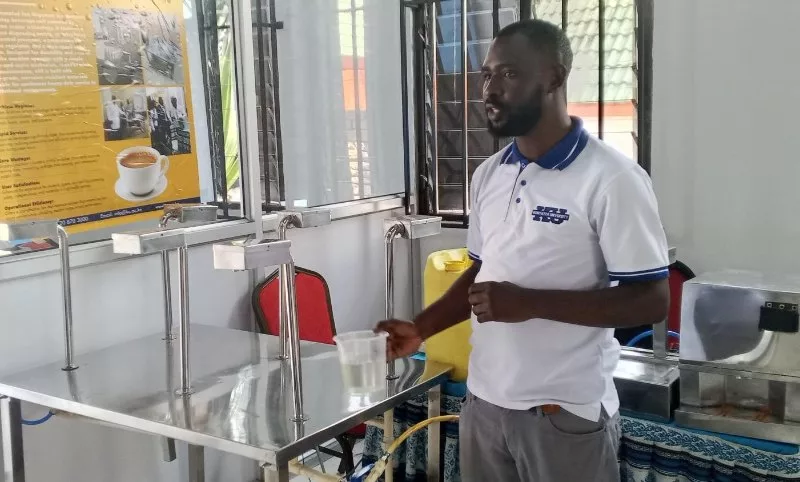
A young Kenyan engineer has developed an automated tea dispenser designed to make the process more hygienic, efficient, and less wasteful.
According to Engineer Felix Nyabuto, the tea-serving system has several challenges, including tea wastage and accidental burns.
These challenges inspired Nyabuto, a 2025 Kenyatta University graduate, to develop an automated tea dispenser that allows students to serve themselves without touching the machine.
Nyabuto says his idea was born from observing the tea-serving system while he was still in school.
“I could see some gaps in the current system. One of the biggest problems, he says, is wastage,” he says.
Many schools use 60-liter containers fitted with manual taps. Once a student opens the tap, there is a tendency to leave it running while filling a cup, resulting in tea being spilled or flowing away.
Nyabuto estimates that some schools can lose up to 15 litres from a 60-litre container after a single serving session. For schools serving large numbers of students, the losses can be even greater.
He explains that the automated dispenser is designed to address this by controlling the amount of tea released.
“Instead of a student opening and closing a tap manually, a sensor detects the cup and automatically releases a pre-set quantity. The school can programme the machine according to the serving size it wants,” he says.
“For example, 200ml, 300ml or 500ml. Once the programmed quantity has been released, the flow automatically stops. This eliminates the possibility of a student leaving the tap running,” Nyabuto says.
But reducing wastage is not the only problem Nyabuto wants to solve. He has also designed the system to be touchless.
In a school with 1,500 students, hundreds of learners could handle the same tap during a tea break.
“Imagine 1,500 students holding the same level open and closing it. They can easily contaminate each other,” he says.
The automated dispenser replaces the manual tap with sensors, meaning students only need to position their cups beneath the outlet.
Nyabuto says the touchless system could help schools reduce contact with a surface handled by many students.
Tea breaks in large schools can become a race against the clock, with students spending several minutes trying to fill their cups as others wait behind them.
To address this, Nyabuto fitted the dispenser with a pump capable of delivering large quantities of tea within seconds.
His demonstration model can dispense 500ml in about two seconds. This means two students requiring about 250ml each could potentially be served within the same period.
He says the system can serve up to 1,500 students in about 20 minutes, depending on the setup and serving volumes.
For schools, the shorter serving period could mean less time spent queuing and more time for students to interact during breaks or return to class.
The machine is connected to electricity in the same way as ordinary household appliances, but Nyabuto says schools can also consider backup options such as solar power or batteries.
“The dispenser is not intended to operate throughout the day. Instead, it can be switched on during scheduled serving times such as breakfast, midday tea or evening meals,” Nyabuto says.
The innovation has evolved through several prototypes. Nyabuto says his first model was designed with households in mind.
“It is small enough to be used at home and requires the user to simply place a cup in the designated position for the machine to dispense the drink. It is just like a coffee machine,” he says.
But feedback from potential users pushed him to develop larger versions. Customers wanted a machine that could accommodate different cup sizes and dispense not only tea but also water, juice and milk.
That led to the development of a larger, double-tap version targeting small businesses and vendors.
Nyabuto says a kiosk selling tea, coffee, milk or juice, for instance, could use the machine to dispense controlled quantities to customers.
The technology can also be adapted for events such as weddings, graduations and exhibitions, where large numbers of people need to be served quickly.
He explains that the school version is larger and designed for high-volume use. Rather than placing the entire machine where students can access it, the dispensing points can be installed on a wall near the kitchen or serving area.
“The technical components are kept behind the wall, leaving students with only the dispensing point and sensor to interact with. This is important in schools where equipment can be vulnerable to interference as students are very curious,” he says.
The system can also be connected to an existing school tea reservoir through pipes, meaning institutions do not necessarily have to replace their existing large containers.
Although tea is the main focus of the current system, Nyabuto sees wider applications for the technology. One area is drinking water.
At a conference attended by school principals, he says he received feedback from institutions in coastal and other areas where access to clean water can be challenging.
“Some schools purchase large quantities of clean water, but the water can subsequently be used for purposes other than drinking,” he says.
Nyabuto believes a controlled dispensing system could help institutions reserve treated water specifically for drinking.
The technology can also be used in hospitals, training institutions, events and commercial vending.
“We are not limited to tea,” Nyabuto says.
He is now looking at partnerships that can help improve the design and manufacture of the dispenser locally.
The cost depends on the number of dispensing points required. A complete unit, including the pump and control system, costs about Sh30,000 per tap, according to Nyabuto.
A small school may require only a few taps, while institutions serving several thousand students could require many more.
Nyabuto says he is currently in discussions with potential clients, including schools in Murang’a and Limuru, as well as institutions such as Kenyatta University.
He is also exploring opportunities in police and military training institutions, where large numbers of trainees have to be served within limited periods.
So far, the technology has not been installed in a school, but Nyabuto says preparations are underway for the first installations in schools in Murang’a and another one in Limuru.