


Milllion of small-scale farmers in Africa are still struggling to translate higher production into reliable incomes and improved livelihoods, a new report now indicates.
This is despite the continent’s agricultural sector recording significant gains over the past two decades, with farm output and farmer incomes doubling and cereal yields rising by about 40 per cent, but
A new report commissioned as part of AGRA@20 says Africa has made progress since the days of recurring famines and devastating crop failures that characterised much of the continent in the 1980s.
AGRA is a pan-African institution focused on scaling agricultural innovations that help small-scale farming enterprises towards increased incomes, better livelihoods and improved food security.
Despite the progress, it warns that the next phase of agricultural transformation must focus less on simply producing more food and more on ensuring that farmers retain value, earn sustainable incomes and become more resilient to economic and climate shocks.
The report, launched in Nairobi on Sunday, traces Africa’s agricultural journey to the 2003 Maputo Declaration and the first Comprehensive Africa Agriculture Development Programme, which established a common African Union-led agenda for transforming agriculture.
AGRA, formerly the Alliance for a Green Revolution in Africa, says its role over the years has been to support and help accelerate this broader continental ambition alongside governments, farmers, businesses, researchers, financiers and development partners.
Drawing on two decades of evidence and learning, the report describes Africa’s agri-food sector as investable, strategic and deeply dependent on local conditions.
But it says production gains must more consistently translate into income, dignity, resilience and economic opportunity for farmers.
Agriculture Gross Value Added growth has risen from about 2.3 per cent to nearly four per cent, while farm output doubled in real terms after 2005.
Farmer incomes have also doubled, while cereal yields have increased by approximately 40 per cent.
Yet the gains have been uneven, with productivity gaps persisting across the continent.
Hunger has continued to rise in some regions, while many farmers remain unable to convert increased production into stable and reliable incomes.
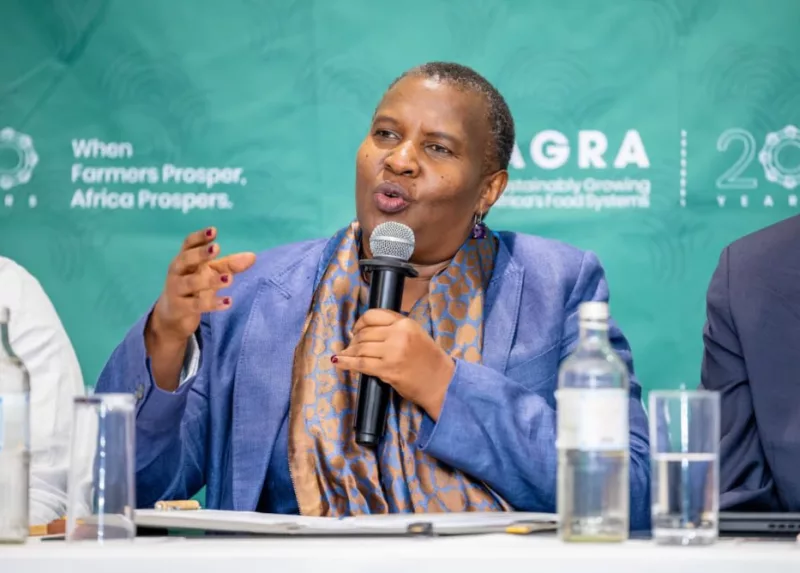
“Twenty years of evidence show that Africa’s agrifood sector can move when the conditions are right. The task now is to turn that progress into income, resilience, dignity and opportunity for farmers,” AGRA president Alice Ruhweza said.
“That will require a renewed alliance that brings governments, farmers, businesses, finance, researchers and development partners around a shared agenda for farmer prosperity.”
The report identifies three priorities that Africa must pursue simultaneously if it is to achieve lasting agricultural transformation.
First, farmers must be able to produce food reliably and build resilience against climate shocks and other disruptions.
Second, agricultural production must be connected more effectively to markets, processing industries, trade and employment opportunities so that farmers can capture a larger share of the value generated along the food chain.
Third, African countries must build stronger institutions and systems, including finance, data, coordination and accountability mechanisms, to ensure agricultural plans are translated into sustained results.
The report warns that progress in one area will not be enough if weaknesses persist elsewhere.
It identifies what it describes as three interconnected challenges—the productivity trap, value trap and the capability trap.
The productivity trap limits farmers’ ability to produce reliably and withstand climate and economic shocks.
The value trap prevents increased agricultural production from consistently translating into higher incomes, jobs, processing opportunities, trade and competitiveness.
Meanwhile, the capability trap weakens the institutions, financing systems, coordination, data and accountability required to turn agricultural strategies into lasting results.
“Progress becomes transformation only when productivity is restored, value is retained and capability is sustained,” AGRA board chair and former Ethiopian Prime Minister, Hailemariam Dessalegn, said.
The report is calling for a renewed alliance involving sectors far beyond agriculture, arguing that farmer prosperity is influenced by decisions made in finance, trade, water, energy, infrastructure, health, nutrition, education, climate, science and industry.
Over the past 20 years, AGRA and its partners have supported the development of 118 seed companies and more than 650 improved seed varieties.
The organisation says it has also helped strengthen a network of more than 25,000 agro-dealers and 33,000 community extension workers, while supporting five million farmers with training in soil health and climate-smart agricultural practices.
Nearly 800 scientists have also benefited from AGRA-supported initiatives, while approximately $691 million (Sh89.5 billion) has been leveraged for national agricultural investment plans.
The organisation says these interventions form part of a much broader effort involving African governments, development institutions, private businesses, research organisations and farming communities.
The report is intended to provide a candid assessment of the continent’s agricultural transformation journey, including areas where progress has been made and where interventions have fallen short.
It draws on independent evaluations, outcome assessments, published research and consultations with governments, funders, researchers and private-sector players, supplemented by AGRA’s own monitoring data.
The launch comes ahead of the Africa Food Systems Forum, scheduled to take place in Kigali, Rwanda, from September 2 to 5, where food security, agricultural investment and the future of Africa’s food systems are expected to dominate discussions.
The report’s central message is that Africa has demonstrated that agricultural transformation is possible, but the continent must now ensure that the benefits reach farmers more directly.
For policymakers, investors and development partners, the challenge for the next decade will be to move beyond isolated agricultural projects and instead invest in integrated systems capable of improving production, retaining value and strengthening the institutions that support farmers.