
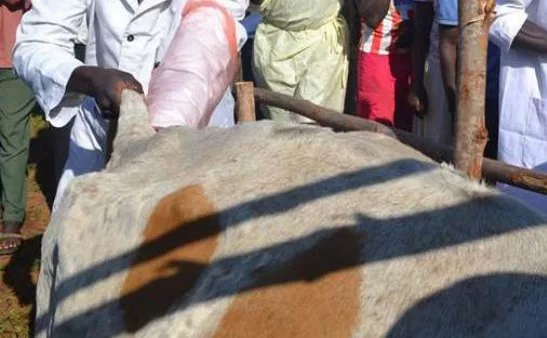
Kakamega County Government has reduced the cost of artificial insemination (AI) services from Sh3,000 to Sh700 over the past six months to improve cattle breeds and increase milk production among small-scale farmers.
AI is a breeding technique in which semen collected from a bull is deposited into a cow’s reproductive tract to achieve pregnancy without natural mating, according to the Food and Agriculture Organization of the United Nations (FAO).
Oscar Odunga, the county Chief Officer for Livestock Production, Veterinary Services and Fisheries, said the county had partnered with Farm Input Promotions Africa (FIPS Africa) to subsidise AI services and make improved breeding more affordable.
He explained that under the new arrangement, a farmer whose cow fails to conceive on the first attempt will pay Sh350 for a repeat service, compared with Sh3,000 previously.
“We have reduced that to Sh350 so that we could share the cost with the farmer. When fertilisation does not take place, it is not the farmer’s fault,” Odunga said.
The programme, which started in May, has so far reached more than 1,700 farmers. AI services are being provided through trained inseminators across the county.
Odunga said the county had trained two AI providers in each of its 12 subcounties and provided their contacts through administrative and ward offices. The aim is to ensure farmers can access an inseminator within 12 hours when a cow is on heat.
“Our goal is to upgrade our cows from the local breed to crossbreeds, which have higher milk-production potential,” he said.
The intervention comes as Kakamega seeks to develop its dairy value chain, with the county planning to establish a Sh200 million milk processing and aggregation centre.
Odunga said improving the quality of the county’s dairy herd would be important in ensuring the facility has adequate milk supplies.
Kakamega is already a significant livestock-producing county. Its 2023–2027 County Integrated Development Plan reported that the county produced 182.4 million litres of milk during the previous planning period, against a target of 200 million litres.
It also reported that 58,028 cows had been served through subsidised AI services during that period.
According to the Kenya Dairy Board, annual milk production in the country has also been rising. In 2024, Kenya produced 5.33 billion litres of milk, up from 3.98 billion litres in 2019.
Odunga said the county was also working to overcome misconceptions surrounding AI, including claims that inseminating indigenous cows could result in oversized calves and complications during delivery.
“We are trying to demystify that. People have this myth that local cows, when you do AI, will never deliver or will die because they will have a big calf. That is not true,” he said.
The county also commissioned an AI station at Springfield Farmers’ Cooperative Society in Likuyani subcounty in March.
The facility, supported through the National Agricultural Value Chain Development Project (NAVCDP), is expected to serve farmers in Likuyani, Lugari and neighbouring areas.
Agriculture, Livestock, Fisheries and Cooperatives executive Mophat Mandela said the station would improve access to quality breeding services, increase milk production and support milk aggregation through cooperatives.
The county government said it also plans to make AI subsidies a sustained county programme by incorporating them into future budgets and agricultural policies, reducing dependence on development partners.