

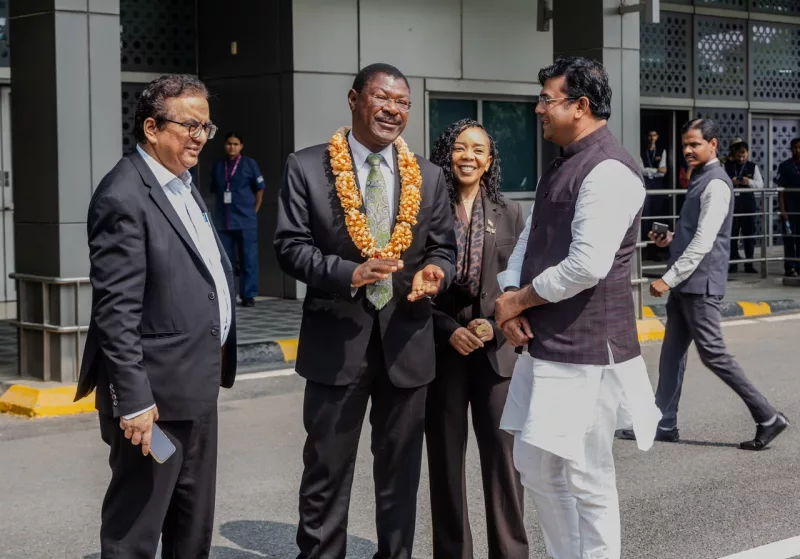
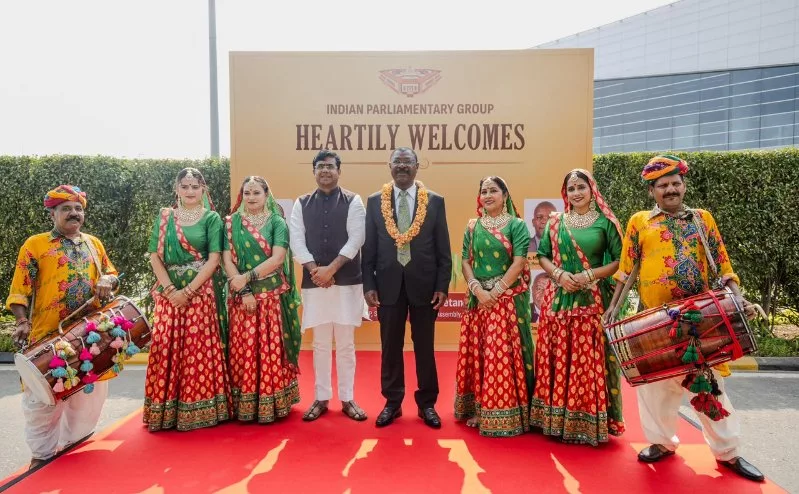
National Assembly Speaker Moses Wetang’ula has arrived in New Delhi, India, for an official visit aimed at advancing high-level parliamentary diplomacy and deepening bilateral cooperation between Kenya and India.
Wetang’ula is in India at the invitation of his counterpart, Shri Om Birla, Speaker of the Lok Sabha, the lower house of the Indian Parliament.
The visit is expected to provide an opportunity for the two countries to strengthen parliamentary relations and explore areas of mutual interest as Kenya and India seek to deepen their longstanding partnership.
Wetang’ula was received upon arrival in New Delhi by Mary Mutuku, Deputy Head of Mission of the Republic of Kenya to India, together with Umeshbhai Babubhai Patel, a Member of the Lok Sabha.
The National Assembly said the visit would advance parliamentary diplomacy while reinforcing the role of Parliament in strengthening relations between the two countries.
“Kenya and India share a historic and enduring partnership, founded on mutual respect, shared values and strong people-to-people and parliamentary ties,” the National Assembly said.
The engagements are expected to focus on strengthening cooperation between the Kenyan Parliament and India’s legislative institutions, while creating opportunities for the two countries to advance shared interests.
The visit comes against the backdrop of longstanding diplomatic, economic, cultural and people-to-people relations between Kenya and India.
Kenya and India have maintained close and friendly relations for decades, with their contemporary partnership expanding into several areas, including trade, investment, education, healthcare, technology, agriculture and capacity building.
The relationship also has deep historical roots stretching back centuries.
Historical accounts document commercial links between the Indian subcontinent and the East African coast long before European colonial expansion.
The presence of Indians in East Africa is documented in the Periplus of the Erythraean Sea, an ancient Greek account written around 60 AD that describes trade routes linking the Indian Ocean region.
A well-established trading network existed between India and the Swahili Coast, facilitating the movement of goods, people and ideas across the Indian Ocean.
The relationship intensified during the colonial period when large numbers of Indians arrived in East Africa.
Diplomatic relations between the two countries have also evolved over the years.
India established the office of Commissioner for British East Africa in Nairobi in 1948, with Apa Saheb Pant becoming the first Commissioner.
Following Kenya’s independence in December 1963, India established a High Commission in Nairobi in the same year, marking the beginning of formal diplomatic relations between the two independent states.
Since then, the relationship has expanded through regular high-level visits and increased government-to-government and people-to-people engagement.
The parliamentary dimension of the relationship has become an important component of bilateral diplomacy, providing legislators from both countries with an avenue to exchange experiences on governance, legislation and democratic institutions.
Wetang’ula’s visit is expected to build on these ties by strengthening cooperation between the National Assembly and the Lok Sabha.
Parliamentary diplomacy has increasingly become an important tool through which countries pursue foreign policy objectives, particularly by allowing lawmakers to establish relationships that complement formal engagements between governments.