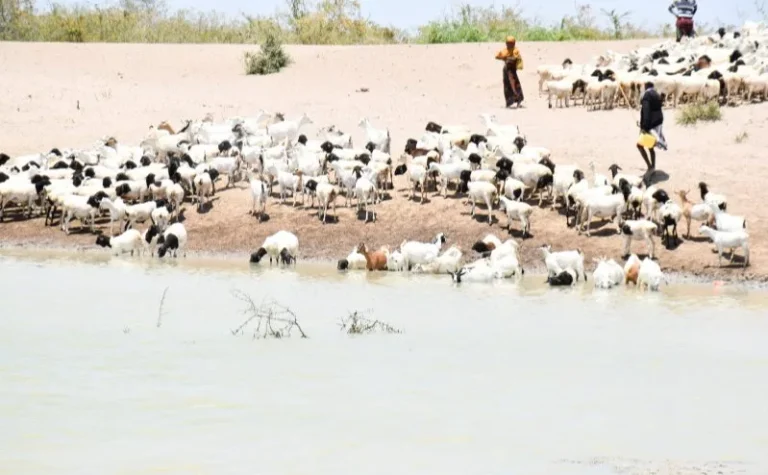



For years, farming in Mbeere North, Embu county, was risky because of frequent droughts and chronic water shortages.
Poor harvests left many families struggling to feed themselves and earn a living.
Today, the story is changing. Through a community-led water project supported by Israeli climate-smart agriculture expertise, hundreds of farmers are turning dry land into productive farms.
They are growing vegetables, fruits and other crops throughout the year while improving household incomes and food security.
Nora Igoki, a member of the Green Paradise Water Project, said the group was formed out of necessity.
“Our area borders Tharaka Nithi and Kitui counties. It is generally dry and we receive very little rainfall. Water has always been our biggest challenge, and sometimes we harvested very little or nothing at all,” she said.
To address the problem, the community obtained the necessary government approvals and began abstracting water from River Thuci, which runs through the area.
The water project has so far benefited 400 of its 780 members. The remaining members are still waiting to benefit as the group mobilises resources to expand the network.
“We make monthly contributions to buy pipes and water tanks. Through our members, well-wishers and donors, we hope to extend water to everyone,” Igoki said.
Access to water has created opportunities beyond domestic use. Farmers now irrigate their crops, enabling year-round production despite erratic rainfall.
According to Igoki, climate-smart agriculture has become a powerful tool for reducing poverty and improving household incomes.
“When people have food, they can then think about earning an income. Our youth are actively involved in horticulture, growing kale, tomatoes, capsicum, coriander and other vegetables. They transport the produce to local markets and neighbouring counties using motorcycles,” she said.
The transformation has been made possible through technical support from Israeli organisation CultiAid, which trains farmers using demonstration farms.
Igoki hosts one such model farm at her home, where she recently trained about 500 farmers on climate-smart farming techniques.
The project has also economically empowered women. Five women’s groups are involved in various income-generating activities, including poultry keeping, pig farming and crop production.
“Women are now earning income, contributing to their savings groups, accessing small loans and paying school fees for their children,” she said.
Improved food production has also enhanced household nutrition.
“We now have vegetables and fruits throughout the year. We grow some of the sweetest mangoes, pawpaws and many other fruits. Cases of malnutrition among children have reduced because families can access nutritious food,” Igoki added.
Despite the progress, she appealed to the government to invest more in water infrastructure.
“We need more pipes, more storage tanks and more water so that every member can benefit. Water remains our biggest limitation.”
The group is also looking beyond local markets. With production increasing, farmers are exploring aggregation and export opportunities, with CultiAid Kenya promising to support market linkages.
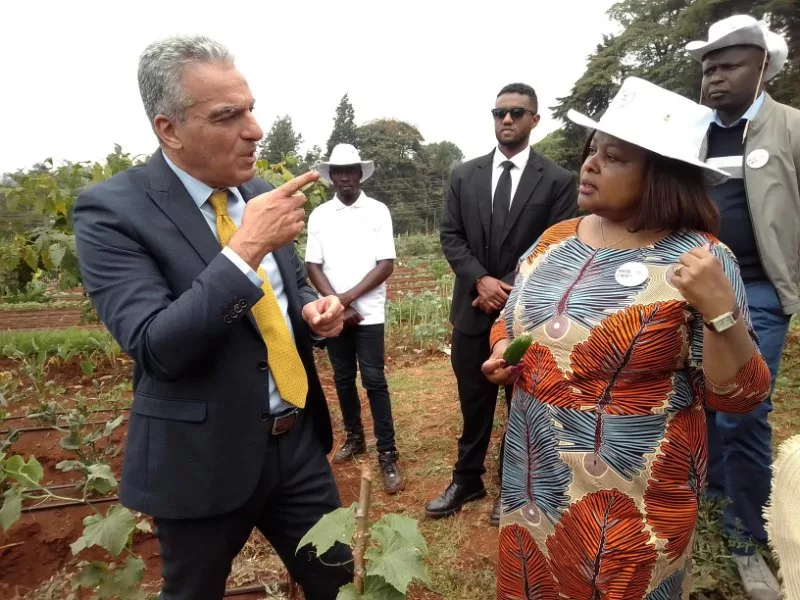
Speaking during a visit to the Mt Carmel Convent Farm in Nairobi, where Israeli drip irrigation technologies have been demonstrated, Israel’s Ambassador to Kenya, Tanzania, Uganda, Malawi and Seychelles, Gideon Behar, said irrigation offers one of the most practical solutions to climate change.
“Drip irrigation is the best irrigation technology available today. It delivers water directly to plant roots, saves more than 50 per cent of water compared with conventional methods and can more than double crop yields,” he said.
The ambassador noted that irrigation allows farmers to produce up to four harvests a year instead of relying solely on rainfall.
“We live in an era of climate change, where rainfall is becoming increasingly unpredictable. By investing in irrigation, we secure food production,” he said.
Behar encouraged Kenya to learn from Israel, where about 60 per cent of the country’s land is desert but agriculture continues to thrive through efficient water management.
He also pointed to Israel’s circular water economy, where about 95 per cent of wastewater is treated and reused for agriculture.
“Waste water should not be viewed as waste but as a resource. That is one lesson Kenya can adopt to improve water security and reduce pollution,” he said.
Mercy Wanjau, Secretary to the Cabinet, who also toured the demonstration farm, said climate-smart agriculture presents an opportunity for Kenya to increase food production despite shrinking land sizes and the growing impacts of climate change.
“We have seen what can be produced from a small piece of land using precision agriculture, climate-smart farming and very little water. This is exactly the direction government policy is encouraging,” she said.
She noted that innovations such as drip irrigation, combined with technical support and improved crop varieties, are enabling women and young people to generate meaningful incomes from small farms.
With the World Meteorological Organization warning of the possibility of above-normal rainfall later in the year, she urged Kenyans to prepare by harvesting water, protecting infrastructure and embracing climate-smart farming practices.
She urged Kenyans to prepare, harvest the rainwater that comes and adopt climate-smart agriculture.
“Whether you own a large farm or a small kitchen garden, every piece of land can contribute to feeding your family,” Wanjau said.